Baking Soda and Water Jugs: Why Safe Isn't the Same as Effective
By the Easy Jug Clean Research Team
Home › Articles › Baking Soda and Water Jugs: Why Safe Isn't the Same as Effective
Baking SodaSodium BicarbonateSafe vs Effective · Reading time: ~6 minutes
Of all the household products recommended for water jug cleaning, sodium bicarbonate — baking soda — earns the cleanest safety record. It is FDA-recognized as generally safe (GRAS), non-toxic, gentle on materials, and leaves residues that are genuinely harmless at any likely concentration. None of this is in question. What is in question is whether safety alone constitutes a reason to use a cleaning agent — and in the specific context of a 5 gallon water jug with biofilm, mineral scale, and odor concerns, baking soda's safety profile is not accompanied by the efficacy required to address those problems.
Baking Soda's Performance Scorecard — Ingredient by Ingredient
Bacterial kill rate
Sodium bicarbonate at 5–10% concentration has no meaningful bactericidal activity against common waterborne pathogens at room temperature. It does not reach the EPA 5-log reduction threshold for food-contact surface sanitization.
FAILS
Biofilm EPS penetration
Mildly alkaline pH (8.3 in solution) has no mechanism for degrading polysaccharide EPS matrix structures. Biofilm colonies are unaffected by bicarbonate chemistry at any practical concentration.
FAILS
Hard water scale removal
Calcium carbonate (mineral scale) is itself alkaline. Alkaline baking soda applied to alkaline scale is a chemical non-reaction — no dissolution occurs. This is the most important and most commonly misunderstood baking soda limitation.
FAILS
Odor neutralization
The alkaline neutralization mechanism of sodium bicarbonate effectively reduces some acidic odor compounds — acetic acid odors (slight vinegary smell), some organic acid metabolites from bacteria. It does not address odors from neutral or alkaline odor compounds, or from active bacterial metabolism.
PARTIAL
Effervescent distribution
When paired with an acid (citric acid, fumaric acid), bicarbonate reacts to generate CO₂ — creating effervescence that distributes solution through the container and helps agitate contaminated surfaces. This is one of its genuinely useful roles in a multi-ingredient cleaning tablet.
USEFUL in combination
pH buffering
Sodium bicarbonate acts as a pH buffer, maintaining solution pH in the 8–9 range and resisting excessive alkalization. This helps keep active oxygen chemistry from degrading too rapidly during the soak period — a functional benefit in a multi-ingredient system.
USEFUL in combination
Residue safety
FDA GRAS classification. Bicarbonate residues in water are harmless at any likely trace concentration. No toxicological concerns at food-contact use levels.
EXCELLENT
Surface safety (plastic)
Mildly alkaline at use concentrations — no meaningful polymer chain attack on HDPE, Tritan, or polycarbonate at typical cleaning concentrations. Safer than bleach or strong acids.
SAFE
The Central Insight: A Safe Ingredient Without the Right Partners Isn't a Cleaning System
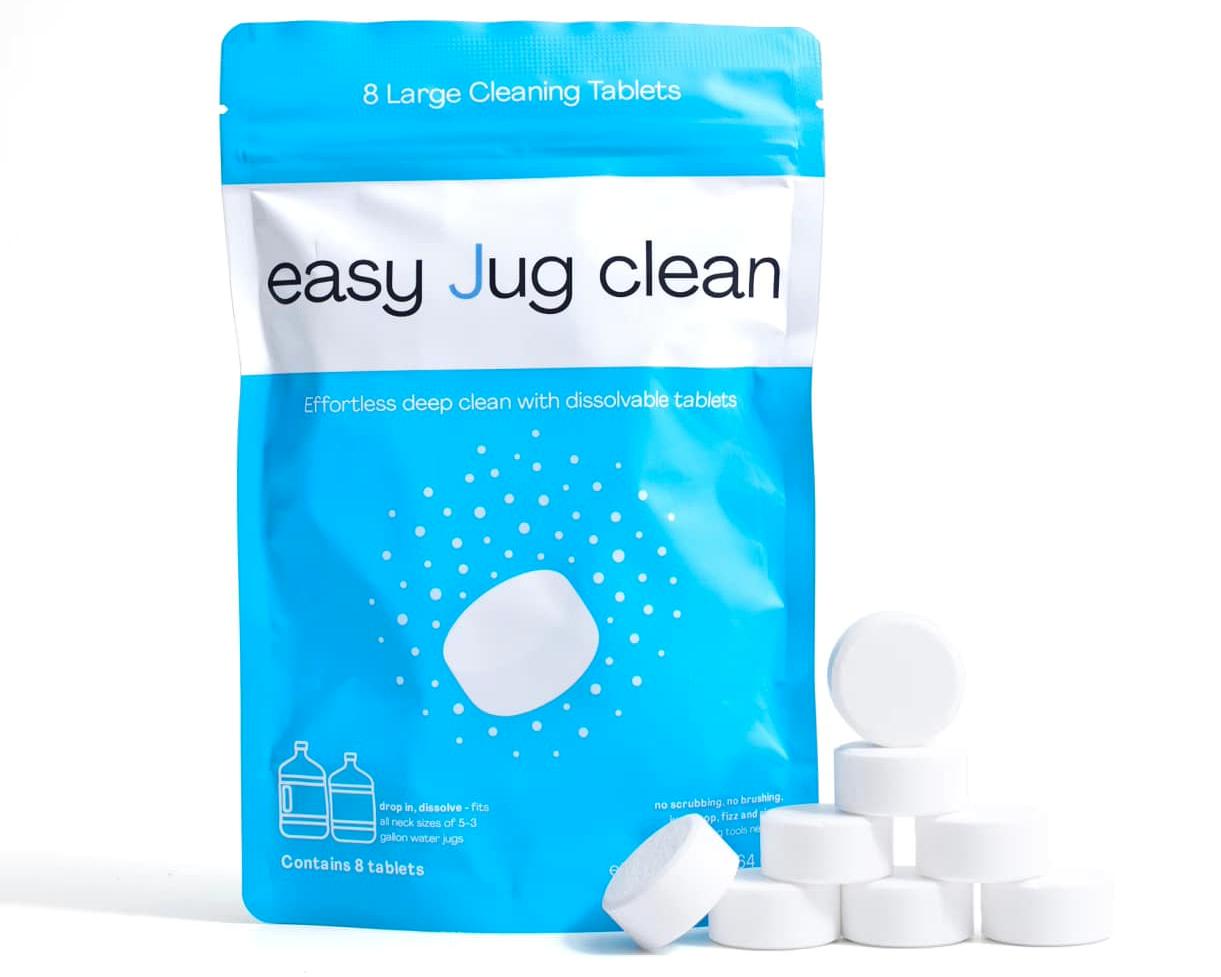
Baking soda's real value in water jug cleaning is as a component, not as a standalone solution. Its safety profile, pH buffering, effervescent action, and mild deodorizing properties are all useful — they're just not sufficient for the complete cleaning job. When combined with an active oxidizer (sodium percarbonate), chelating agents (sodium citrate and sodium gluconate), a plant-based surfactant, and surface conditioning (glycerin), baking soda's legitimate contributions are activated by a system that covers what it cannot do alone.
💡 Why Easy Jug Clean contains baking soda: Sodium bicarbonate appears in Easy Jug Clean's formula because its genuine contributions — pH buffering to protect active oxygen stability during soak, CO₂ generation for the effervescent distribution mechanism, and mild deodorization as a secondary function — complement the primary sanitizing and descaling chemistry. It's there because it does real work in the right context. It's not there as the primary cleaning agent, which is where most DIY baking soda recommendations go wrong.
✅ The take-away framing: Baking soda earns a "yes" on safety for a drinking water container application and a "partial or no" on efficacy for the actual cleaning tasks required. Using it alone is like having a high-quality wrench when you need a full toolkit. Easy Jug Clean includes it in the toolkit where it belongs — alongside the tools that do what it can't.
It was really easy to clean, just drop it in and let it fizz and do its cleaning magic! The jug smelled and looked soooo clean after using this, I couldn’t believe it.



 Order now — get it by