Baking Soda for Water Jug Cleaning: What It Can and Can't Do
Reading time: ~5 minutes | Baking Soda Safe Cleaning
What Baking Soda Actually Does in Chemistry
Sodium bicarbonate is an alkaline compound (pH ~8.3 in solution). Its chemistry provides two genuinely useful properties: (1) it acts as a pH buffer, neutralizing acids in solution, and (2) when combined with an acid, it releases CO₂ gas, creating effervescence. These properties give it two legitimate cleaning-adjacent functions: mild deodorization of acid-caused odors, and — when paired with an acid like vinegar or citric acid — a fizzing action that distributes a solution through a container.
The Honest Capability Assessment
| Cleaning Task | Baking Soda Performance | Why |
|---|---|---|
| Neutralize some odors | ✅ Mild benefit | Alkaline neutralization of acidic odor compounds |
| Kill bacteria | ❌ None | Not a sanitizer; bacteria survive alkaline pH at this concentration |
| Remove biofilm | ❌ None | Alkaline compounds don't degrade EPS polymer matrix |
| Dissolve mineral scale | ❌ None | Alkaline compound cannot dissolve alkaline mineral deposits (CaCO₃ is also alkaline) |
| Safe residue | ✅ Excellent | FDA GRAS; completely food-safe |
| Plastic surface safe | ✅ Yes | No polymer chain attack |
The critical failure is the mineral scale point. Many people reach for baking soda expecting it to function like an acid — to dissolve the chalky deposits in their jugs the way they might imagine citric acid or vinegar would. But calcium carbonate (the primary mineral deposit in hard water) is itself alkaline. Alkaline compounds don't dissolve alkaline deposits. Baking soda on mineral scale is a chemical non-reaction.
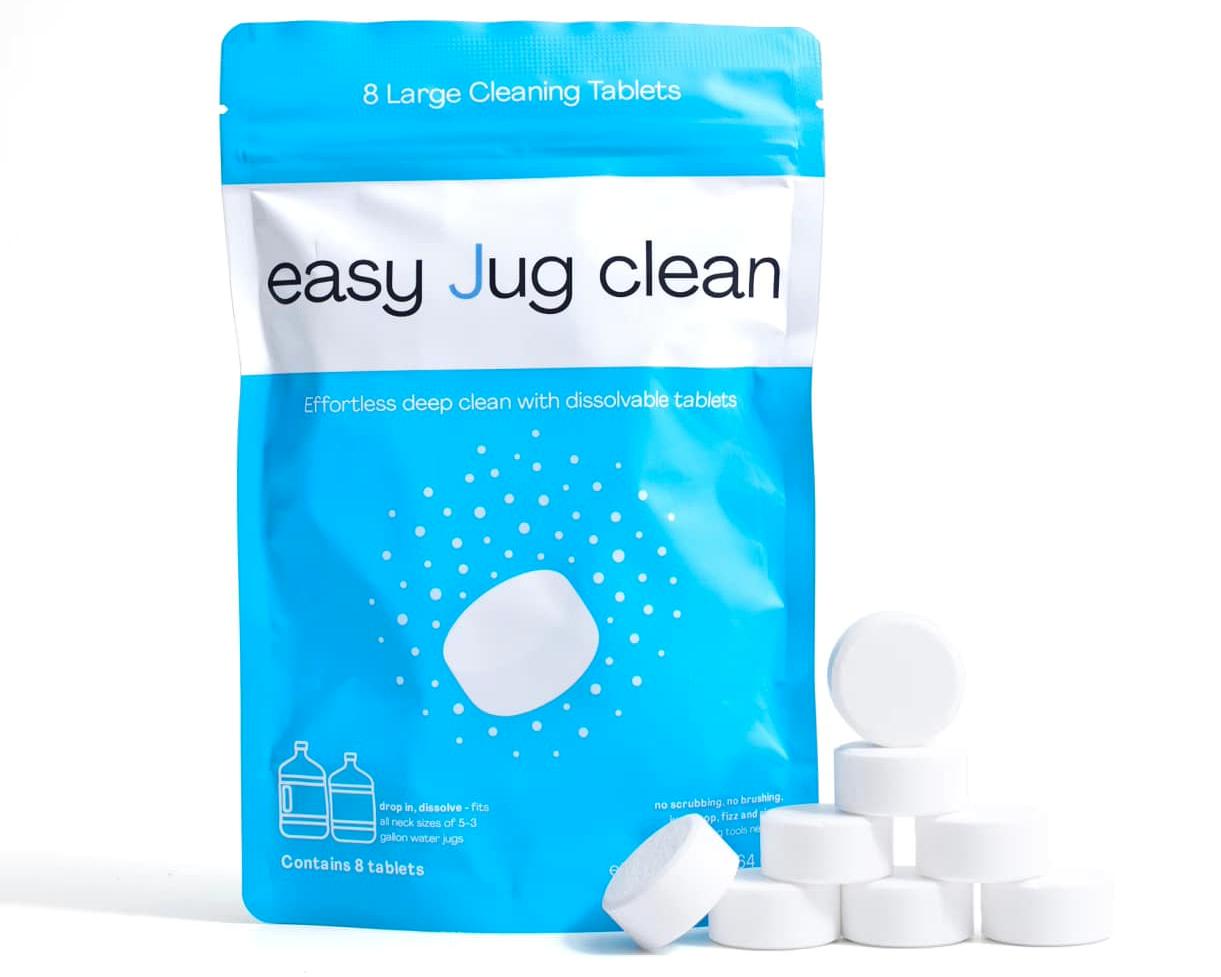
Baking soda cannot penetrate or disrupt biofilm. For a more comprehensive cleaning method that addresses everything baking soda misses, here's the complete protocol.
See why the tablet method beats manual cleaning on every single measure that matters:


 Order now — get it by