Vinegar for Cleaning Water Jugs: Does It Really Work?
Reading time: ~7 minutes | Vinegar DIY Cleaning 5 Gallon Jug
What Vinegar Actually Is — and What It Does Chemically
White vinegar is a dilute solution of acetic acid (CH₃COOH) — typically 5% concentration in household varieties. Acetic acid is a weak organic acid produced through fermentation, and it has genuine chemical activity on some substances. Understanding exactly which substances is what separates the cases where vinegar helps from the cases where it does nothing.
The Vinegar Scorecard for 5 Gallon Water Jug Cleaning
Where Vinegar Actually Provides Value
The Core Problem: Vinegar Is Not a Sanitizer
The Residue Problem Nobody Warns You About
Even setting aside the sanitization failure, there is a practical problem with vinegar in a 5 gallon water jug that disqualifies it as a regular cleaning solution: it is extraordinarily difficult to fully rinse from a narrow-neck container.
Acetic acid molecules have a mild affinity for plastic surfaces — particularly the slightly polar surfaces of HDPE and polycarbonate — and they don't flush out as completely as water alone. A jug that smells like vinegar after several rinses still contains measurable acetic acid residue. This residue dissolves into your drinking water, slightly acidifying it and producing that faint sour taste many users report persisting for days after a vinegar cleaning session. If you can taste it, you're consuming it. In small amounts this isn't a health concern, but it is a clear indicator that the product isn't appropriate for this application.
The Time Problem: Hours vs. Minutes
For vinegar to achieve even its partial effectiveness on light mineral scale, the jug requires a soak of several hours — typically 2–4 hours for meaningful results. Compare this to Easy Jug Clean's 20–30 minute treatment that simultaneously descales, destroys biofilm, sanitizes, and neutralizes odors. The time investment for a partial result with vinegar versus a complete result with the tablet is not a reasonable trade-off.
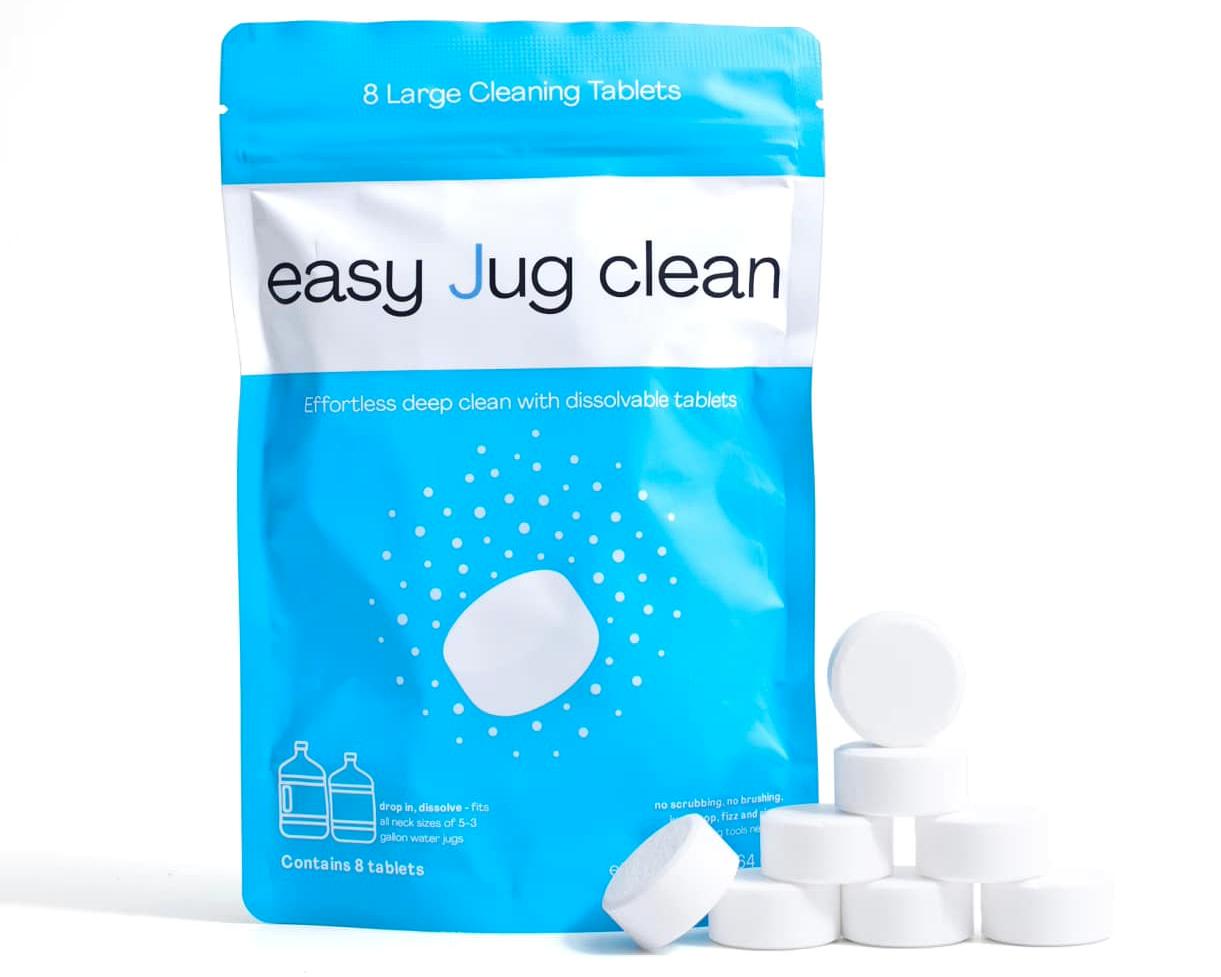
See how Easy Jug Clean cleans a 5 gallon water jug in 20 minutes — no scrubbing required:
✅ Do What Vinegar Can't — In 20 Minutes
Easy Jug Clean descales, sanitizes, and deodorizes in a single 20-minute treatment. No sour residue. No multi-hour soak. Just clean water that tastes like nothing — which is exactly right.
Frequently Asked Questions
Q: Can I mix vinegar and baking soda to clean my water jug?
The vinegar-and-baking-soda combination produces a dramatic fizzing reaction that looks impressive — but the chemical result is largely the neutralization of both compounds into water, carbon dioxide, and sodium acetate. The cleaning benefit is minimal, and you've eliminated the mild acidity that gave vinegar its partial descaling action. This combination is one of the most popular and least effective DIY cleaning approaches.
Q: What about apple cider vinegar — is it more effective?
Apple cider vinegar contains the same active component (acetic acid) at similar concentration as white vinegar, plus additional organic compounds from the fermentation process. For jug cleaning purposes, it has no meaningful advantage over white vinegar — and the additional organic compounds make the residue and taste problem worse, not better.
Q: I've been using vinegar for years and my family hasn't gotten sick — doesn't that prove it's working?
Not getting sick is not the same as your cleaning method being adequate. Healthy adult immune systems handle low-level bacterial exposure routinely without obvious illness. The risk is real for vulnerable household members, and the standard of "clean enough to not obviously make people sick" is lower than the standard of "genuinely safe drinking water container." The goal of regular jug cleaning is not to avoid acute illness — it's to ensure the water you drink every day is free of bacterial contamination.


 Order now — get it by