Best Water Jug Cleaner for People with Chemical Sensitivities or Asthma
Chemical SensitivitiesAsthmaMCSFragrance-Free · Reading time: ~7 minutes
Four Cleaning Chemical Classes That Affect Sensitive Individuals
Chlorine gas (Cl₂) and chloramines released during bleach application are well-documented asthma triggers. Even household bleach diluted to cleaning concentrations releases chlorine gas in measurable quantities, particularly in warm, poorly ventilated spaces. The OSHA threshold for chlorine gas is 0.5 ppm (8-hour TWA) — and household bleach use in a kitchen can produce concentrations approaching or exceeding this threshold in the immediate use area.
For people with asthma, the airway hyperresponsiveness that defines the condition means that chlorine concentrations well below OSHA workplace thresholds can provoke bronchoconstriction, coughing, and exacerbation. For MCS individuals, chlorine exposures that produce no measurable physiological effect in unaffected people can cause significant multi-system reactions.
Fragrance is a recognized asthma trigger — listed by the American College of Allergy, Asthma & Immunology alongside cigarette smoke and strong odors as common non-allergic asthma triggers. "Fragrance" on a product label can represent a blend of up to several hundred individual chemicals, many of which are VOCs that remain airborne and in contact with surfaces after application. In a water jug, fragrance residue that survives rinsing continues off-gassing into the water stored in the container, creating chronic low-level inhalation exposure during normal use.
Solvent-based cleaning compounds — including some specialty cleaning products and certain dish soap formulations — contain volatile organic compounds (VOCs) that evaporate at room temperature and are inhaled during and after cleaning. Common VOCs in cleaning products include d-limonene (from citrus-derived cleaners, despite "natural" framing), terpenes from pine or tea tree formulations, alcohols, and glycol ethers. These compounds are respiratory irritants at concentrations achievable during normal household use in poorly ventilated spaces.
Beyond the inhalation exposure during cleaning, trace residues in the water stored subsequently are a distinct concern for sensitive individuals. For MCS patients, there is often no clear dose-response relationship with chemical sensitivities — minute trace concentrations of specific compounds (including synthetic surfactants, fragrances, chlorinated compounds) can provoke reactions. The complete residue profile of the cleaning product used in a water container is therefore a critical consideration beyond just acute handling safety.
Product Selection Checklist for Sensitive Households
✅ What to Look For in a Water Jug Cleaner for Chemical Sensitivities
How Common Options Score for Sensitive Individuals
| Cleaning Method | Chlorine / Airborne Irritant | Fragrance | VOCs | Residue Safety | Overall for Sensitive Household |
|---|---|---|---|---|---|
| Household bleach | ❌ Chlorine gas release | Typically none | Minimal | ❌ Trihalomethanes | NOT APPROPRIATE |
| Scented dish soap | None | ❌ Often present | ❌ Fragrance VOCs | ⚠️ Surfactant residue | NOT APPROPRIATE |
| Unscented dish soap | None | Not present | Minimal | ⚠️ SLS/SLES residue possible | CONDITIONAL |
| White vinegar | None | None | ⚠️ Mild acetic acid vapor | ⚠️ Acetic acid residue | LOW RISK — limited efficacy |
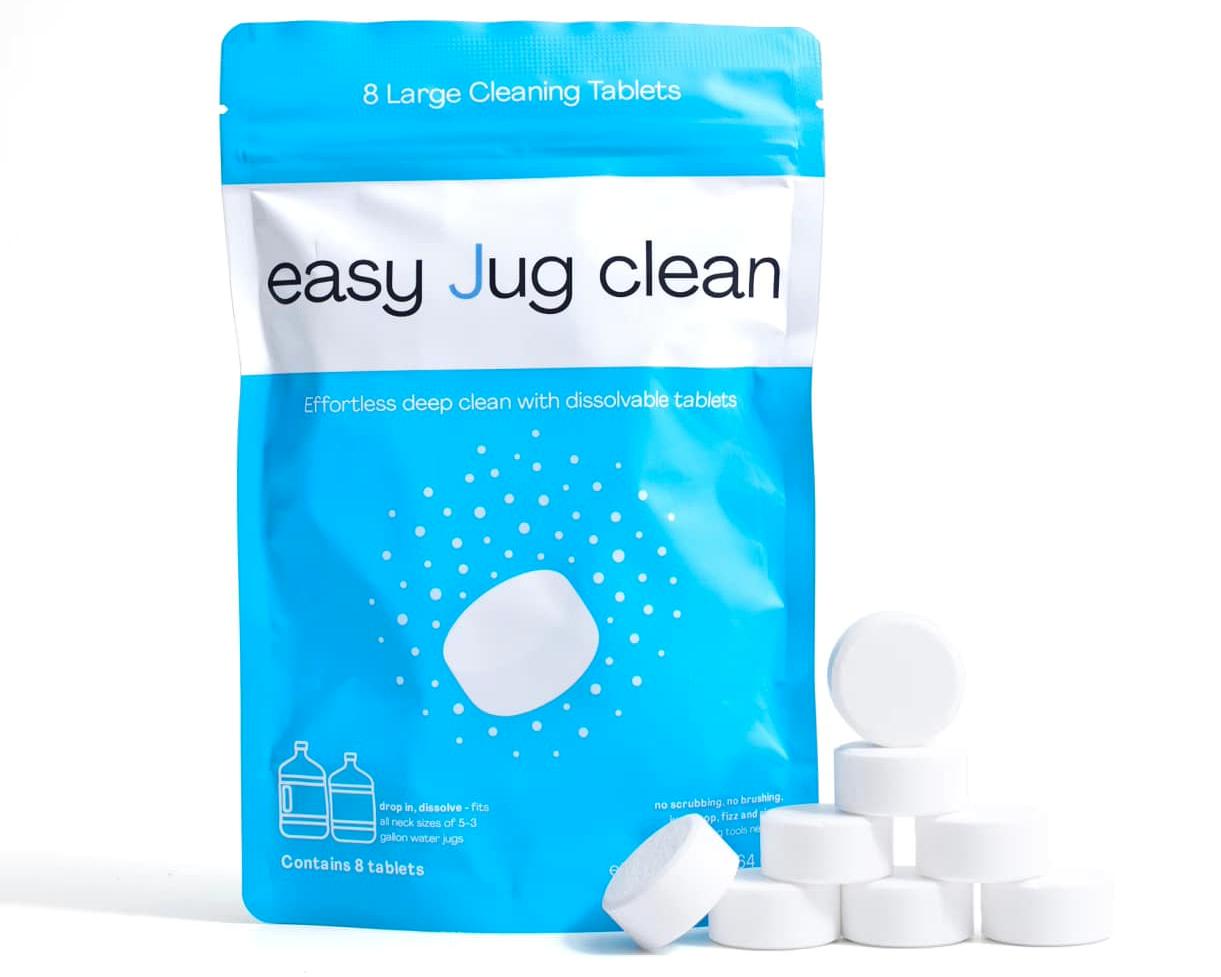
| Easy Jug Clean | ✅ Oxygen only | ✅ Fragrance-free | ✅ No VOCs | ✅ Food-grade only | ✅ APPROPRIATE |
Watch the right cleaning approach versus what a brush actually does to your jug:
✅ No Chlorine. No Fragrance. No VOCs. Safe for Your Whole Household.
Easy Jug Clean is formulated around food-grade safety standards — appropriate for households where chemical sensitivities, asthma, or respiratory conditions make ingredient choices a health priority.
Q: The effervescent fizzing produces CO₂ — is that a concern for asthma?
Carbon dioxide released from the effervescent reaction is not a respiratory irritant at the trace concentrations produced in a residential cleaning application. The CO₂ released from two tablets dissolving in half a jug of water represents a negligible addition to normal room air CO₂ concentrations. It is not a trigger for asthma exacerbation. Unlike bleach, which produces chlorine gas and chloramines, the Easy Jug Clean reaction produces only CO₂ and oxygen — neither of which is an airway irritant at these concentrations.
Q: Can I get a full ingredient list to review before purchasing?
Yes — the complete ingredient list for Easy Jug Clean is publicly available on the product page at easyjugclean.com/pages/ingredients. Each of the nine ingredients is named by its INCI designation and assessed for safety. For households with MCS or severe sensitivities, reviewing the full ingredient list before purchase is absolutely appropriate — it's one of the reasons full ingredient transparency was a core commitment of the product's development.


 Order now — get it by