Dishwasher-Safe vs. Dispenser Jug: Why That Label Means Nothing for 5 Gallon Containers
Reading time: ~5 minutes | Dishwasher Cleaning Material Labels Large Water Bottle
What "Dishwasher-Safe" Actually Means
The "dishwasher-safe" label is a manufacturer's claim about material durability — that the plastic, glass, or metal can survive a typical dishwasher cycle without warping, leaching, cracking, or losing structural integrity. It is not a claim about cleaning effectiveness. The label answers the question "will this container survive a dishwasher?" not "will a dishwasher clean this container?"
For a sports bottle with a 2-inch wide opening, those two questions have the same practical answer — the dishwasher both survives and cleans it. For a 5-gallon water jug, the questions diverge sharply. The plastic might survive (some polycarbonate jugs are technically heat-rated for dishwasher temperatures), but the cleaning effectiveness is essentially zero regardless of the label.
Why Dishwashers Don't Clean Large Water Bottles
The Geometry Problem
A standard residential dishwasher has approximately 22 inches of interior height in the lower rack and 9 inches in the upper rack. A 5-gallon water cooler jug is roughly 19.5 inches tall — fits the lower rack vertically, but its 11-inch body diameter takes up half the rack width, blocking water flow to other dishes and standing on its side or upside down because the jug doesn't fit standing up under the spray arms.
The Pressure Problem
Dishwasher spray arms produce roughly 8–15 PSI of water pressure. That's enough to clean dish surfaces directly exposed to the spray, but not enough to drive water column upward through a narrow opening into a deep cavity against gravity. The interior of an inverted 5-gallon jug receives essentially the same minimal water contact as the air around it.
The Detergent Problem
Dishwasher detergent is formulated for short-contact, mechanical-action cleaning of food residue from open surfaces. It's not designed to penetrate biofilm, dissolve mineral scale, or sit on a surface for the contact time needed to inactivate established bacterial colonies. Even on a perfectly accessible surface, dishwasher detergent isn't a sanitizer.
The Comparison
| Cleaning Variable | Sports Bottle in Dishwasher | 5-Gallon Jug in Dishwasher |
|---|---|---|
| Container fits | Yes | Sideways or barely upright |
| Spray arms reach interior | Yes — wide mouth lets water in | No — narrow neck blocks flow |
| Detergent contact with biofilm zones | Adequate | Essentially zero |
| Sanitizing temperature reaches walls | Yes | No — interior stays cool |
| Effective post-cycle? | Generally yes | Outside cleaned, inside untouched |
What "Dishwasher-Safe" Often Hides
Some 5-gallon jug manufacturers print "dishwasher-safe" on their packaging, and consumers reasonably assume that means dishwasher cleaning is appropriate. The label is technically accurate at the material level — the polycarbonate or PET will survive — and dangerously misleading at the practical level because the cleaning result is meaningless. People wash the outside, assume the inside got clean too, and return the jug to the dispenser. A visually clean jug can still make you sick if the interior was never reached.
What Actually Cleans a Large Water Bottle Interior
The interior of a narrow-neck large water container can only be cleaned by a method that doesn't depend on external water pressure or mechanical reach. That means a cleaning agent introduced into the container that distributes itself across the full interior surface.
✅ Stop Trusting the "Dishwasher-Safe" Label on Large Containers
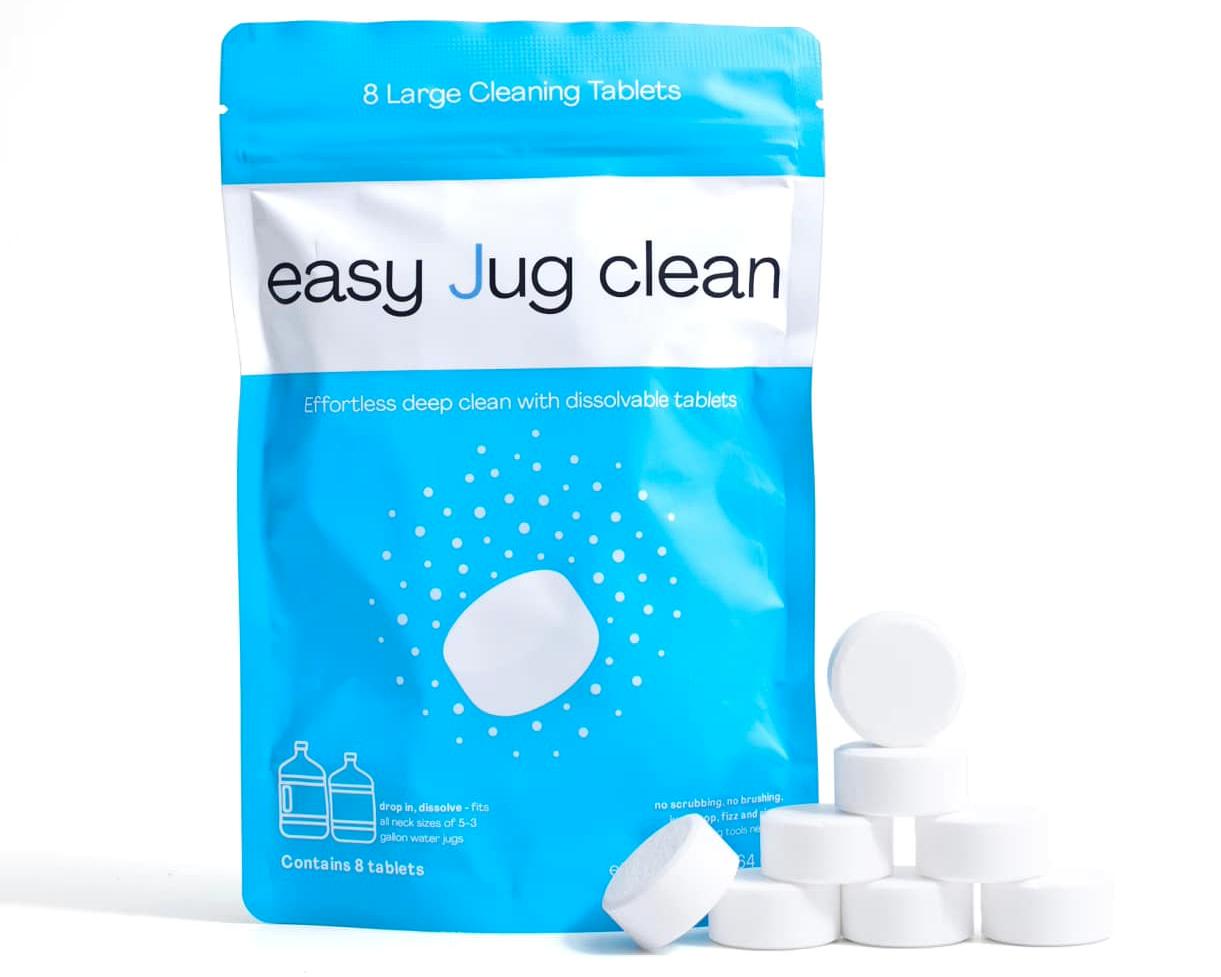
The label was never about cleaning effectiveness. Easy Jug Clean does what a dishwasher physically cannot — clean the entire interior of a narrow-neck large water bottle. Two tablets, 20 minutes, done.
FAQ: Dishwashers and Large Water Containers
Q: Should I run my 5-gallon jug through the dishwasher to at least clean the outside?
The outside of the jug doesn't need much cleaning beyond a damp wipe. The interior is what matters, and the dishwasher doesn't help there. Save the dishwasher cycle for things it actually cleans.
Q: What about commercial high-pressure dishwashers used in restaurants?
Higher pressure improves the situation marginally but doesn't solve it. The geometry — narrow opening, deep cavity — is still the limiting factor. Commercial water bottle suppliers use rotary spray nozzles that insert into the bottle through the opening, which is genuinely effective. That's not what residential dishwashers do.
Q: My 1-gallon water jug fits in the dishwasher. Does it work for that size?
Better than for a 5-gallon, but still incomplete. A 1-gallon jug has narrower-neck geometry than a sports bottle but better access than a 5-gallon. The exterior gets clean. The interior gets partial cleaning. For routine use, a tablet treatment is still more reliable.
Q: What if I just take the jug apart? Can I dishwash the parts separately?
Standard 5-gallon water dispenser jugs aren't designed to come apart. The rigid one-piece molded body is the only access point.
The Bottom Line
"Dishwasher-safe" is a material label, not a cleaning verdict. For sports bottles, the two are functionally equivalent. For large water bottles with narrow openings, they have nothing to do with each other. The right method for cleaning a large water bottle is one that can reach the interior surfaces a dishwasher physically cannot — which means tablet-based, self-distributing chemistry rather than external water pressure.


 Order now — get it by