scrubbing 5 gallon water jugs makes it worse

Hard Water Scale Inside Water Jugs: Why Scrubbing Makes It Worse

Hard Water ScaleScrubbing DamageMineral Deposits Β· Reading time: ~7 minutes

When you see the chalky white deposits inside your water jug and reach for a brush, the instinct is completely understandable. Deposits on surfaces get scrubbed off. But calcium carbonate β€” the mineral that forms hard water scale β€” is not like dried food residue or general grime. It's crystalline, bonded to the plastic substrate, and harder than the plastic it's deposited on. Scrubbing it doesn't remove it. It fractures it, embeds particles deeper, and damages the surface underneath in ways that make future scale accumulation faster and worse.

The Mineral Hardness Problem

Calcium carbonate (the primary component of hard water scale) has a Mohs hardness of approximately 3. Most food-grade plastics used in 5 gallon water jugs β€” HDPE, Tritan, polycarbonate β€” have surface hardness values in the range of 1.5–2.5 Mohs. Calcium carbonate is harder than the plastic surface it's deposited on. When you scrub scale with a brush, the calcite crystals act as abrasive particles β€” the brush pushes harder particles against softer plastic, producing abrasion of the plastic while the scale crystals themselves fracture, chip, and partially re-embed in the damaged surface.

πŸ”¬ The re-embedding mechanism: When scale crystals fracture under brush pressure, some fragments are carried away into the rinse water. But broken crystal edges are often sharper than intact crystal faces β€” and sharp edges have higher adhesion energy with rough or scratched plastic surfaces. Some fraction of the fractured scale re-embeds in the micro-scratches created by the same brush pass, creating mineral nucleation sites that are now mechanically locked into the surface rather than surface-bonded. These embedded fragments are harder to remove chemically than surface-deposited scale because chelating agents cannot access all faces of a partially embedded crystal.

The Scratch-and-Redeposit Cycle That Worsens Over Time

The Progressive Scrubbing Damage Loop

β†’
Week 1 of brushing: Scale is light; brush abrades some scale particles while scratching the plastic surface beneath. Scale partially removed; new micro-scratches created.
β†’
Week 2–3: New scale deposits preferentially on the roughened, scratched surface β€” rough surfaces have higher nucleation energy and accumulate minerals faster than smooth surfaces. More scale forms in less time than before brushing began.
β†’
Week 4–8: More aggressive scrubbing required to address increased scale; each session deepens scratches further; scale nucleates faster after each clean. The interval between visible scale re-appearance shortens.
β†’
Month 3+: Scale partially fractures and embeds in deepened scratch grooves; chelating chemistry now needed to remove embedded fragments but not being applied; surface becomes a permanent scale trap requiring more effort with each cleaning to achieve less complete results.
β†’
End state: Jug interior is rougher, scalier, harder to clean, and faster to recontaminate than before the brushing routine began β€” despite consistent weekly cleaning effort. The act of cleaning has made the jug progressively harder to clean. Scrubbing micro-scratches the plastic and drives scale deeper. The right approach to cleaning a 5 gallon jug dissolves mineral deposits chemically without any abrasion.

Why Chemical Dissolution Is the Only Appropriate Mechanism

Hard water scale is removed by dissolving it β€” not by abrading it. The calcium carbonate crystal must be broken down chemically: either by acid (protonation of carbonate ions) or by chelation (metal ion coordination that removes calcium from the crystal lattice). Both mechanisms work at the molecular level, attacking the crystal structure from within rather than chipping at it from outside with mechanical force.

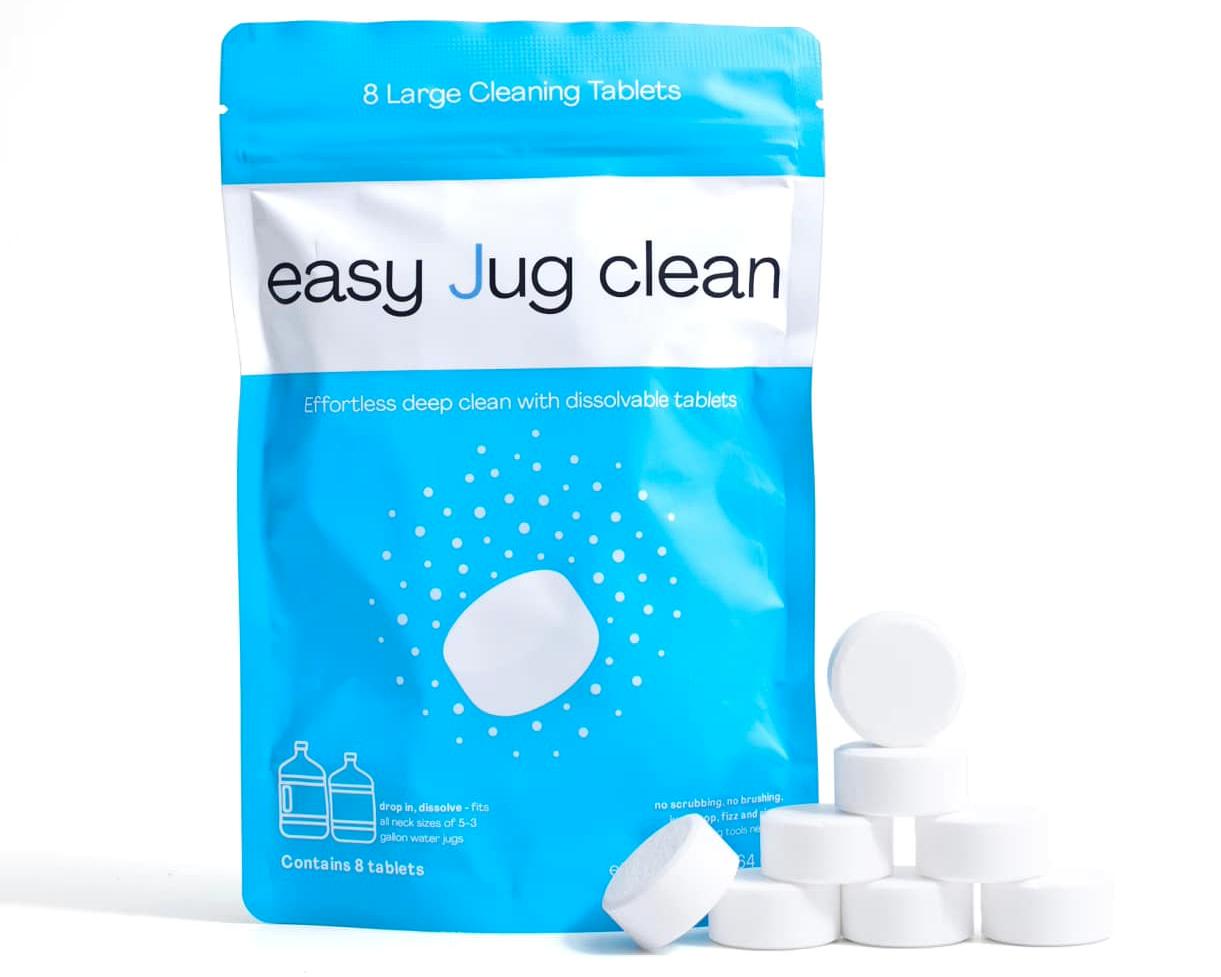
Easy Jug Clean's chelating agents (sodium citrate and sodium gluconate) diffuse into scale deposits by concentration gradient and coordinate to calcium ions in the crystal lattice, holding them in solution as stable chelate complexes. The crystal is dissolved from the inside out β€” calcium ions removed layer by layer without mechanical force, without fracturing crystals, and without abrading the underlying plastic surface. The result is clean plastic, not scratched plastic with embedded scale fragments.

βœ… The practical rule: Never use any mechanical cleaning tool on a 5 gallon water jug with visible mineral scale deposits. Scrubbing will fracture and embed the scale, making it harder to remove subsequently. Apply Easy Jug Clean first β€” the chelating treatment dissolves deposits completely. If scale was extensive, run two consecutive treatments before assessing the result. Then maintain weekly to prevent scale from reaching the crystalline-embedded stage again.

Β 

Watch Easy Jug Clean dissolve scale and odor buildup in a single 20-minute treatment:

Β 

βœ… Dissolve Scale. Don't Scrub It In Deeper.

β†’ Get Easy Jug Clean β€”

Related Reading


Back to blog