Water Jug Cleaning Tablets vs. Bottle Brushes: Why Tablets Win Every Time
Category: Product Comparison | Tablets vs Brushes 5 Gallon Jug Comparison Guide
The Case for the Bottle Brush — And Why It Falls Apart Under Scrutiny
Before we dismantle it, let's give the bottle brush a fair hearing. The argument for using a long-handled brush to clean a 5 gallon water jug goes something like this: physical scrubbing removes dirt, and if you can see the brush making contact with the surface, you can be confident it's getting clean. This is a reasonable intuition that works perfectly well for wine glasses, baby bottles, and narrow-mouth flasks.
A 5 gallon water jug is different from all of those things in ways that make the brush's advantages irrelevant and its disadvantages catastrophic. Here's what the intuition misses.
Round-by-Round: Bottle Brush vs. Water Jug Cleaning Tablets
Let's go category by category — the measures that actually determine whether your jug is clean and safe.
🖌️ Bottle Brush
A brush inserted through the narrow neck must be physically maneuvered to contact different areas of the interior. The straight shaft limits angular reach — the brush head makes good contact with the center bottom but poor contact with the lower corners, curved walls at mid-height, and the tapered shoulder near the neck. Studies on manual cleaning of narrow-neck containers consistently show coverage gaps in these exact zones. You can feel the brush moving — but movement is not the same as contact.
💊 Cleaning Tablet
When an effervescent tablet dissolves in water inside the jug, it creates a solution that fills the entire volume — every curve, every corner, every square centimeter of the interior wall is submerged in active cleaning chemistry simultaneously. The fizzing action generates thousands of microbubbles that rise through the solution and press the cleaning agent into continuous contact with the walls. Not some of the walls. All of them. Physics, not manual effort, guarantees coverage.
🖌️ Bottle Brush
Biofilm is a structured colony of bacteria anchored to the jug's interior surface by a self-secreted polymer matrix. Mechanical scrubbing can physically dislodge some surface-level biofilm — but it cannot penetrate the matrix to kill the bacteria within it. Brushing over mature biofilm is like mowing a lawn: the visible surface changes, but the root system remains. Worse, disrupted biofilm fragments can redistribute to other areas of the jug where they re-anchor and re-colonize faster than undisturbed biofilm, because the disruption triggers a stress response that accelerates bacterial reproduction.
💊 Cleaning Tablet
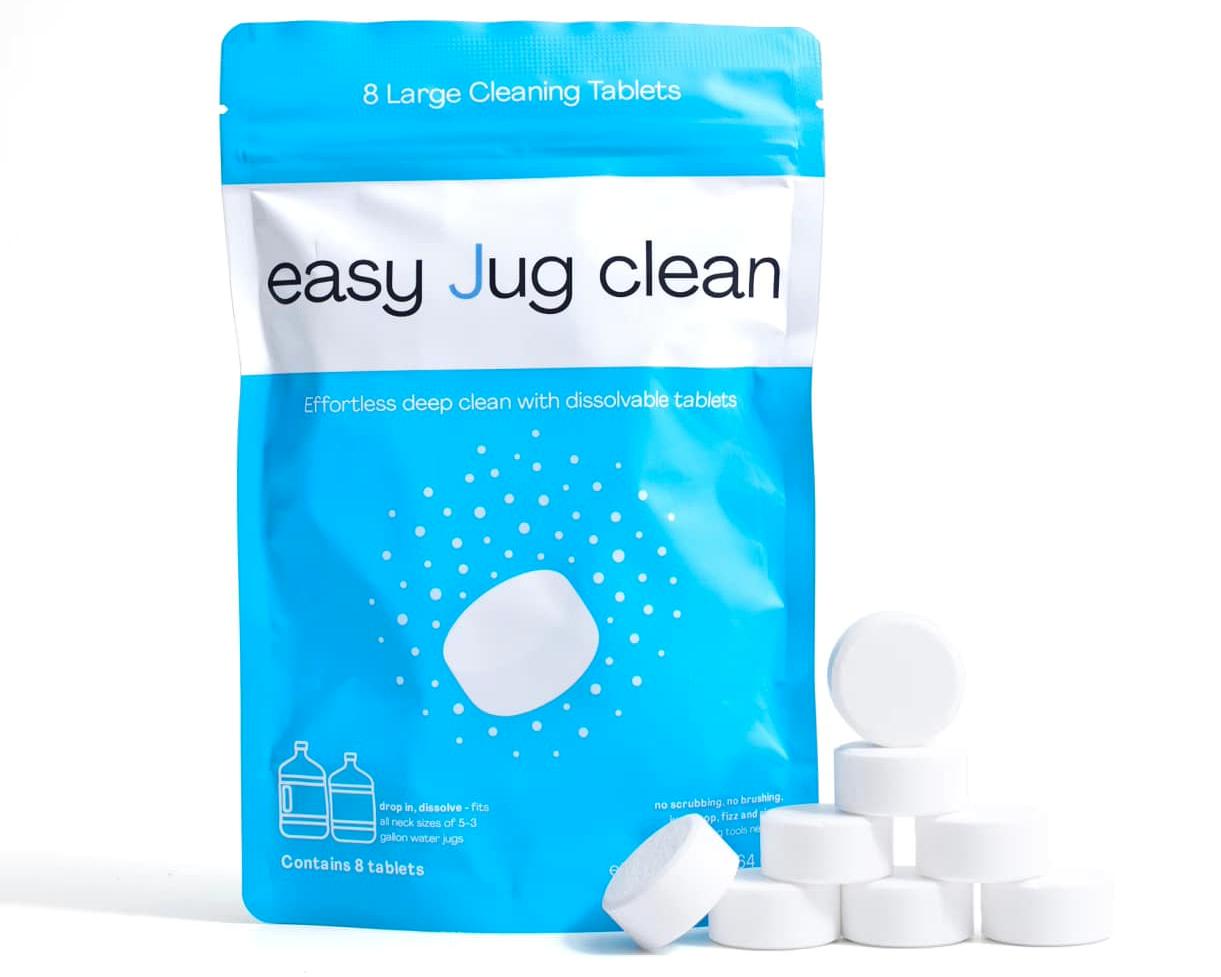
Easy Jug Clean's active oxygen release from sodium percarbonate directly targets the biofilm polymer matrix — oxidizing the extracellular compounds that hold the colony together and disrupting bacterial cell walls simultaneously. This is chemical penetration, not surface abrasion. The difference in outcome is the difference between removing a biofilm's protective cap and destroying its foundation.
🖌️ Bottle Brush
Hard water scale — the chalky calcium and magnesium carbonate deposits that cloud jug walls and accumulate at the waterline — cannot be removed by mechanical scrubbing alone. Scale is a mineral deposit that is chemically bonded to the plastic surface. Scratching at it with bristles may chip some away while simultaneously micro-scratching the surrounding plastic , creating new surface irregularities that trap future deposits and bacteria more aggressively than the original smooth surface. You are not solving the scale problem — you are making it progressively worse.
💊 Cleaning Tablet
Easy Jug Clean contains sodium citrate and sodium gluconate — two chelating agents specifically chosen because they bind to calcium and magnesium ions and pull them away from the jug surface into solution, where they rinse out completely. This is the same chemistry used industrially to descale beverage equipment. It dissolves scale rather than abrading it, leaving the plastic surface intact and smoother after every treatment.
🖌️ Bottle Brush
This is the argument that genuinely surprises people: the bottle brush is often dirtier than the jug it's cleaning . After each use, the bristles remain damp in a warm kitchen environment — a near-perfect incubator for bacterial growth. Mold and mildew colonize brush heads within days of use. Unless you're sanitizing your brush between every single use (almost nobody is), you're introducing whatever has colonized the brush directly into the jug you're trying to clean. Multiple kitchen hygiene studies have ranked bottle brushes among the most contaminated items in the average kitchen.
💊 Cleaning Tablet
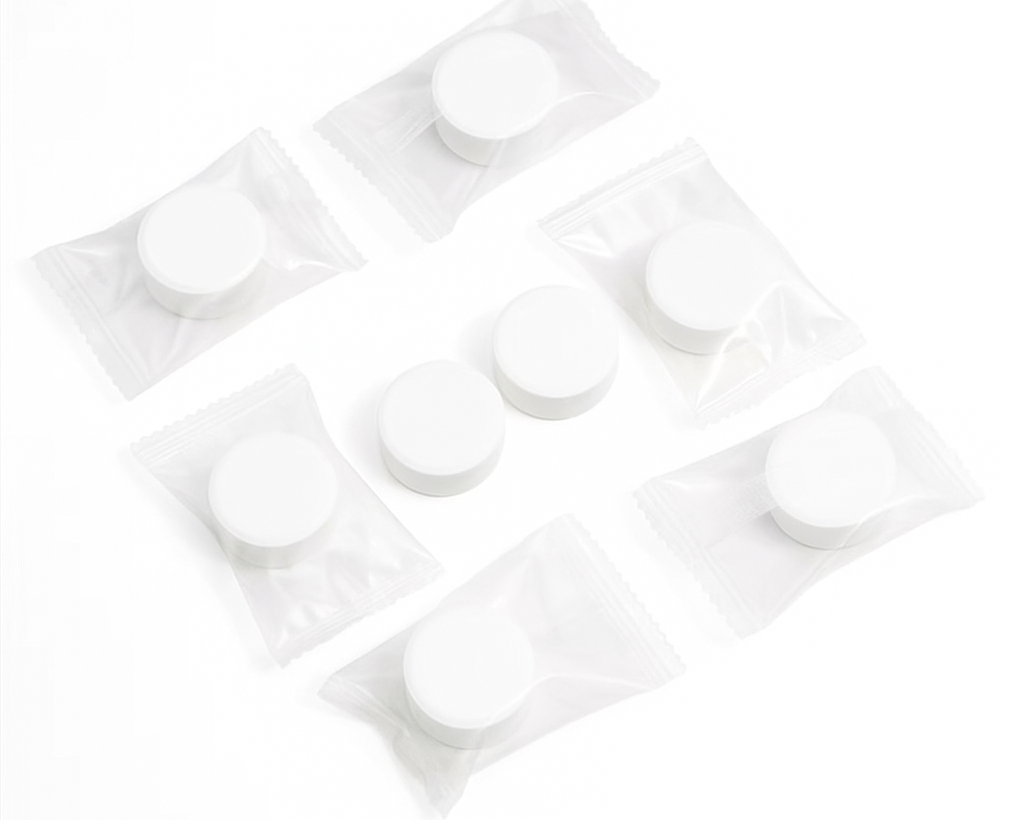
A sealed tablet introduces nothing into your jug except the intended cleaning chemistry. There is no tool that accumulates contamination between uses, no bristles to harbor mold, no cross-contamination pathway. Each tablet is a fresh, sealed unit — what goes into your jug is exactly what the formula says, nothing more. The single-use format eliminates an entire category of contamination risk that brush users don't even know they're carrying.
🖌️ Bottle Brush
Odors in a 5 gallon water jug are caused by volatile organic compounds (VOCs) produced by bacteria as metabolic byproducts — compounds like hydrogen sulfide, indole, and short-chain fatty acids that cling to the plastic surface at a molecular level. Brushing the surface may mechanically dislodge some odor-causing residue, but it does not neutralize the compounds. The result is a jug that may smell better immediately after scrubbing — then returns to the same odor within days as the remaining bacteria continue their metabolic activity.
💊 Cleaning Tablet
Easy Jug Clean's sodium bicarbonate component acts as a pH buffer and odor neutralizer , chemically neutralizing the acids that produce musty and stale smells rather than masking them. Simultaneously, the active oxygen from sodium percarbonate oxidizes the odor-producing bacteria themselves, eliminating the source. This is why users consistently report their jug smelling genuinely fresh after an Easy Jug Clean treatment — not temporarily suppressed, but actually clean.
🖌️ Bottle Brush
Weekly brush-cleaning a 5 gallon jug realistically means: retrieving the brush, filling the jug, maneuvering the brush through the neck while applying soap, attempting to reach different zones with awkward elbow-deep twisting, rinsing thoroughly enough to remove all soap residue, shaking out excess water, and storing both the wet jug and wet brush. In practice, the physical inconvenience means many people skip cleaning cycles or do a cursory 30-second swirl that accomplishes little. A cleaning routine that's unpleasant enough to skip regularly isn't a cleaning routine — it's a good intention.
💊 Cleaning Tablet
Fill jug halfway with warm water. Drop two tablets. Walk away for 20 minutes. Rinse. The entire hands-on component takes under 60 seconds. The absence of physical effort is not a luxury — it's what makes weekly cleaning a realistic habit rather than an occasional chore. Consistency is the single biggest factor in ongoing water jug safety, and the tablet format removes every friction point that causes inconsistency.
🖌️ Bottle Brush
A quality long-handled jug brush typically costs $8–$15. That sounds economical until you factor in: replacement cost every 2–4 months as bristles degrade and the brush becomes a contamination vector, the dish soap used with each cleaning, and the time cost of the physical cleaning process. More significantly, you need to factor in what you're getting for that spend — which, as established across every round above, is incomplete cleaning that leaves your family drinking from a jug that is never truly sanitized.
💊 Cleaning Tablet
Easy Jug Clean is for a pack of 8 tablets — a full month of weekly cleanings for one jug at approximately 62 cents per treatment. No replacement cost. No supplementary products needed. No time overhead beyond 60 seconds of active handling. The cost per genuinely clean, fully sanitized jug is lower than the brush alternative when you account for what "clean" actually means.
The Final Scorecard
| Category | Bottle Brush | Easy Jug Clean Tablet |
|---|---|---|
| Full interior coverage | ❌ Partial — geometry limits reach | ✅ Complete — fills every surface |
| Biofilm removal | ❌ Disturbs but doesn't destroy | ✅ Oxidizes the matrix chemically |
| Mineral scale removal | ❌ Cannot dissolve scale | ✅ Chelating agents dissolve deposits |
| Tool contamination risk | ❌ Brush harbors mold and bacteria | ✅ Single-use sealed tablet |
| Odor elimination | ❌ Surface-level; odor returns | ✅ Neutralizes compounds at source |
| Effort required | ❌ High — discourages consistency | ✅ 60 seconds hands-on time |
| Cost per effective clean | ❌ Higher when replacements counted | ✅ ~$0.62 per complete treatment |
| Safe for plastic surface | ❌ Micro-scratches over time | ✅ Conditions and protects surface |
| No residue left behind | ⚠️ Soap residue if not fully rinsed | ✅ Food-grade breakdown products only |
| Works while you do other things | ❌ Requires full physical attention | ✅ 20-minute hands-free soak |
See why Easy Jug Clean beats the bottle brush on every single measure that matters:
🏆 10 Rounds. 10 Wins. One Clear Answer.
Easy Jug Clean tablets outperform bottle brushes on every single measure that matters for clean, safe drinking water. Drop two tablets, wait 20 minutes, rinse. That's it.
The Specific Problems Bottle Brush Users Face — Recognized but Rarely Addressed
Most people who use a bottle brush for their 5 gallon jug already sense that something isn't working perfectly. Here are the most common complaints — and why each one is a structural feature of brush cleaning rather than a fixable user error.
"My jug still has a smell even after I scrub it"
This is the odor problem. Persistent jug odor after brushing means the odor-producing bacteria have not been eliminated — they've been redistributed. The brush cannot reach all of them, and it cannot chemically neutralize the VOCs they produce. The smell returns because the source was never fully addressed.
"The inside of my jug looks cloudy even after cleaning"
Cloudiness is hard water mineral scale — chemically bonded calcium and magnesium deposits that bristles cannot dissolve. The only solution is a chelating agent that binds to the mineral ions and pulls them into solution. Brushing over scale doesn't remove it; it just occasionally chips small flakes that then float in your water.
"I can feel a slippery coating inside even after scrubbing"
That slippery feeling is mature biofilm . It means bacterial colonies have established themselves with a polymer matrix that mechanical scrubbing disturbs but cannot destroy. If you can feel it after cleaning, you haven't cleaned — you've just touched it.
"I have to use so much soap that rinsing takes forever"
The soap residue problem is a direct consequence of using dish soap in a narrow-neck deep container. Surfactants cling electrostatically to plastic and resist rinsing in ways that don't happen with open, flat surfaces. The more soap you need (because the brush alone isn't doing the job), the harder it becomes to rinse completely. This is a doom loop the brush format creates.
What Happens When You Make the Switch to Tablets
The transition from brush to Easy Jug Clean tablets is reported consistently by users as genuinely surprising — not because the tablet is complicated, but because of how dramatically different the result is from what they'd accepted as "normal" with a brush.
- The cloudiness disappears. Sodium citrate and sodium gluconate dissolve scale that the brush was never touching. Jug walls become visibly clear after the first treatment in many cases.
- The smell is gone — actually gone. Not masked. Not temporarily suppressed. The odor-causing bacteria and their metabolic byproducts are neutralized. Users describe the jug smelling like nothing — which is exactly what clean water should smell like.
- The slippery film doesn't come back as fast. With biofilm destroyed at the matrix level and the surface conditioned by glycerin, the interior of the jug stays cleaner between treatments. Weekly cleaning is sufficient to keep it that way.
- The actual cleaning time drops to almost nothing. The biggest behavioral change users report is the realization that they had been spending five to ten minutes on a cleaning session that wasn't working, and that two minutes of setup plus 20 minutes of walking away produces a genuinely cleaner result.
Addressing the Brush Defender's Best Arguments
In the interest of being thorough, here are the strongest arguments for keeping the brush — and why they don't hold up.
"I can see what I'm cleaning with a brush — I know it's working"
"Brushes have worked for years — why would I change?"
"Tablets are an extra thing to buy and remember"
How to Use Easy Jug Clean Tablets: The Complete Switch-Over Protocol
If you're making the switch from brush to tablet, here's the exact protocol — including what to do for the first cleaning, which may require a bit more attention if your jug has accumulated brush-era buildup.
Frequently Asked Questions
Q: Do I need to use a brush at all if I use Easy Jug Clean tablets?
No. The tablet's effervescent action, chelating chemistry, and active oxygen release collectively handle what a brush attempts to do — plus everything a brush can't do. There is no cleaning benefit to supplementing the tablet treatment with a brush, and doing so reintroduces the contamination risk the brush carries.
Q: What about a first clean on a brand-new jug — do I still need a brush?
No. New jugs benefit from an initial Easy Jug Clean treatment to remove manufacturing residues and any contamination accumulated during shipping and storage. A brush adds nothing to this process and risks micro-scratching a surface that is currently smooth.
Q: What if I can see visible residue stuck to the inside of my jug — won't I need to scrub it out?
Visible scale and biofilm residue respond to chemistry, not mechanical force. An Easy Jug Clean treatment — possibly two consecutive treatments for a severely neglected jug — will dissolve and lift the residue completely without any scrubbing. If something remains visible after two treatments, it is almost certainly a structural discoloration of the plastic rather than removable residue.
Q: My jug has a very narrow neck — will the tablets still work?
Yes. A narrow neck is actually where the tablet has its greatest advantage over a brush — the tablet enters the neck easily regardless of opening size, and the cleaning solution fills the entire interior volume without any of the reach limitations that make a brush ineffective in narrow containers.
Q: How do I know when to replace my 5 gallon water jug entirely?
Signs that a jug should be retired include permanent discoloration that doesn't respond to cleaning, visible cracks or crazing in the plastic, a persistent chemical smell after multiple cleaning cycles (indicating plastic degradation from prior harsh-chemical exposure), or any visible structural deformation. A jug maintained with Easy Jug Clean from the start — which avoids the plastic degradation caused by bleach and synthetic surfactants — lasts significantly longer than one cleaned with harsh chemicals.
The Verdict: The Bottle Brush Had a Good Run. It's Over.
The bottle brush was the best available option for jug cleaning before a better option existed. It isn't anymore. Easy Jug Clean tablets outperform it on surface coverage, biofilm removal, mineral scale removal, contamination risk, odor elimination, effort, cost, and plastic safety — every measure that matters for a drinking water container.
The brush gave you the feeling of cleaning. The tablet gives you the result.


 Order now — get it by