How to Remove Hard Water Buildup from a 5 Gallon Water Jug
Reading time: ~7 minutes | Hard Water Mineral Scale 5 Gallon Jug
What Is Hard Water Buildup and What Causes It?
Hard water is water with a high concentration of dissolved minerals — primarily calcium (Ca²⁺) and magnesium (Mg²⁺) ions that enter the water supply as it passes through limestone, chalk, and dolomite rock formations. These minerals are harmless to drink in normal quantities — in fact, they're the reason hard water sometimes tastes slightly different from soft water — but they cause a specific problem when water evaporates or is left standing in a container.
Inside a 5 gallon water jug that is regularly refilled, the scale accumulation cycle runs continuously. Each fill leaves a tiny additional deposit. The waterline area — where water meets air — sees the heaviest accumulation because evaporation concentrates the minerals and accelerates precipitation. Over weeks and months, the deposits build into visible layers that cloud the plastic and roughen what was once a smooth surface.
How Hard Is Your Water? The Scale That Determines Your Risk
Not all water has the same mineral content. Where you live determines how quickly scale builds up in your jug — and how aggressively your cleaning routine needs to address it.
0–60 mg/L
Soft Water
Minimal scale formation. Jug walls will remain clear for longer between cleanings. Most of the Pacific Northwest, parts of New England. Scale removal is not the primary cleaning concern.
61–120 mg/L
Moderately Hard Water
Noticeable scale buildup over 2–4 weeks of regular jug use. Waterline deposits become visible within a month. Weekly cleaning is sufficient to prevent significant accumulation.
121–180 mg/L
Hard Water
Rapid scale buildup. Visible cloudiness can develop within 1–2 weeks. Common across the Midwest, Southwest, and much of Texas and Florida. Weekly cleaning with a chelating agent is essential.
180+ mg/L
Very Hard Water
Heavy scale accumulation even with weekly cleaning. Users in very hard water areas may benefit from cleaning every 5 days. Scale can also affect the dispenser unit and nozzles. Phoenix, Las Vegas, Dallas, and much of the American Southwest fall in this category.
Why Hard Water Scale Is More Than Just a Cosmetic Problem
The cloudiness that hard water deposits create is visually unpleasant — but the more important consequences are what you can't see.
Scale Creates a Rougher Surface That Traps More Bacteria
A brand-new 5 gallon water jug has a smooth interior surface. Smooth plastic is relatively easy to clean because biofilm has fewer anchor points. As hard water scale accumulates, it creates a progressively rougher, more irregular surface at the microscopic level — a texture that gives bacteria far more surface area to colonize and far more physical protection against cleaning agents and water turbulence. Scale and biofilm are co-conspirators: scale makes biofilm harder to remove, and biofilm communities accelerate further scale deposition by providing nucleation sites for mineral precipitation.
Scale Can Harbor Bacteria Beneath Its Layers
Flaking Scale Appears in Your Drinking Water
As mineral deposits build up and are repeatedly disturbed by water movement, they begin to flake. You may notice white or grayish particles floating in water poured from a heavily scaled jug. These are calcium carbonate flakes — not toxic, but an immediate indicator that your jug's scale problem has progressed to a point requiring urgent treatment.
Why Common Scale-Removal Attempts Fall Short
❌ Bottle Brush Scrubbing
Calcium carbonate scale is a crystalline mineral deposit that is chemically bonded to the plastic surface. Bristles can chip away small surface flakes of loose scale — the deposits that are already beginning to detach — but they cannot dissolve or remove the underlying mineral layer. Aggressive brushing also micro-scratches the plastic around scale deposits, creating new surface roughness that accelerates future mineral deposition. You are making the long-term problem progressively worse each time you scrub.
❌ Plain Hot Water Rinse
Hot water does not dissolve calcium carbonate — in fact, heating water accelerates scale formation because the bicarbonate decomposition reaction that produces CaCO₃ is temperature-dependent. A hot water rinse will flush loose particles but leaves the bonded scale layer completely intact. It may also risk warping plastic jugs if water is too hot.
⚠️ White Vinegar Soak — Partial Credit, Major Limitations
This is the one DIY method that has genuine chemistry behind it. Acetic acid (the active component in vinegar) does react with calcium carbonate — the acid dissolves the mineral by converting it to calcium acetate, which is water-soluble. For very light, fresh scale deposits, a long vinegar soak can provide partial improvement. The limitations are significant, however: household vinegar is only 5% acetic acid, which is a low concentration that works very slowly and incompletely on established scale. Contact time of several hours is needed for meaningful results — compared to 20 minutes with Easy Jug Clean. And the acetic acid residue that remains in the jug after soaking is difficult to fully rinse from a 5 gallon narrow-neck container, affecting the taste of your water. Most importantly, vinegar provides no sanitizing action — so you've partially addressed the scale but done nothing about the biofilm that almost certainly co-exists with it.
❌ Baking Soda
Sodium bicarbonate is alkaline — and calcium carbonate scale is also alkaline. There is no chemical reaction between them. Baking soda cannot dissolve mineral scale under any circumstances. Its usefulness as a deodorizer is real but completely unrelated to scale removal.
The Right Chemistry for Hard Water Scale: Chelation
Dissolving mineral scale effectively requires one of two chemical approaches: acid dissolution (breaking down CaCO₃ with an acid) or chelation (using a chelating agent to bind the calcium and magnesium ions and pull them away from the surface into solution).
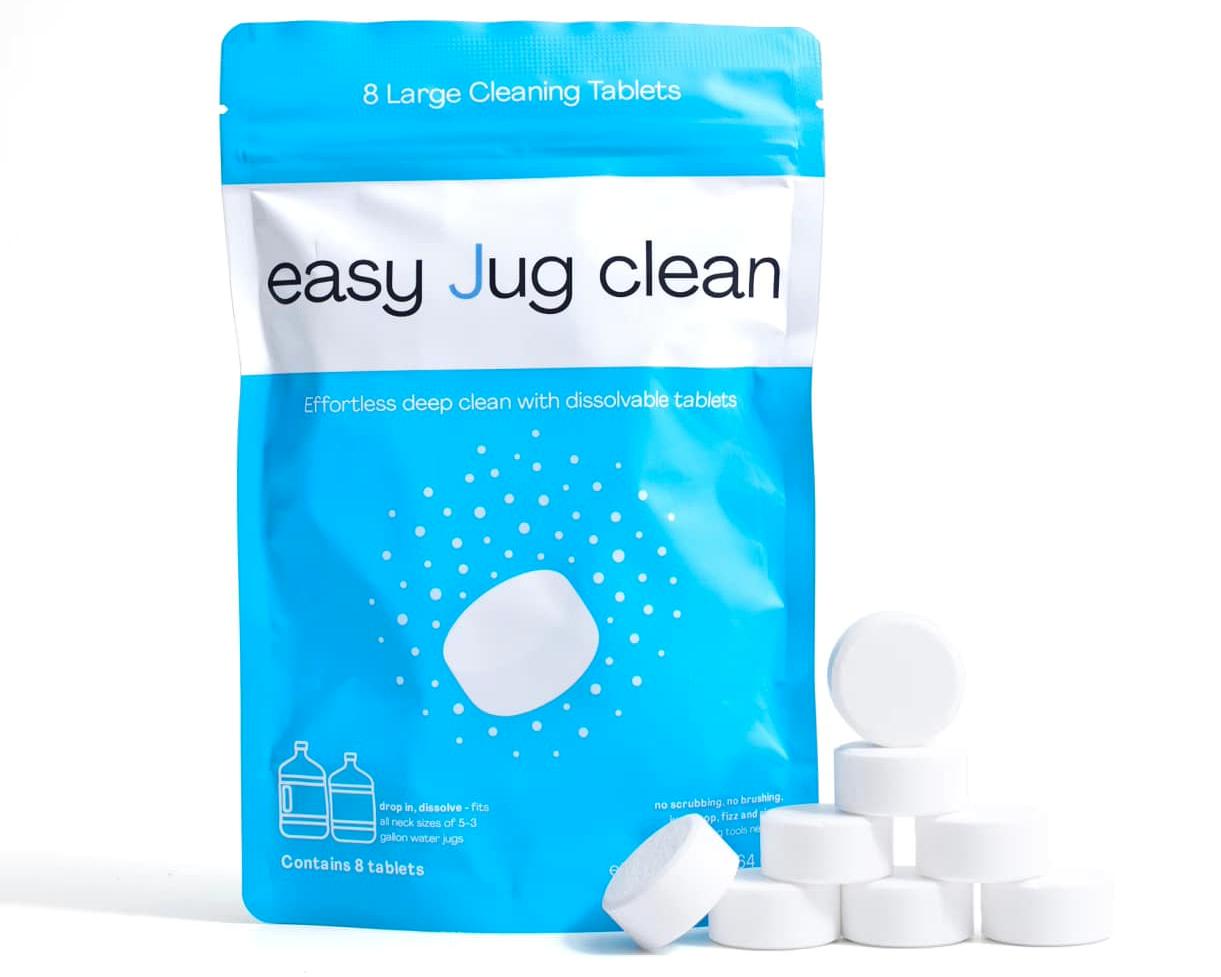
Easy Jug Clean contains two chelating agents specifically selected for this job:
- Sodium Citrate — the sodium salt of citric acid, widely used in food and pharmaceutical applications and an effective chelator for calcium and magnesium ions. It binds preferentially to the minerals that form hard water scale and holds them in solution throughout the cleaning cycle.
- Sodium Gluconate — a complementary chelating agent that enhances mineral removal by targeting additional mineral species and stabilizing the overall cleaning system. Together with sodium citrate, it ensures comprehensive descaling action across the full range of mineral deposits found in hard water jugs.
These chelating agents work simultaneously with the active oxygen release from sodium percarbonate — meaning Easy Jug Clean is attacking scale and biofilm at the same time, in the same treatment. This is the critical advantage over vinegar, which handles some scale but ignores biofilm entirely.
Watch Easy Jug Clean dissolve hard water scale and eliminate odor buildup in a single treatment:
✅ Dissolve Hard Water Scale Without Scrubbing
Easy Jug Clean's dual chelating agents pull calcium and magnesium deposits off your jug walls in 20 minutes — while simultaneously removing biofilm and sanitizing the interior. No vinegar taste. No brushing. No residue.
Step-by-Step: How to Remove Heavy Scale from a Neglected Jug
For a jug with significant existing buildup, follow this protocol:
Preventing Scale Buildup: The Weekly Maintenance Standard
Once you've cleared existing scale, weekly cleaning with Easy Jug Clean prevents it from returning to problematic levels. The chelating agents in each tablet treatment bind any freshly deposited mineral ions before they can crystallize into bonded scale, rinsing them away with the cleaning solution. In hard water areas, this weekly maintenance approach keeps jug walls consistently clear — something that is simply not achievable with any cleaning method that lacks chelating chemistry.
Hard Water Scale vs. Biofilm: Understanding the Difference
| Characteristic | Hard Water Scale | Biofilm |
|---|---|---|
| What it is | Calcium/magnesium carbonate mineral deposit | Bacteria colony in protective polymer matrix |
| How it feels | Rough, chalky, hard to the touch | Slippery, slimy, smooth |
| Appearance | White, chalky, cloudy walls | Often invisible; sometimes pink, green, or dark spots |
| Removed by brushing | Partially — chips loose flakes only | Partially — disturbs but doesn't destroy |
| Removed by vinegar | Partially — light scale only | No |
| Removed by Easy Jug Clean | Yes — chelation dissolves deposits | Yes — active oxygen destroys matrix |
| Health risk | Low directly; high indirectly via bacterial shelter | Direct bacterial contamination risk |
Both problems almost always co-exist in a regularly used water jug — scale provides the rough surface that helps biofilm establish, and biofilm provides nucleation sites that accelerate scale formation. This is why a cleaning product that addresses only one of them — vinegar for scale, or a simple sanitizer without chelating action — will always leave part of the problem unsolved.
Frequently Asked Questions
Q: Can hard water scale make you sick?
Calcium carbonate itself is not harmful to drink — it's the same mineral found in antacid tablets. The health risk from scale is indirect: rough scale surfaces accelerate biofilm formation and can physically shelter bacteria beneath mineral layers, making them resistant to sanitizing agents. The scale is the accomplice, not the primary threat.
Q: Will a water softener prevent scale in my jug?
A whole-house water softener replaces calcium and magnesium ions with sodium ions, which significantly reduces scale formation. However, softened water still contains dissolved solids and biological contaminants that require regular jug cleaning. A softener reduces the descaling workload but doesn't eliminate the need for weekly cleaning.
Q: How long does it take for scale to become visible?
In hard water areas (120+ mg/L), visible cloudiness can develop within 2–3 weeks of regular jug use without chelating treatment. In very hard water zones, the waterline ring can appear within 10 days. In soft water areas, significant visible scale may take 6–8 weeks to develop.
Q: My jug has been scaling up for months — will Easy Jug Clean really clear it?
Yes, though heavy long-term accumulation may require two consecutive treatment cycles. Users in hard water areas with jugs that haven't been properly descaled in months consistently report visible clearance of clouding after the first or second treatment. Extremely heavy deposits — years of accumulated scale — may require three treatments over consecutive days to fully dissolve.


 Order now — get it by