How Effervescent Tablets Clean Surfaces Brushes Can't Reach
EffervescenceCO₂ AgitationTablet Delivery · Reading time: ~6 minutes
The Three Mechanisms of Effervescent Cleaning Action
🔵 Mechanism 1: Nucleation-Preferential Agitation
CO₂ bubbles from the effervescent reaction form preferentially at nucleation sites — points of surface irregularity where the energy barrier to bubble formation is lowest. In a water jug, the highest-density nucleation sites are precisely the areas that need the most cleaning: rough mineral scale deposits, micro-scratches in the plastic surface, and areas where biofilm EPS matrix has created a roughened texture. This means the effervescence naturally concentrates its agitation energy where contamination is most established — exactly the inverse of manual scrubbing, which exerts force uniformly regardless of contamination density.
🔵 Mechanism 2: Micro-Turbulence in Hydrodynamic Dead Zones
As detailed in our companion article on cleaning physics, a 5 gallon water jug has specific fluid dynamic dead zones — the bottom corners, the shoulder below the neck, the lower side walls — where bulk fluid flow is near-zero regardless of shaking or agitation intensity. CO₂ bubble formation at nucleation sites in these dead zones creates micro-scale turbulence directly at the surface, at the exact locations where bulk agitation cannot reach. Each bubble nucleating, growing, and detaching from the surface disturbs the stagnant fluid layer immediately adjacent to the surface — the layer that, in the absence of effervescence, would protect surface contamination from exposure to the cleaning chemistry in the bulk solution.
🔵 Mechanism 3: Continuous Active Chemistry Renewal at Surfaces
In any soak treatment, chemical depletion occurs at the surface as the active ingredients react with contamination. Without agitation, a stagnant layer of partially depleted chemistry forms adjacent to the surface — reducing effective concentration over time. Effervescent bubbling continuously disrupts this depletion layer, bringing fresh active chemistry from the bulk solution into contact with the surface throughout the soak period. A 20-minute effervescent soak maintains active chemistry concentration at the surface far more consistently than a 20-minute still soak of the same solution.
Why CO₂ Effervescence Is Superior to Manual Shaking for This Application
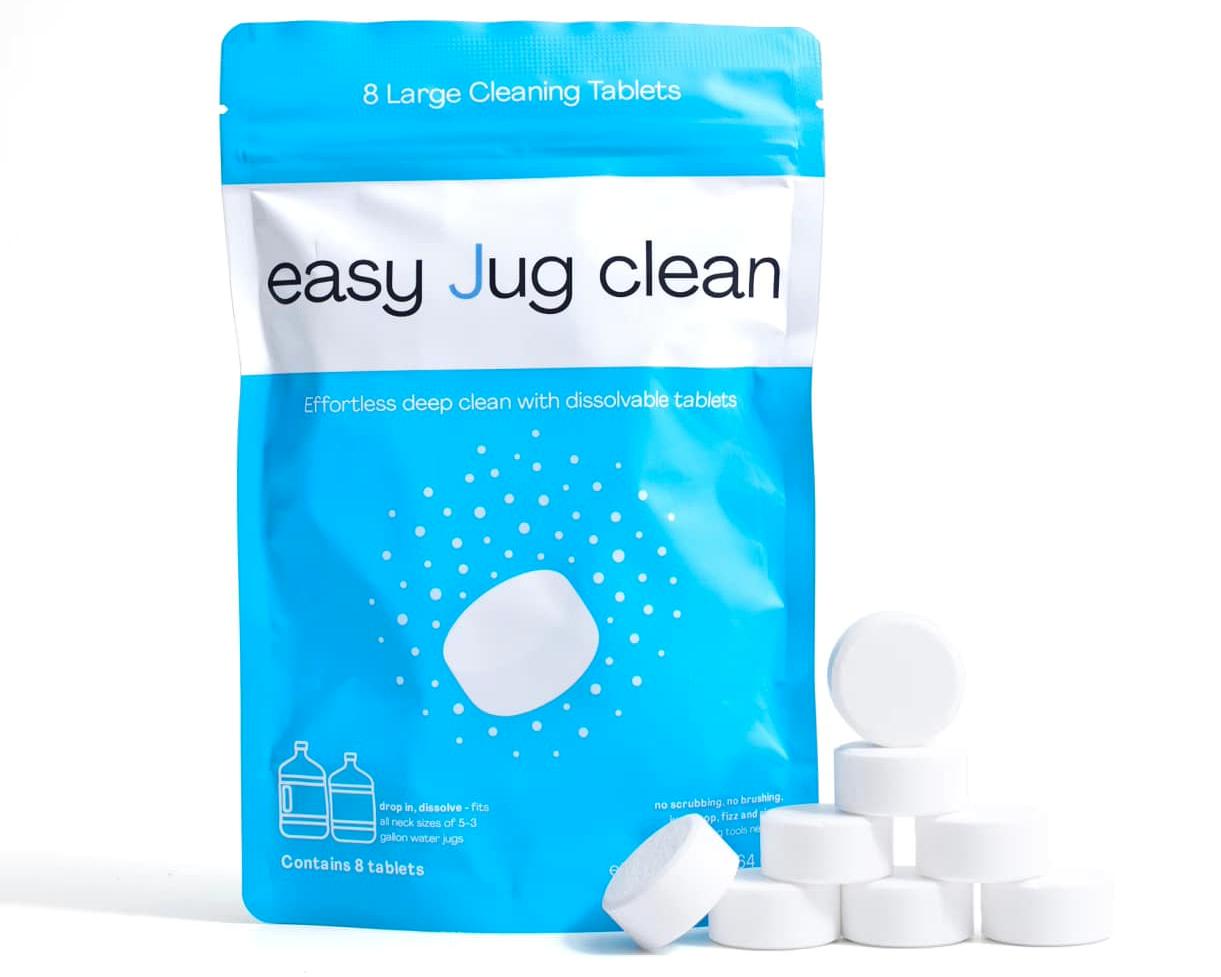
The Fumaric Acid Role in Easy Jug Clean's Effervescence System
Easy Jug Clean's effervescent system uses fumaric acid paired with sodium bicarbonate. Fumaric acid is selected over citric acid (more common in generic tablets) for two reasons: it releases CO₂ more gradually over a longer period, maintaining effervescence through the full 20-minute soak rather than spending its agitation energy in the first 5 minutes, and it has a higher melting point that improves tablet stability in storage (preventing premature reaction from humidity). The longer, more sustained effervescence is what maintains micro-turbulence throughout the treatment duration.
See why the tablet method beats manual cleaning on every single measure that matters:
✅ The Fizz That Cleans Where Brushes Can't Go
Q: Should I also shake or rotate the jug during treatment to improve results?
Rotating the jug at the 10–15 minute mark to ensure the shoulder zone (below the neck) receives full contact time is beneficial. Beyond that, the effervescent and diffusion mechanisms handle distribution without requiring additional manual agitation. The 20-minute unattended soak is specifically designed around this self-distribution capability.


 Order now — get it by