The Physics of Cleaning a Deep Narrow Container (And Why Your Jug Stays Dirty)
Reading time: ~6 minutes | Fluid Dynamics Cleaning Physics Container Geometry
Reynolds Number: Why Vigorous Shaking Isn't the Solution
The practical consequence: no matter how hard you shake a 5 gallon jug, the fluid dynamics of the narrow neck mean you cannot generate turbulent, high-shear flow at the lower surfaces. Contamination in these zones is not physically dislodged by shaking. It must be removed by chemical action that doesn't depend on fluid velocity.
Mechanical Force Transmission: The Lever Problem
Every tool inserted through the 48mm neck to clean the jug interior operates as a lever. The neck is the fulcrum. Force applied at the handle end is transmitted to the cleaning head, but at significant mechanical disadvantage once the head is 12–18 inches inside the jug. The force transmission follows basic lever mechanics: the further the head from the fulcrum (neck), the more of the applied force is lost to deflection, angle loss, and friction against the neck walls.
For a brush reaching the bottom of the jug — approximately 16–18 inches from the neck — the effective cleaning force at the brush head is a small fraction of what the user applies at the handle. Combined with the angular constraint (the brush must approach most surfaces at less than 90°, reducing effective cleaning force by the cosine of the approach angle), the physics guarantee that mechanical cleaning effort at the bottom and lower walls is minimal regardless of user effort.
Dead Zones: The Specific Areas Fluid Dynamics and Mechanics Both Miss
| Zone | Fluid Dynamics Problem | Mechanical Access Problem | Result |
|---|---|---|---|
| Bottom center | Low velocity zone — fluid decelerates at walls | Brush reaches but at reduced force | Poor cleaning despite apparent access |
| Bottom corners | Near-zero velocity — flow separates at corners | Geometrically inaccessible to any tool | Worst-cleaned zone in the jug |
| Lower side walls | Laminar flow parallel to surface — no shear | Brush at 20–30° approach angle — minimal force | Consistent undercleaning |
| Shoulder (below neck) | Flow reversal zone — turbulence collapses here | Neck geometry blocks tool access | High biofilm risk; consistently uncleaned |
| Upper side walls | Better turbulence near neck constriction | Best mechanical access | Best-cleaned zone — but also lowest risk |
Why Chemistry Solves What Physics Prevents
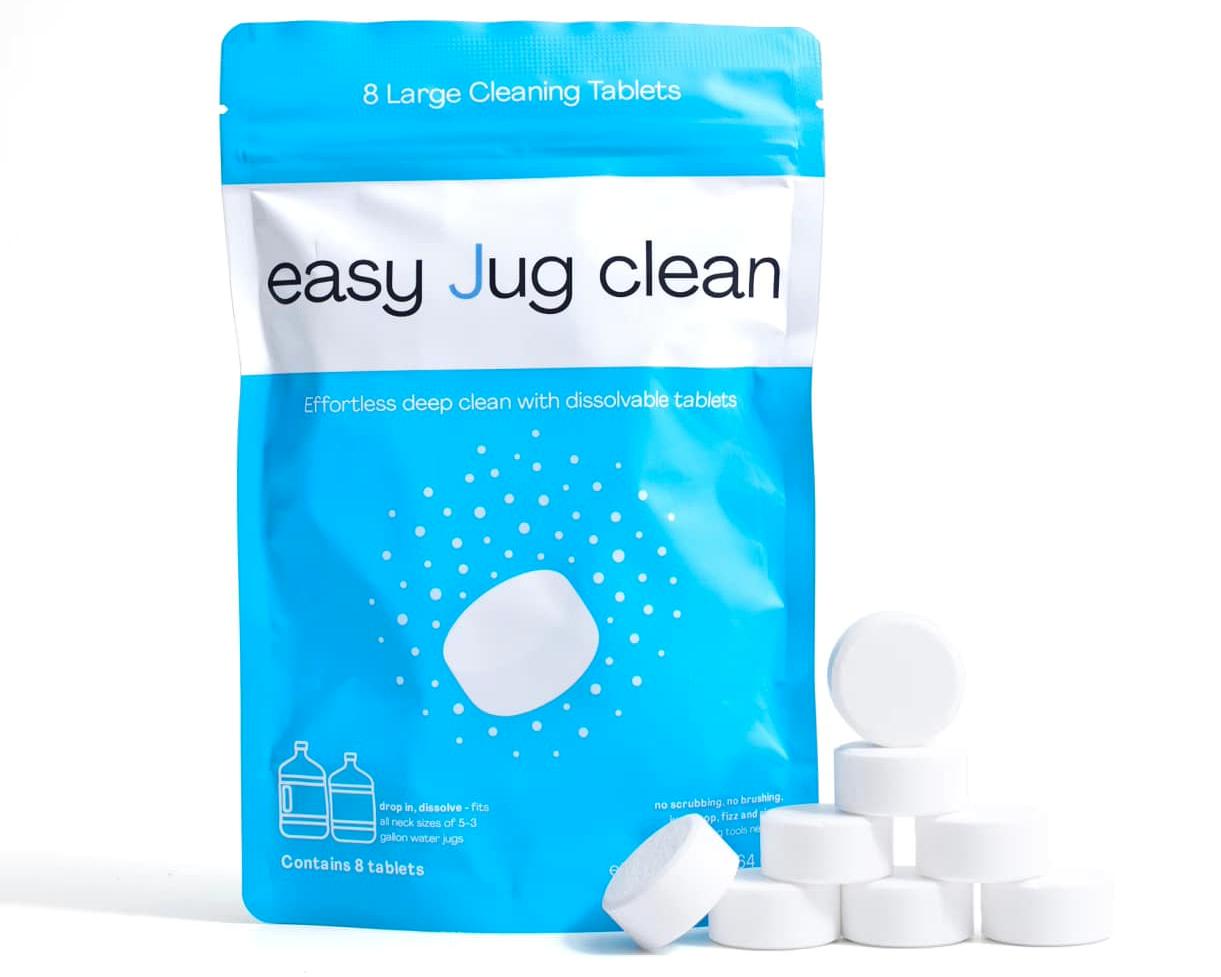
Chemical cleaning agents in liquid solution are not subject to the fluid dynamic constraints that limit mechanical cleaning. Dissolved molecules distribute by diffusion — moving independently of bulk fluid velocity, driven by concentration gradients. Active oxygen molecules from Easy Jug Clean's sodium percarbonate diffuse into the dead zones that turbulent flow never reaches and that brushes cannot touch. The effervescent CO₂ bubbles nucleating on contaminated surfaces create micro-scale turbulence directly at the surface — exactly where bulk fluid shear is absent. Chelating agents diffuse into scale deposits by the same concentration-gradient mechanism, working chemically where no mechanical force could reach.
Watch the right cleaning approach versus what a brush actually does to your jug:
✅ Chemistry That Works Where Physics Blocks Every Tool
Easy Jug Clean's dissolved active oxygen diffuses to the dead zones — the bottom corners, the shoulder, the lower walls — that fluid dynamics and mechanical tools cannot reach.
Q: Would using a pressure washer or power sprayer solve the turbulence problem?
High-pressure liquid injection through the neck would increase turbulence in the upper jug volume — but the jet would still decelerate and lose turbulence before reaching the bottom corners, and the safety and practicality concerns of using high-pressure water inside a plastic jug are significant. Chemical distribution remains the superior approach.


 Order now — get it by