Why Self-Distributing Sanitizers Are the Only Real Option for 5 Gallon Jugs
Reading time: ~7 minutes | Sanitizing Science 5 Gallon Jug Self-Distributing Chemistry
The Contact Requirement: What Sanitization Actually Demands
Regulatory definitions of sanitization — the EPA standard for food-contact surfaces is 99.999% reduction (a 5-log reduction) in target pathogens — are based on three variables: concentration of the sanitizing agent at the surface, time of contact, and temperature. All three must be met simultaneously across the entire surface being sanitized. Miss any of them on any portion of the surface, and that portion is not sanitized, regardless of what happens elsewhere.
This is the challenge the 5 gallon jug creates. Its interior surface area is approximately 600–800 square centimeters — spread across a cylindrical body 8–10 inches in diameter and 18 inches tall, connected to the outside world by a 48mm neck opening. Getting consistent sanitizing agent contact across that entire surface, including the curved bottom, the tapered shoulder below the neck, and the lower wall sections, is a genuine physics problem.
Why Every Non-Self-Distributing Method Fails the Contact Test
The Three Properties a 5 Gallon Jug Sanitizer Must Have
Given the contact requirement and the geometry constraint, any sanitizing method appropriate for a 5 gallon water jug must satisfy three conditions:
- Liquid-phase active chemistry — the sanitizing agent must be dissolved in water so it contacts the full interior surface when the jug is filled and soaked. No mechanical application, no spray, no foam.
- Adequate contact time by soaking — the sanitizing mechanism must work through extended contact without mechanical agitation. Soak-based sanitization is the only distribution model that works in a sealed 5 gallon jug interior.
- Food-grade breakdown products — because the jug will hold drinking water immediately after sanitization, the sanitizing agent must decompose into compounds that are safe for incidental ingestion at trace levels after thorough rinsing.
What "Self-Distributing" Looks Like in Practice
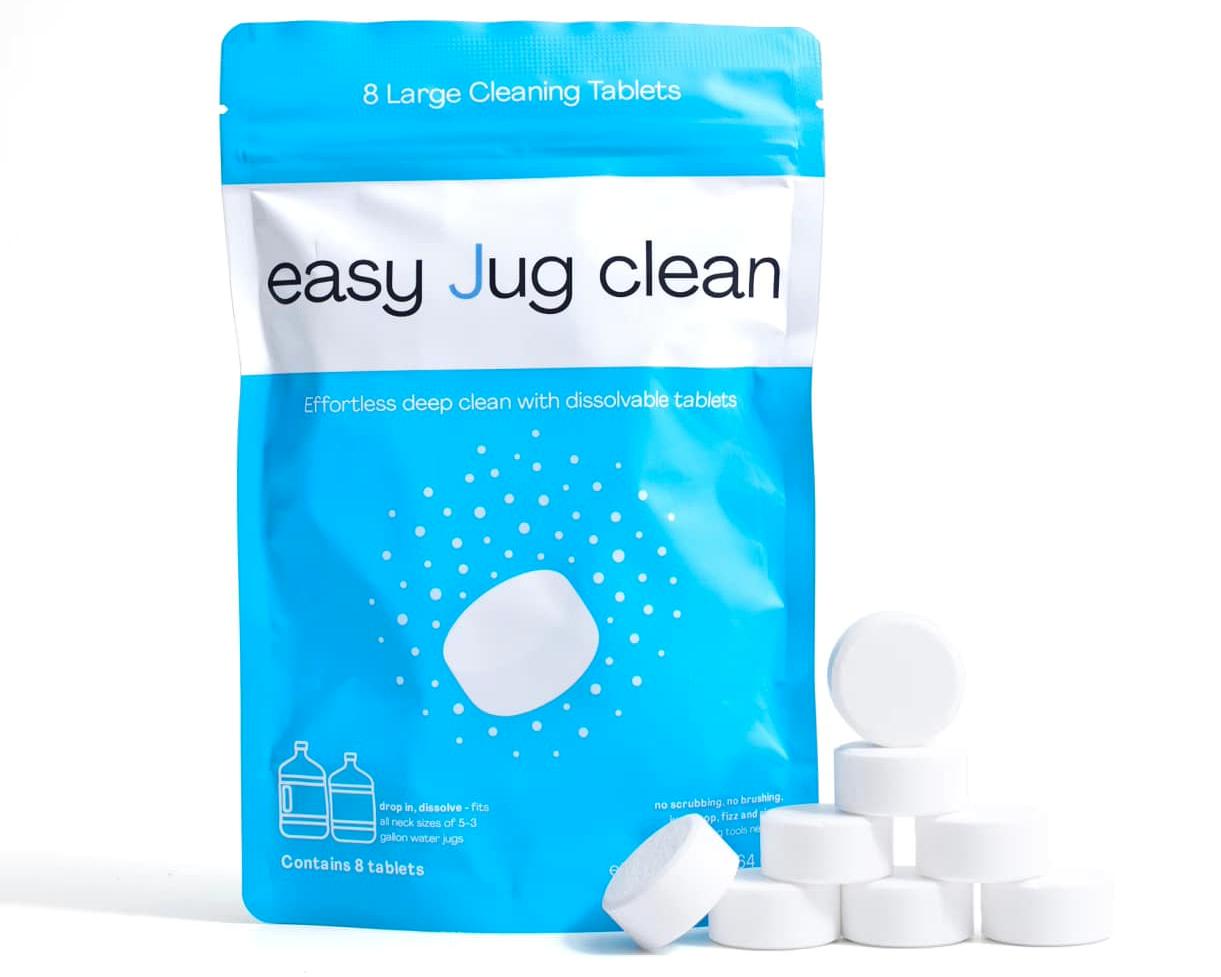
When you drop two Easy Jug Clean tablets into a 5 gallon jug half-filled with warm water and let it sit, four simultaneous processes occur. The tablets dissolve and release active oxygen chemistry into the water volume. Effervescent CO₂ bubbles continuously agitate the solution, ensuring it reaches the full interior volume including the shoulder zone. Active oxygen molecules diffuse through the solution by concentration gradient, reaching all surfaces equally — including the bottom corners and lower walls that no brush or spray can reach. The chelating agents simultaneously work on mineral scale by the same diffusion mechanism.
After 20–30 minutes, every interior surface has had sustained, consistent contact with sanitizing chemistry at effective concentration. The geometry of the jug never becomes a limiting factor because the chemistry fills the space, not a tool operating through it.
Watch Easy Jug Clean's active oxygen sanitize a 5 gallon water jug without scrubbing:
✅ Complete Coverage. Every Surface. Every Time.
Easy Jug Clean's self-distributing active oxygen reaches the bottom corners, the shoulder, the lower walls — everywhere a brush or spray cannot. Two tablets. Twenty minutes. Genuinely sanitized.
Frequently Asked Questions
Q: Does rotating or shaking the jug during treatment improve sanitization?
Rotating the jug at the 10-minute mark to ensure the shoulder zone is submerged is a useful step — particularly for ensuring the upper tapered section gets full contact time. The effervescent action handles most distribution automatically, but a mid-soak rotation adds confidence for the neck area.
Q: Are commercial water jug sanitizing services any different from home tablet treatment?
Commercial water jug exchange programs typically sanitize jugs using industrial ozone or chlorine dioxide — both self-distributing gaseous sanitizers applied in sealed chambers. The principle is identical: self-distribution through the jug volume without mechanical application. Easy Jug Clean replicates this principle in a consumer-accessible tablet format using active oxygen chemistry.


 Order now — get it by