How Mold Spores Get Inside a Sealed Water Jug (The Five Pathways)
How Mold Spores Get Inside a Sealed Water Jug (The Five Pathways)
Reading time: ~5 minutes | Spore Biology Contamination Sources Mold Origins
The Premise: Spores Are Already Everywhere
The atmosphere around you contains airborne fungal spores at all times, in all locations. Outdoor air typically contains 1,000 to 10,000 spores per cubic meter; indoor air ranges from 200 to several thousand depending on ventilation, humidity, and the building's mold load. Many spores are invisible to the naked eye. They're light enough to remain suspended in air for hours and travel with even the slightest air movement.
This baseline matters because it changes the framing of the question. The interesting question isn't "how did spores enter my jug" — they were always going to. The interesting question is "how do I prevent the spores that inevitably arrive from establishing a mold colony." Spore introduction is unpreventable; colonization is preventable.
The Five Pathways
1. The Dispenser Interface (The Dominant Pathway)
Every time a jug is mounted on a top-loading dispenser, the seal cap is pierced by the dispenser probe — and ambient air enters along with the seal break. The probe itself, having been exposed to ambient air for the past week or month, also carries spores on its surface. The probe contacts every new jug as it's installed, transferring whatever's on its surface into the fresh water.
For bottom-loading dispensers, the pickup tube performs the same function — it's been sitting in the dispenser cabinet (often warm and humid from the cooling system) for the previous jug's cycle, accumulating spores, and then enters the new jug as soon as it's installed.
2. Atmospheric Settling During Refill
When a jug is refilled at a refill station or under a tap, the cap is removed and the interior is exposed to ambient air. Spores in that air settle on the wet interior surfaces. Even a brief refill — two minutes from cap-off to cap-on — exposes hundreds of square inches of wet interior to thousands of airborne spores.
Refill stations are particularly notable because they're often in retail or commercial environments with concentrated foot traffic, dust, and air-handling systems that may have higher spore counts than residential air.
3. Spores Already in the Source Water
Even treated municipal drinking water contains some baseline level of fungal spores — typically below regulatory thresholds but not zero. Pre-filled commercial 5-gallon jugs are tested at the bottling facility, and reputable brands meet bottled water standards (typically 0 colony-forming units per 100 ml for fungal organisms). But "tested at bottling" doesn't account for what happens during storage and transit, where temperature fluctuations and time can allow trace contamination to multiply.
4. Inheritance from Previous Use Cycles
This pathway explains why mold tends to come back to the same jugs. The visible colony was eliminated, but the substrate (biofilm + scratches) and dormant spore reservoir remained. New environmental conditions — warmer water, longer dwell, accumulated sediment — re-activated the established population.
5. Hand-Contact and Cap Handling
The cap of a new water jug, while sealed, has been handled during transport, distribution, and storage. The exterior of the cap and the area around the neck have been exposed to spores in handling environments. When the cap is removed and the area around the neck is touched (intentionally or not) during installation, those spores can be transferred to the wet interior.
Hand contact during refill operations adds a similar pathway — spores from skin and ambient air on hands transfer to the rim and inside-edge of the jug opening.
Why Spore Introduction Isn't Really Preventable
Each of the five pathways could theoretically be reduced — sterile dispenser probes, HEPA-filtered refill rooms, sealed bottling environments, perfect cleaning of every prior cycle, gloves during handling. None of these are realistic in residential or office contexts. The infrastructure to prevent all spore introduction would cost more than the entire household water service.
This is a useful realization because it shifts the focus to the actually-controllable variable: whether the spores that arrive can germinate and colonize.
What Determines Whether Spores Become a Colony
Mold spores need four conditions to germinate: moisture, organic food, oxygen, and a temperature in the right range (typically 4–40°C / 40–104°F). A water jug provides three of these abundantly: moisture is constant, oxygen is available in the air space and dissolved in water, and temperature is in the favorable range.
The fourth condition — organic food — is the one that varies. Polycarbonate plastic itself isn't a food source. But trace organic matter from water, from biofilm communities, and from accumulated mineral scale provides enough nutrients for fungal growth. When all four conditions align, spores germinate within days and visible colonies appear within weeks.
The Actual Prevention Strategy
Since you can't prevent spore introduction, you prevent colonization by making the interior chemically and biologically inhospitable on a regular schedule. Specifically:
- Keep the interior surface clean of biofilm. Without bacterial biofilm, mold has no organic food anchor on plastic. Active oxygen + chelation cleaning eliminates biofilm at every cycle.
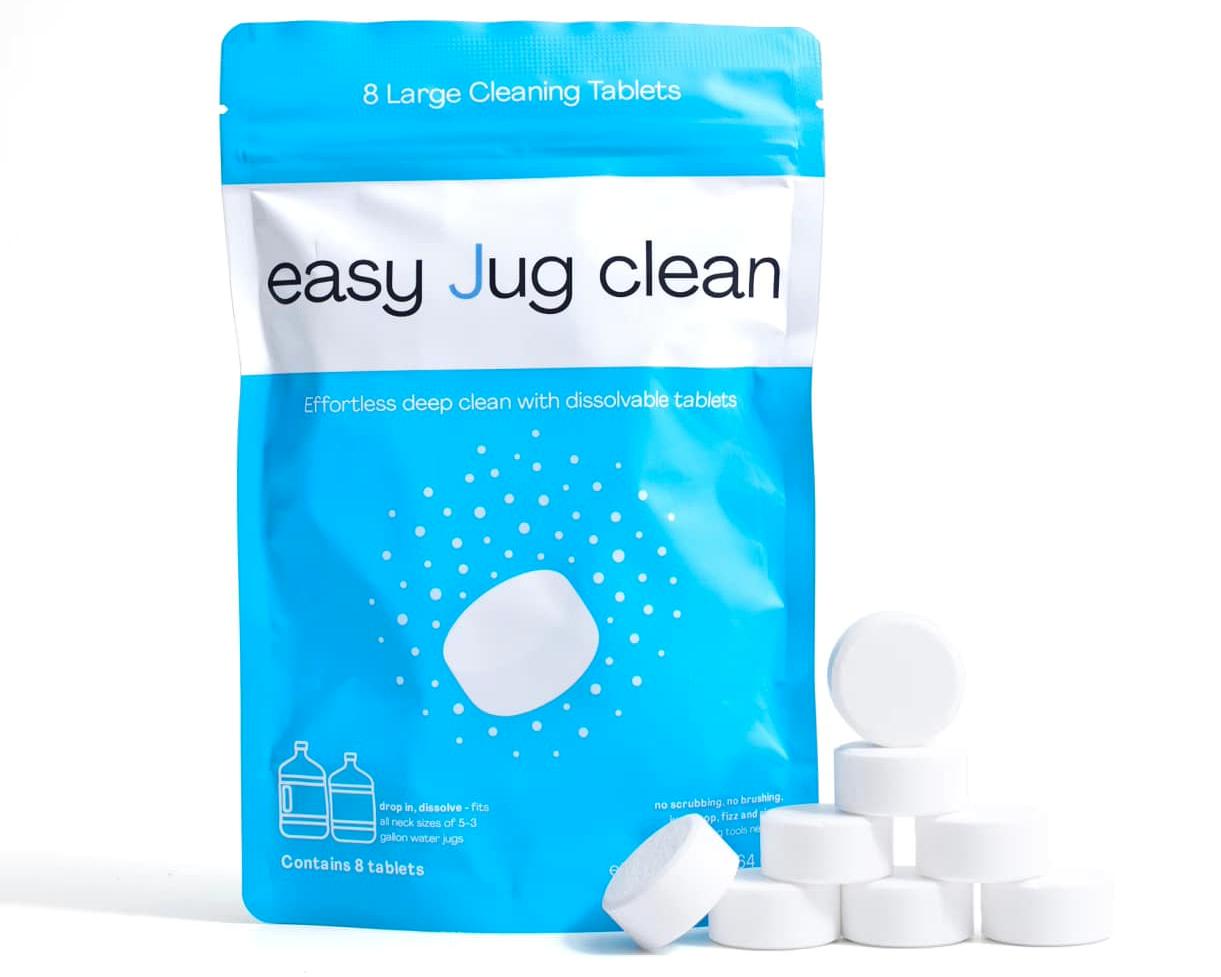
- Keep the surface free of mineral scale. Scale provides texture and nutrients that mold uses. Chelating agents in Easy Jug Clean dissolve scale before it accumulates.
- Reset the cleaning cycle frequently. Each weekly treatment eliminates any spores that germinated since the last treatment, before they form visible colonies. Weekly preventive treatment is the operative discipline.
- Dry the jug fully between uses when possible. Dry conditions are hostile to spore germination.
✅ Stop the Colonization, Not the Introduction
Spores will arrive. The cleaning chemistry decides whether they grow. Two tablets, 20 minutes, weekly — that's the prevention strategy that actually works.
FAQ: Spore Introduction
Q: My new sealed jug from the supplier had visible mold within a week. How is that possible?
Most likely two things: (1) the dispenser interface introduced spores when the jug was mounted, and (2) the dispenser itself had biofilm or pre-existing colonies that seeded the new water. The fresh jug wasn't pre-contaminated; the dispenser was.
Q: Should I be cleaning the dispenser probe?
Yes, monthly at minimum. Wipe the probe with a food-safe sanitizing wipe or a small amount of Easy Jug Clean solution on a clean cloth. Probe cleaning reduces spore transfer at every jug change.
Q: Does using a HEPA filter near the dispenser help?
Marginally. It reduces ambient spore counts in the immediate area, which slightly reduces introduction during cap-off events. Not a primary defense — the cleaning frequency matters more.
The Bottom Line
Mold spores entering your water jug isn't a defect or an unusual event — it's the baseline condition of any water container in any residential or office environment. Five specific pathways do most of the work, and none are practically preventable. The strategy that actually keeps your water jug mold-free is to make colonization impossible by keeping the interior chemically inhospitable on a regular schedule. The pillar guide covers both treatment and prevention.


 Order now — get it by