How to Remove Mold From a 5 Gallon Water Jug: What You're Actually Seeing and How to Fix It
Category: Mold and Water Safety | Mold Removal Water Jug Hygiene Health & Safety Sanitization Guide
First, Is It Actually Mold?
Not every dark spot inside a water jug is mold. Before you commit to a treatment plan, it's worth knowing what you're looking at — because mold, mineral scale, biofilm, and certain bacteria all produce visible interior marks, and they each respond differently to cleaning. Misidentifying the problem is the first reason most jug treatments fail.
Mold appears as fuzzy, sometimes raised spots in colors ranging from black, dark green, blue-green, gray, white, or pinkish. Mold colonies have visible texture under good lighting — the surface looks "alive," with hyphae (the thread-like filaments of fungal growth) extending from a central point. Mold is most common at the waterline (where moisture meets air) and in the bottom shoulder area where condensation pools.
Mineral scale appears as flat, chalky, white-to-grayish films or rings, often near the waterline. Scale is smooth and crystalline rather than fuzzy. White residue is calcium and magnesium carbonate, not mold. It looks alarming but is chemically inert.
Biofilm appears as a glossy, slightly slimy, almost translucent coating — sometimes faintly tinted pink, yellow, or gray. Biofilm doesn't have the fuzzy texture of mold and doesn't have the chalky look of scale. Biofilm is a bacterial community, not fungal — but the cleaning chemistry that handles biofilm also handles mold, so the practical treatment is the same.
Pink slime is a common look-alike worth knowing. The pink-to-orange staining sometimes seen in water containers is often Serratia marcescens, a bacterium — not mold. It responds to the same active oxygen treatment.
What Mold in a Water Jug Actually Is
Mold is a category of fungus that reproduces by releasing microscopic spores, which travel through air and water, settle on surfaces, and germinate when conditions allow. The species most commonly identified in residential water containers include Cladosporium (often green or olive), Aspergillus (yellow to green), Penicillium (blue-green), and occasionally Stachybotrys (the so-called "black mold" that gets the most public attention). Each requires moisture, an organic food source, an oxygen supply, and a temperature range — conditions a water jug provides in abundance.
Inside a water jug, mold typically grows in three zones:
- The waterline. The boundary between water and air is the highest-oxygen, most condensation-active zone. Mold colonies form here as small black or green spots that ring the interior at the half-full or quarter-full mark.
- The neck and shoulder. The upper interior, where airborne spores settle and where water vapor condenses, supports mold growth even when the lower jug stays cleaner.
- The bottom curve. Sediment and organic material settle here, providing food. Mold in the bottom of the jug is among the hardest to reach with conventional cleaning tools.
Whatever colour or location, the visible spot you can see is just the surface signature. Below the visible mold colony, hyphae extend microscopically into surface scratches and biofilm layers — which is the reason wiping or rinsing the spot away never solves the problem permanently.
How Mold Got Into Your "Sealed" Water Jug in the First Place
One of the most common reactions to discovering mold inside a water jug is "but the jug was sealed — how did mold get in?" The honest answer: most water jugs aren't actually sealed against airborne spores during normal use, and the conditions inside are favorable enough that even a small spore introduction grows over weeks.
Mold spores enter through several pathways:
- The dispenser interface. Each time the jug seats onto a top-loading dispenser probe, or onto a bottom-loading water pickup, ambient air containing mold spores enters along with the seal. Spore introduction during mounting is the dominant entry pathway in residential systems.
- The water itself. Even treated municipal water contains trace mold spores. Pre-filled commercial jugs typically test under regulatory thresholds, but "under threshold" is not zero.
- The refill process. Refilling at a refill station or filling from a tap exposes the open jug to ambient air, and spores settle on interior surfaces during the time the jug is uncapped.
- Pre-existing colonies. Many jugs that develop mold are inheriting it from previous use cycles. The bottom shoulder area held biofilm. The biofilm hosted mold spores. The mold germinated when conditions were right.
The takeaway: spore introduction is not preventable in real-world residential or office use. What's preventable is the conditions that allow the spores to germinate and colonize — and that comes back to consistent cleaning.
The Health Question: Can Mold in a Water Jug Make You Sick?
This is the question most people who find mold in their jug are really asking, and it deserves a careful, factual answer rather than reassurance or alarmism. The short version: it depends on the species, the exposure level, and the individual.
Most household molds — Cladosporium, Penicillium, common Aspergillus species — are widespread in indoor and outdoor air at low concentrations and are not acutely dangerous to healthy adults at the exposure levels a contaminated water jug typically provides. The Centers for Disease Control and Prevention notes that the health effects of mold exposure depend on the amount of mold and the sensitivity of the exposed person.
That said, three groups are at elevated risk and should treat any mold-contaminated water source seriously:
- Immunocompromised individuals — including people undergoing chemotherapy, organ transplant recipients, and those with poorly controlled diabetes or HIV. Some Aspergillus species can cause serious infection in this population.
- People with mold allergies or asthma. Even low-level chronic exposure can trigger respiratory symptoms.
- Infants, young children, and elderly adults. Developing or aging immune systems are less tolerant of contamination.
For everyone, regardless of risk category: drinking water from a visibly moldy jug is a situation to fix, not ignore. Some mold species produce mycotoxins — compounds with their own toxicity profile separate from the mold itself — and while the levels in a typical contaminated jug are low, the appropriate response is to stop using the contaminated water, treat the container, and resume use only after the contamination is fully resolved.
The Two Common Responses That Don't Actually Work
Bleach: Stronger Than Necessary, and It Damages the Jug
Vinegar: Doesn't Kill Mold to Regulatory Standard
✅ The Method That Actually Eliminates Mold — and Prevents It From Returning
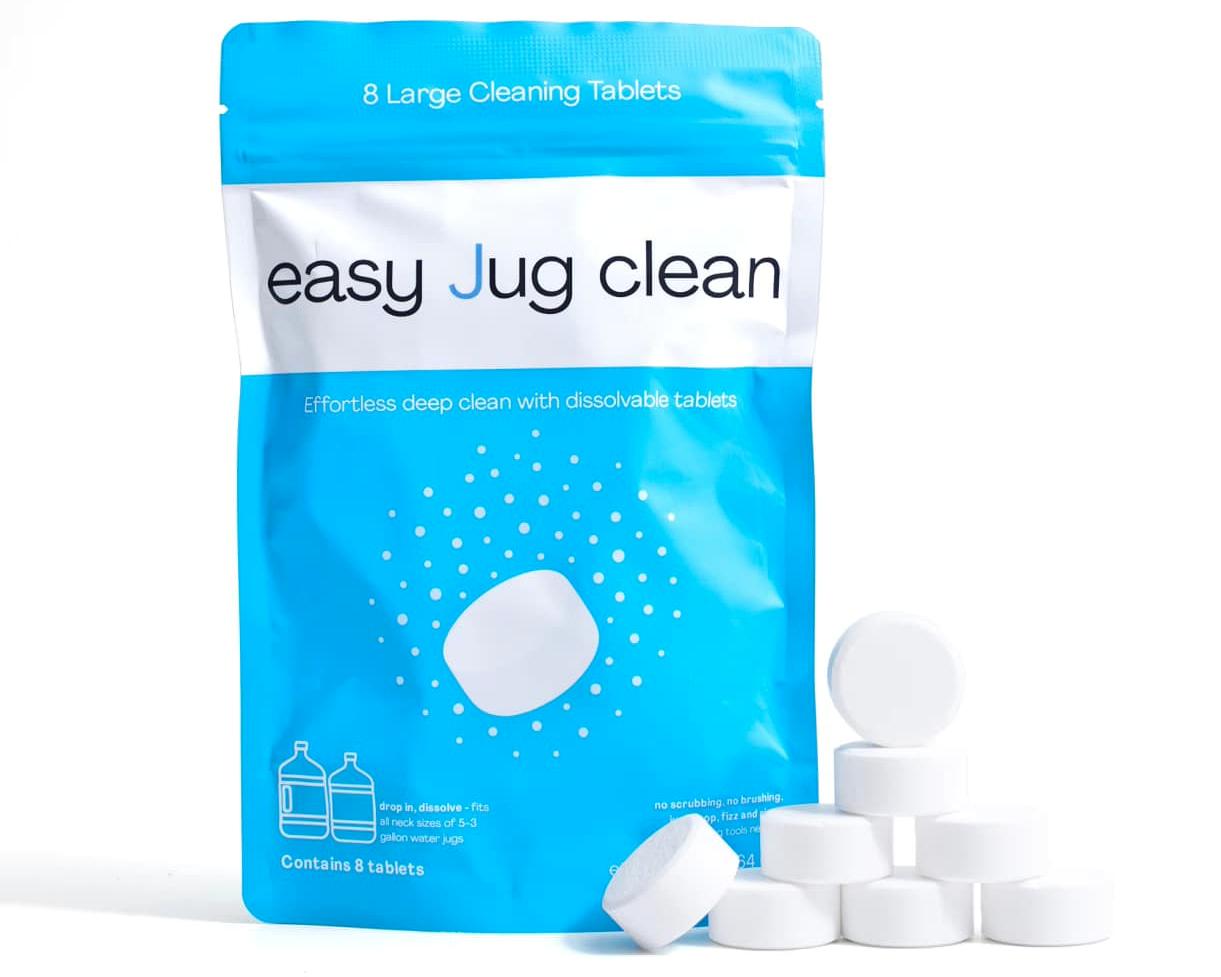
Easy Jug Clean uses food-grade active oxygen chemistry (sodium percarbonate) that destroys mold colonies, dissolves the biofilm scaffold they grow on, and removes the mineral scale that contributes to recurrence — all in one treatment. No bleach. No vinegar. No scrubbing. No plastic damage. Drop 2 tablets into warm water, wait 20 minutes, rinse.
See Easy Jug Clean eliminate mold and biofilm from a 5-gallon jug in 20 minutes:
The Step-by-Step Mold Removal Protocol
This is the protocol for eliminating an established mold colony from a 5-gallon water jug. It works for mold visible at the waterline, in the shoulder zone, or at the bottom curve. For first-time treatment of a heavily moldy jug, two consecutive treatments on successive days are recommended.
The Mold Recurrence Problem: Why It Comes Back After Cleaning
One of the most frustrating experiences for water jug owners is treating a mold problem successfully — only to see it return within weeks. The recurrence isn't bad luck or treatment failure. It reflects a structural pattern that most cleaning approaches miss.
Mold recurrence happens when any of three things wasn't fully addressed:
- The biofilm scaffold remained. Mold colonies frequently grow on top of bacterial biofilm rather than directly on the plastic surface. Treatments that kill the visible mold but don't dissolve the underlying biofilm leave a perfect substrate for the next mold colony to establish.
- Hyphae below the surface survived. Mold hyphae extend microscopically into surface scratches, crevices, and biofilm depths. Surface-only treatments (vinegar wipes, light bleach rinses) leave the hyphae intact, and the colony regenerates from the residual structure.
- The jug surface was damaged. Plastic that has been scratched by brushes or eroded by repeated bleach exposure provides micro-anchors that future mold colonies use to establish. Damaged plastic is more mold-prone than intact plastic.
The Easy Jug Clean approach addresses all three: active oxygen oxidizes mold cells and hyphae together; chelating agents dissolve mineral scale that biofilm uses for stability; the chemistry doesn't damage the polycarbonate, so future cleaning treatments don't progressively worsen the substrate. Preventing recurrence is the second half of solving the mold problem — and it's where most household methods fail.
When to Save the Jug vs. When to Replace It
Most moldy water jugs can be fully restored by proper cleaning. Some can't. The decision points:
| Situation | Save with Cleaning? | Notes |
|---|---|---|
| Visible mold but jug interior is otherwise smooth and clear | ✅ Yes | Two Easy Jug Clean treatments restore most jugs in this state |
| Mold + scratched/cloudy interior | ⚠️ Borderline | Cleaning helps but recurrence is more likely; consider replacement after one full cleaning cycle |
| Persistent dark staining after two cleanings | ❌ Replace | Likely permanent plastic discoloration; substrate is compromised |
| Visible cracks, chips, or warping | ❌ Replace | Structural damage; cleaning doesn't restore integrity |
| Jug has been used in a household with severe mold sensitivity | ⚠️ Owner's call | Cleaning works but psychological factor may favour replacement |
| Jug is more than 5 years old + mold present | ⚠️ Owner's call | Aging polycarbonate is more prone to recurrence; replacement is reasonable |
For most readers, the first row applies — the mold is recent, the jug is otherwise sound, and a proper cleaning treatment fully restores it. The replace-or-clean decision is judgment-based, but cleaning is almost always the right first step.
Preventing Mold From Coming Back
Prevention is dramatically easier than treatment, and the protocol is simple. Mold needs four conditions: moisture, organic food, oxygen, and a hospitable temperature. You can't eliminate the last three from a water container in normal use. You can prevent the conditions that allow established colonies to form, by keeping the jug interior chemically and biologically inhospitable on a consistent schedule.
- Sanitize at every refill, or weekly — whichever is sooner. Two Easy Jug Clean tablets, 20 minutes, rinse. The weekly reset prevents biofilm establishment, which prevents the substrate mold needs.
- Dry fully between uses if the jug will sit unused. An empty, fully dry jug is a hostile environment for spore germination.
- Wipe the dispenser interface monthly. The probe (top-loaders) or pickup (bottom-loaders) is the primary spore introduction pathway. Cleaning the dispenser interface reduces spore introduction at every jug change.
- Store empty jugs in a cool, dry place with the cap off if possible. Sealed humid storage encourages exactly the conditions you don't want.
- Don't use bleach for routine cleaning. Even though bleach kills mold, repeated use damages the jug surface and progressively makes recurrence more likely.
Frequently Asked Questions
Q: I cleaned the visible mold but I'm worried about what's still there. Should I be?
Reasonably so, if the cleaning was a surface wipe or rinse. With a full Easy Jug Clean treatment plus a second consecutive treatment for first-time mold removal, the residual concern is low. Air-dry the jug fully and inspect after 24 hours. If no visible mold returns within a week of resuming use, the treatment was effective.
Q: Is the water that was sitting in the moldy jug safe to drink?
Discard it. The cost of a few gallons of water is trivial compared to the uncertainty about mold-related GI exposure. Do not drink, cook with, or give to pets water from a visibly moldy jug.
Q: How often should I check for mold?
Visual inspection at every refill is reasonable practice. Look for spots, slime, or color changes inside the jug under good lighting. Mold typically becomes visible weeks after initial spore germination, so monthly inspection catches most problems before they advance.
Q: My jug has a vinegar smell after cleaning — does that mean residual vinegar?
If you used vinegar before, possibly. Easy Jug Clean leaves no vinegar smell. If you treated with vinegar first and then with Easy Jug Clean, run an additional rinse cycle to clear any residual acetic acid. Vinegar smell on its own doesn't indicate ongoing mold.
Q: Is mold in a 3-gallon water jug treated the same way?
Yes. Reduce the water volume during the soak (1.5 gallons of warm water) but keep the same 2-tablet dose for active treatment of mold contamination. The chemistry is identical regardless of jug size from 1 to 5 gallons.
Q: What about mold in the dispenser itself, not just the jug?
Treat the dispenser separately. The complete dispenser sanitizing routine covers the spigots, drip tray, and internal reservoir. A clean jug placed on a moldy dispenser will be re-contaminated quickly.
The Bottom Line
Finding mold in a water jug is alarming, but it's also one of the more solvable household contamination problems — provided you use the right treatment. The wrong treatments are the common ones: bleach damages the jug and doesn't address recurrence, vinegar doesn't kill mold to regulatory standard, and surface scrubbing makes the problem worse over time. The right treatment is active oxygen chemistry that destroys mold, dissolves the biofilm scaffold, and leaves the jug surface intact for next time.
Drop two tablets. Wait 30 minutes. Rinse three times. Air-dry 24 hours. That's the complete mold removal protocol — and the same protocol on a weekly schedule keeps mold from coming back.


 Order now — get it by