How Refill Frequency Changes the Cleaning Equation Between Small and Large Water Bottles
Reading time: ~5 minutes | Refill Cycle Cleaning Frequency Dwell Time
The Refill Cycle as a Reset Mechanism
Every time you empty a container and refill it with fresh water, you partially reset the bacterial population. The free-floating bacteria in the old water get poured down the drain. The new water comes in with a much lower starting bacterial count. The biofilm anchored to the interior walls remains, but the open-water reservoir of bacteria is reduced.
This reset isn't perfect — the biofilm immediately begins re-seeding the new water — but it does keep contamination from compounding indefinitely. The frequency of the reset determines the equilibrium contamination level in the container over time.
How Frequency Drives Equilibrium
Imagine two identical containers, both with the same starting biofilm load on their interior walls.
- Container A is refilled every 12 hours. The biofilm has 12 hours to seed the new water before the next refill resets it. Bacteria reach a moderate concentration, then get poured out before they can compound. Equilibrium contamination stays moderate.
- Container B is refilled every 7 days. The biofilm has 168 hours to seed the new water — 14 times longer. Bacteria reach much higher concentrations, and they compound for the full week before any reset occurs. Equilibrium contamination is much higher than container A.
Same starting biofilm. Same container. Same water. The only difference is refill frequency, and it changes the steady-state contamination level by an order of magnitude.
The Refill Frequency Comparison
| Container Type | Typical Refill Frequency | Daily Bacterial Reset? | Cleaning Demand |
|---|---|---|---|
| 16-oz sports bottle (gym use) | Multiple times per day | Yes — reset every 4–8 hours | Light: rinse + occasional wash |
| 32-oz reusable bottle (work) | Once or twice per day | Yes — daily reset | Light: daily rinse + weekly wash |
| 1-gallon refill jug (kitchen) | Every 1–3 days | Partial — every few days | Moderate: weekly wash |
| 3-gallon water cooler jug | Every 5–10 days | No — biofilm establishes between refills | Heavy: full sanitization per refill |
| 5-gallon dispenser jug | Every 7–14 days | No — biofilm matures between refills | Heavy: full sanitization per refill |
| Stored emergency water container | Months to years | No — long-term equilibrium contamination | Extreme: full deep clean before any use |
Why Sports Bottle Refill Frequency Is Self-Cleaning
A sports bottle refilled every few hours essentially never gives biofilm enough time to mature. The frequent reset prevents contamination from compounding. Even casual cleaning — a daily rinse, a weekly soap wash — is enough because the underlying biofilm load never reaches problematic levels in the first place. The container is mostly self-protecting through use frequency.
Why Large Jug Refill Frequency Compounds Contamination
A 5-gallon jug refilled weekly gives biofilm a full 7-day growth window between resets. By the time the first refill cycle ends, biofilm is thoroughly established. By the third or fourth refill cycle, the biofilm is mature enough that the cleaning required to remove it has escalated significantly. Each subsequent refill cycle adds to the cumulative load — and the gap between refills is exactly long enough for the bacterial population to repopulate fully each time.
The refill frequency that's normal for a 5-gallon jug is, from a hygiene perspective, the worst-case interval: long enough for biofilm to mature, short enough that you don't notice anything's wrong yet, and predictable enough that the contamination compounds in a steady cycle.
Adjusting Cleaning to Match Refill Frequency
The fundamental rule: clean the container every refill, not on an arbitrary calendar. For a sports bottle refilled multiple times daily, the daily rinse is sufficient — the frequent reset does most of the work. For a 5-gallon jug refilled weekly, weekly cleaning is the minimum and per-refill cleaning is the optimum.
✅ Match the Cleaning to the Refill Cycle
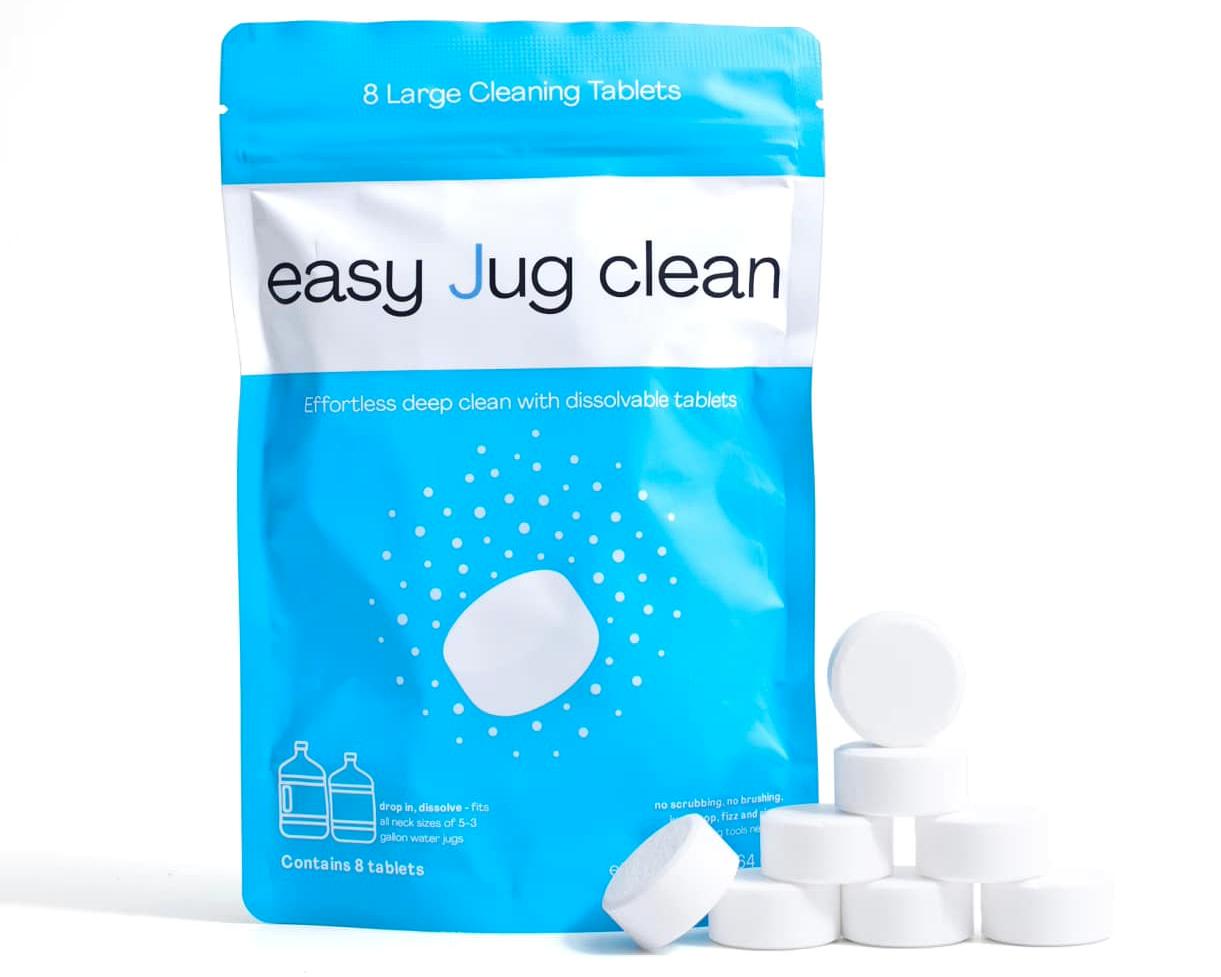
One pack of Easy Jug Clean () gives you 4 treatments — exactly enough for a month of weekly refill cycles on one jug. Treat at every refill and contamination never compounds.
FAQ: Refill Frequency and Cleaning
Q: My family goes through a 5-gallon jug in 4 days. Should I clean every 4 days or wait for a week?
Clean every refill — every 4 days in your case. The cleaning frequency should match your actual use pattern, not a generic weekly recommendation.
Q: What if I only use my 5-gallon jug occasionally and it sits half-full for weeks?
The worst-case scenario for biofilm formation. Sitting partially full is more dangerous than sitting empty because it provides continuous moisture. Treat before each occasional use, and consider draining and dry-storing between uses.
Q: Does using cold water from the dispenser slow biofilm growth enough to extend the cleaning interval?
It slows growth but doesn't eliminate it. The bottom of the jug warms toward room temperature in the dispenser cabinet, and biofilm grows even at refrigerated temperatures, just slower. Don't extend the interval beyond what your actual refill cycle dictates.
The Bottom Line
Refill frequency is the variable that explains why cleaning advice for sports bottles doesn't scale to large water bottles. Frequent refills self-protect the container through bacterial reset. Infrequent refills allow biofilm to compound. The cleaning frequency for any container should match its refill cycle, and for large water bottles that means treating at every refill — not on a calendar.


 Order now — get it by