How to Store a 5 Gallon Water Jug to Prevent Bacteria Between Refills
Reading time: ~6 minutes | Storage Bacteria Prevention 5 Gallon Jug
The Four Storage Factors That Matter
1. Temperature — The Single Biggest Variable
Bacterial growth rates are exponentially temperature-dependent. Most waterborne bacteria double in population every 20–40 minutes at optimal temperatures (around 98°F/37°C). At refrigerator temperatures (38°F/3°C), growth rates drop by a factor of 100 or more. A jug stored in a warm room colonizes far faster than one stored in a cool pantry.
| Storage Temperature | Bacterial Doubling Time | Days to Visible Biofilm |
|---|---|---|
| Below 40°F (4°C) — refrigeration | Hours to days | 2–3 weeks+ |
| 60–68°F (15–20°C) — cool pantry | 1–2 hours | 7–10 days |
| 68–77°F (20–25°C) — room temperature | 30–60 minutes | 5–7 days |
| 77–86°F (25–30°C) — warm room/summer | 20–30 minutes | 3–5 days |
| Above 86°F (30°C) — hot environment | 15–20 minutes | 2–3 days |
Practical implication: A jug stored in a cool pantry at 65°F maintains cleaner conditions nearly twice as long as one on a countertop at 75°F. Cleaning frequency should increase during summer months or when storage temperature rises.
2. Light — UV and Algal Growth
UV light from direct sunlight accelerates plastic degradation over time — weakening the polymer chains and potentially increasing chemical migration. More immediately, any light that reaches a water jug interior can enable algal photosynthesis if algae spores are present — producing the green contamination that sometimes appears in clear jugs stored in sunny locations. Store all jugs — glass and plastic — away from direct sunlight and fluorescent lighting where possible.
3. Capping — The Right Protocol for Each Storage Scenario
| Scenario | Capping Approach | Why |
|---|---|---|
| Active use on dispenser | No cap — jug is seated and sealed by dispenser | Dispenser provides the seal |
| Filled, waiting to use (1–3 days) | Cap sealed | Prevents airborne contamination entry |
| Empty, fully dry, short storage (1 week) | Cap sealed | Prevents dust and airborne bacteria entry |
| Empty, not fully dry | Loosely cap or invert uncapped | Allow moisture to evaporate before sealing |
| Long-term empty storage (1 month+) | Cap sealed after confirming fully dry | Clean before use after extended storage |
4. Chemical Separation — An Underappreciated Risk
Do's and Don'ts of Water Jug Storage
✅ DO
- Store in cool, dark pantry or cabinet
- Keep away from direct sunlight and UV sources
- Cap sealed when dry and not in active use
- Store upright for filled jugs
- Clean before returning to use after extended storage
- Keep storage area clean and dry
❌ DON'T
- Store in direct sunlight or near windows
- Store in hot spaces (garage in summer, car trunk)
- Cap a jug that still has interior moisture
- Store near chemicals, fuels, or solvents
- Store on the floor near cleaning products
- Use a jug that's been stored for weeks without re-cleaning first
How Long Can a Filled Jug Be Stored?
A clean, sealed, filled 5 gallon water jug stored correctly (cool, dark, away from chemicals) can maintain acceptable water quality for 6 months to 1 year — the general guideline for emergency water storage.
If you're building out a broader emergency water prep setup, Survival Stoic's guide to the best water storage containers for emergency preparedness covers what else belongs in your kit alongside the jug.
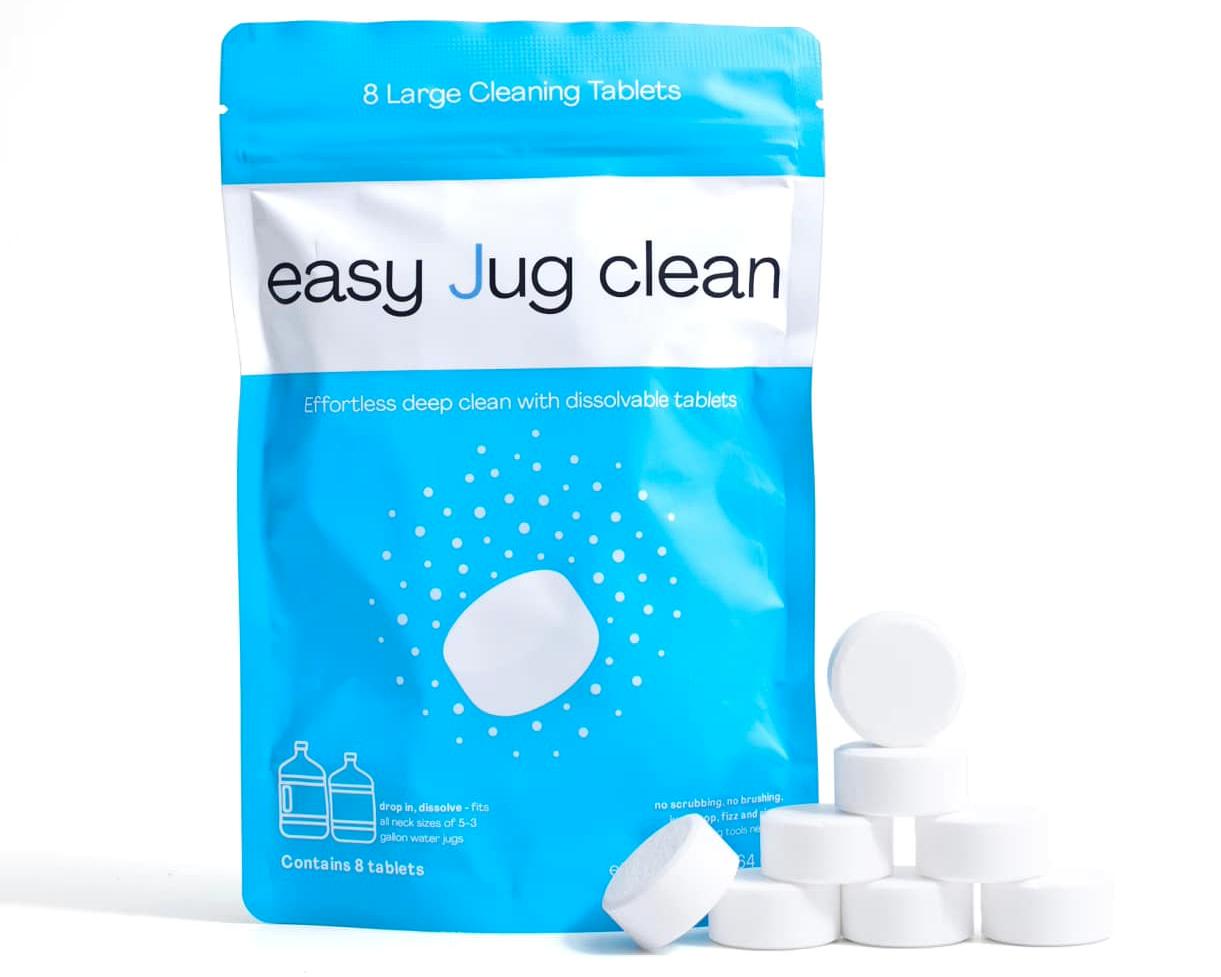
For everyday household use, a jug that's been on the dispenser or filled and waiting for more than 2–3 weeks should be cleaned before the water is consumed. When in doubt, the 2-tablet/20-minute Easy Jug Clean treatment before consuming stored water is the responsible choice.
Watch the right cleaning approach versus what a brush actually does to your jug:
✅ Clean It Right. Store It Right. Drink Safe Water Every Day.
Easy Jug Clean's 20-minute tablet treatment pairs perfectly with these storage best practices — together they keep your jug in genuinely clean condition between every refill.
Frequently Asked Questions
Q: Should I store a spare full jug upright or on its side?
Always upright. A 5 gallon jug stored on its side puts constant lateral pressure on the cap seal and increases the risk of slow seepage. Upright storage maintains the intended cap seal pressure and is the correct position for all standard 5 gallon water jug designs.
Q: If I have a full jug stored for several months, is the water still safe to drink?
If the jug was clean when filled, was properly sealed, and was stored in cool, dark conditions away from chemical contamination, the water is likely still safe — but an Easy Jug Clean treatment after emptying and before refilling is the right approach to return the jug to confirmed-clean status before the next fill cycle.


 Order now — get it by