How Long Does It Take for Biofilm to Form in a Water Jug?
Reading time: ~6 minutes | Biofilm Timeline Bacterial Colonization Water Safety
The Five-Stage Biofilm Formation Timeline
Stage 1: Reversible Attachment
Individual planktonic (free-floating) bacteria from the water or air come into contact with the jug surface and temporarily adhere. At this stage the bond is weak — simple rinsing can detach most bacteria. No visible change. No detectable odor. This stage begins immediately when bacteria are introduced into the jug environment.
Stage 2: Irreversible Attachment
Surface-attached bacteria begin secreting extracellular polymeric substances (EPS) — the polysaccharide matrix that anchors the colony permanently to the surface. After EPS secretion begins, simple rinsing cannot remove the bacteria. Chemical disruption of the EPS matrix is required. This transition — from reversible to irreversible — is the critical threshold that cleaning must interrupt before it occurs.
Stage 3: Microcolony Formation
Attached bacteria begin dividing and recruiting additional bacteria from the water column. The growing colony organizes into microcolonies — clusters with emerging internal structure. The EPS matrix thickens, providing increasing chemical resistance. At the end of this stage, the biofilm can resist concentrations of bleach and other sanitizers 10–1,000× higher than concentrations that kill free-floating bacteria of the same species.
Stage 4: Maturation I — Three-Dimensional Structure
The colony develops a three-dimensional architecture with water channels that distribute nutrients throughout the colony. Bacterial communication (quorum sensing) coordinates colony behavior. At room temperature, this stage completes in 48–72 hours. In warm kitchens or summer conditions, it can complete in as little as 24 hours. Mature biofilm at this stage requires specific oxidizing chemistry to penetrate — simple sanitizers at household concentrations fail to achieve penetration.
Stage 5: Maturation II — Dispersal-Ready Colony
The fully mature biofilm begins actively dispersing daughter bacteria into the water column — cells that detach from the colony and enter the water the jug holds. These dispersed cells are what you actually drink when you consume water from a biofilm-colonized jug. Dispersal is continuous once established, and the released bacteria include any pathogens present in the colony. Visual and olfactory detection may begin at this stage, but contamination has been occurring since Stage 4.
Why the 7-Day Cleaning Interval Is the Right Threshold
The biofilm formation timeline above — complete maturation in 48–72 hours at room temperature, active dispersal from Day 3 onward — makes the case for weekly cleaning based on contamination interruption rather than visual inspection. Cleaning weekly ensures that the cycle is interrupted at or before Stage 4 maturation, before dispersal into drinking water begins. Allowing the interval to extend to 10 or 14 days means drinking from a jug with an established, actively dispersing mature biofilm for 3–7 days before the next treatment.
Why Clean Jugs Re-Establish Biofilm So Quickly
One of the more frustrating discoveries for users who start a consistent cleaning routine is that a week feels very short — they just cleaned, and now it needs cleaning again already? The reason is that biofilm formation is continuous and inevitable in any water container at room temperature. The goal of weekly cleaning is not to achieve a state that lasts indefinitely, but to interrupt the cycle before it progresses to active dispersal. Every cleaning resets the clock to Hour 0. Every week that passes without cleaning advances through Stages 1–4.
Watch the right cleaning approach versus what a brush actually does to your jug:
✅ Interrupt the Cycle Before Stage 4. Every Week.
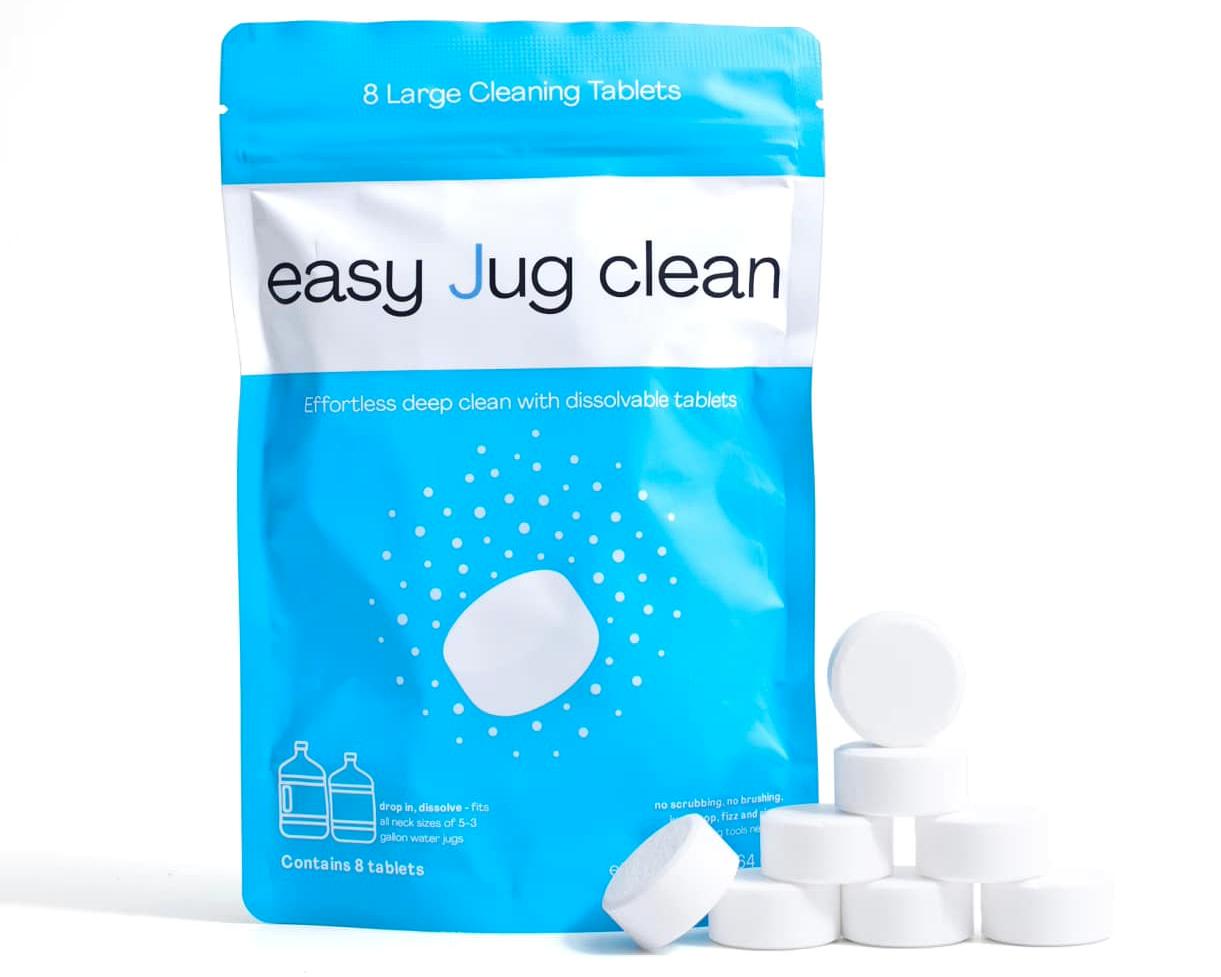
Easy Jug Clean's active oxygen breaks the biofilm formation cycle at the right moment — before maturation, before dispersal, before your water is contaminated.
Q: Can I tell if biofilm has reached Stage 4 or 5 by smell or appearance?
Not reliably. Early-stage biofilm is invisible and odorless. Stage 5 maturation may produce a faintly musty or earthy odor from bacterial metabolic byproducts, and advanced colonies produce the characteristic slippery feel on jug walls. But you cannot reliably detect Stages 1–4 by sense alone — which is why cleaning on schedule, rather than in response to visible or olfactory cues, is the appropriate approach.


 Order now — get it by