Why Does My Water Taste Like Plastic? 5 Gallon Jug Edition
Reading time: ~8 minutes | Water Taste Plastic Leaching 5 Gallon Jug
First: Is It Actually the Plastic, or Something Else?
The phrase "tastes like plastic" is how most people describe any off-taste from their water jug — but in the majority of cases, the actual plastic is not the primary culprit. This is an important distinction because it changes the fix entirely.
True plastic taste — caused by chemical compounds leaching from the jug material — is one of six possible causes, and it's actually one of the less common ones in modern, food-grade 5 gallon jugs. More frequently, what people describe as a "plastic taste" is actually:
- Bacterial metabolic byproducts from biofilm colonizing the interior surface
- Mineral compounds from hard water scale dissolving into the water
- Residual cleaning chemical compounds left from inadequate rinsing
- Actual plastic compound leaching — from UV damage, heat exposure, or jug age
Each of these has a different cause, a different profile, and a different fix. Let's go through all six systematically.
The 6 Causes of Plastic Taste in 5 Gallon Water Jug Water
This is the most common cause of off-taste in 5 gallon water jug water — and the one most people don't suspect because it doesn't look like anything is wrong. Biofilm bacteria produce volatile organic compounds (VOCs) as metabolic byproducts — specifically geosmin (an earthy/musty compound), 2-methylisoborneol (a camphor-like note), hydrogen sulfide (an eggy or stale smell), and various short-chain fatty acids. These compounds are detectable by the human nose and palate at extremely low concentrations — in the parts per trillion range for some of them.
The result is water that smells and tastes subtly wrong — often described as musty, earthy, stale, flat, or "like an old water bottle." The compounds dissolve into your water from the biofilm-colonized surface and are present even in freshly filled water because the source is the jug surface, not the water itself.
How to diagnose it: Run your finger along the inside wall of the jug near the bottom. If it feels slippery or slimy rather than smooth, biofilm is the cause. If the taste is earthy, musty, or stale rather than chemical, biofilm VOCs are the primary culprit.
A brand-new 5 gallon water jug — whether polycarbonate, Tritan, or HDPE — has a characteristic plastic smell and taste that dissipates with use and cleaning. This is off-gassing: the release of residual monomers, plasticizers, and manufacturing process compounds from the plastic material. It's not a sign of a defective jug — it's a normal property of new plastic that diminishes quickly with proper treatment.
The taste is typically described as distinctly chemical, slightly sweet, or reminiscent of a new shower curtain. It is most pronounced in the first few fills and usually resolves within 1–3 proper cleaning cycles.
How to diagnose it: The jug is new or recently purchased and the plastic taste was present from the first use. It doesn't have the earthy/musty quality of biofilm VOCs — it's cleaner and more chemical in character.
Mineral scale deposits — primarily calcium and magnesium carbonates — don't just cloud the walls of your jug. As the scale layer thickens, it begins to affect the taste of water stored in contact with it. Calcium carbonate itself is relatively tasteless, but magnesium compounds can impart a faintly bitter or metallic note. More significantly, scale surfaces harbor biofilm more aggressively than smooth plastic — so a scaled jug usually also has a biofilm problem contributing to the off-taste.
Users in very hard water areas sometimes describe their water as slightly chalky, faintly bitter, or just "heavy" compared to softer water. These are the signatures of mineral compound dissolution into the water column.
How to diagnose it: The jug walls look cloudy or have visible white deposits. The taste has a faint chalky or mineral quality. More common in households in hard water regions (Midwest, Southwest, Texas, Florida).
This is the cause most people never attribute to their cleaning routine — but it's extremely common. Dish soap surfactants, bleach, and vinegar all leave residues inside a 5 gallon jug when not thoroughly rinsed. The narrow neck makes complete rinsing genuinely difficult, and most people underestimate how much residue clings to the plastic even after what feels like adequate rinsing.
Dish soap residue produces a faint soapy, slightly chemical taste that becomes more noticeable as water sits in the jug. Bleach residue creates a distinctly chemical, slightly chlorinated taste — the same quality as over-chlorinated pool water. Vinegar residue acidifies the water slightly and produces a faint sour or acidic note. Each is a distinct signature of the wrong cleaning chemistry being used in a container that is difficult to rinse completely.
How to diagnose it: The taste appeared or worsened after a cleaning session. The character of the taste correlates with what you used to clean — soapy, chlorinated, or sour/acidic.
This is where actual plastic leaching becomes relevant. Polycarbonate and HDPE plastics — the materials used in most 5 gallon water jugs — are stable under normal conditions, but both are susceptible to degradation when exposed to UV light (sunlight) or high temperatures. Degradation breaks down the polymer chains, releasing small organic molecules including aldehydes, ketones, and — in older polycarbonate jugs — residual bisphenol A (BPA) compounds.
How to diagnose it: The jug has been stored in direct sunlight, a hot car, a warm garage, or near a heat source. The taste is distinctly chemical and plastic — not earthy or mineral — and worsens over time even with regular cleaning. If the jug is old (5+ years) or has visible hazing or crazing of the plastic surface, degradation is likely a contributing factor.
All plastic has a service life. Even with proper storage and regular cleaning, a 5 gallon water jug's plastic gradually degrades over years of use — the polymer chains break down incrementally, the surface develops micro-fractures, and the material's ability to contain its chemical components without leaching slowly diminishes. The result is water that develops a persistent plastic taste regardless of how meticulously the jug is cleaned.
For most well-maintained 5 gallon jugs, this end-of-life degradation becomes detectable at around 3–5 years for polycarbonate and 5–7 years for high-quality HDPE. Jugs that have been regularly cleaned with harsh chemicals — bleach in particular — reach this point faster because bleach accelerates polymer degradation with each treatment.
How to diagnose it: The jug is several years old. The plastic taste persists even after thorough Easy Jug Clean treatment and multiple rinsing cycles. The plastic surface has visible hazing, cloudiness that doesn't clear after chelation treatment, fine surface cracks (crazing), or significant discoloration.
Quick Diagnosis: Which Cause Is Your Problem?
| How the taste is described | Most Likely Cause | Severity |
|---|---|---|
| Musty, earthy, stale, "old water bottle" | Biofilm VOCs (Cause 1) | Immediate clean needed |
| Chemical, new, slightly sweet — brand new jug | Off-gassing (Cause 2) | 1–2 cleaning cycles |
| Chalky, faintly bitter, mineral, "heavy" | Hard water scale (Cause 3) | Descaling needed |
| Soapy / chlorinated / sour after cleaning | Cleaning residue (Cause 4) | Switch cleaning method |
| Chemical plastic — jug stored in sun or heat | UV / heat degradation (Cause 5) | Relocate jug + clean |
| Persistent plastic taste — old jug, won't clear | End-of-life degradation (Cause 6) | Replace the jug |
The Most Overlooked Factor: Your Cleaning Method Might Be Causing the Taste
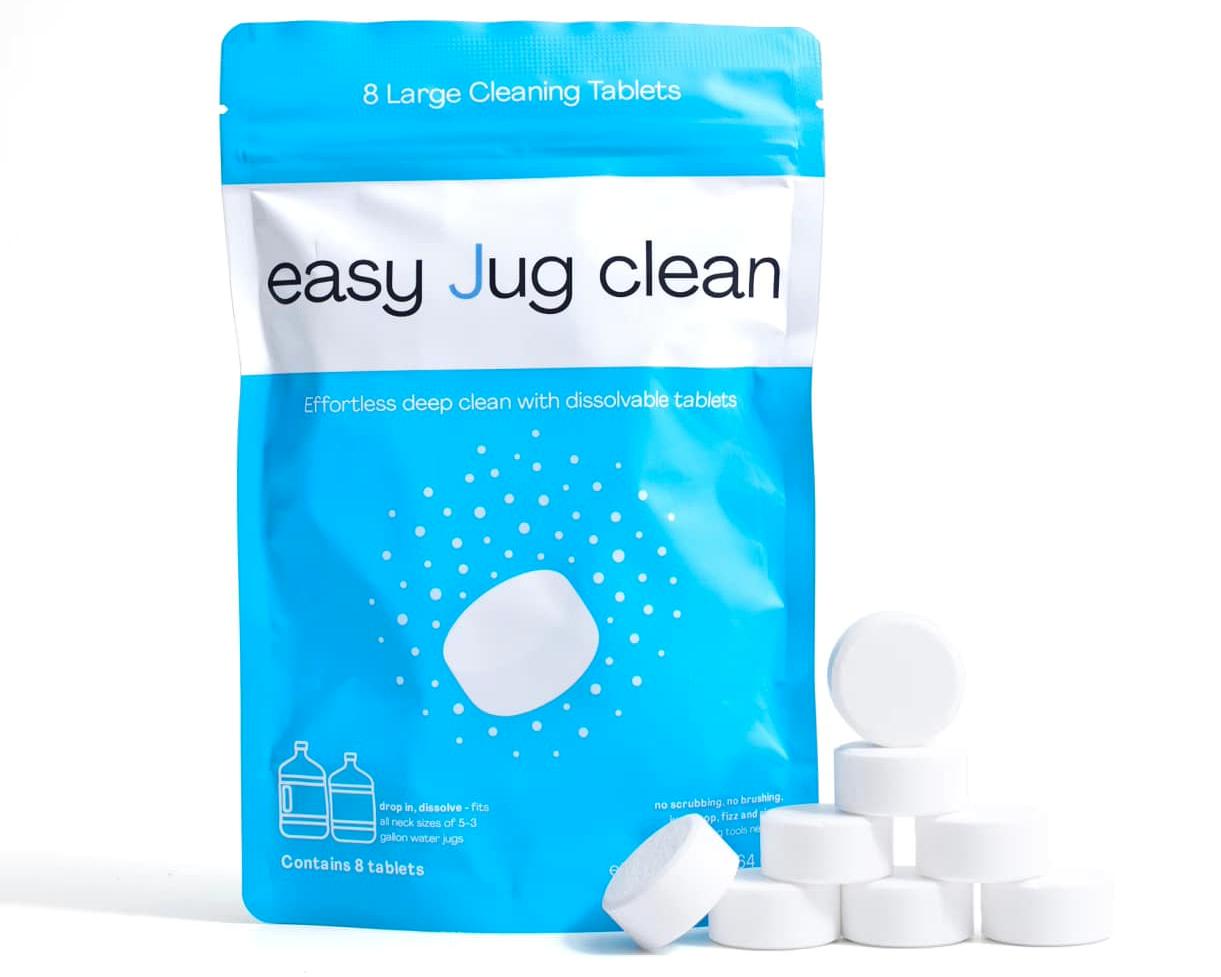
This is one of the most important reasons why the chemistry of your cleaning product matters as much as its effectiveness. A food-grade, residue-free formula like Easy Jug Clean doesn't just clean better — it removes a potential taste contamination source entirely. When the cleaning chemistry breaks down into water and oxygen, there's nothing left to taste.
See how Easy Jug Clean cleans a 5 gallon water jug in 20 minutes — no scrubbing required:
✅ Water That Tastes Like Nothing — Which Is Exactly Right
Easy Jug Clean eliminates all three of the most common causes of plastic taste: biofilm VOCs, mineral scale, and cleaning residue. Food-grade ingredients. No chlorine. No surfactant residue. Just clean water that tastes the way clean water should.
Preventing Plastic Taste: The Storage and Cleaning Standard
Avoiding plastic taste in your 5 gallon water jug comes down to three principles working together:
- Clean weekly with the right chemistry. A weekly Easy Jug Clean treatment prevents biofilm from establishing and mineral scale from accumulating — addressing the two most common causes of off-taste before they reach detectable levels.
- Store correctly. Keep your jug in a cool, dark location away from direct sunlight and heat sources. UV and heat are the primary environmental accelerants of plastic degradation. A jug stored on a sunny countertop ages years faster than one kept in a cabinet or pantry.
- Know when to replace. A well-maintained jug with proper cleaning and correct storage should give you 5–7 years of service without plastic taste issues. When the taste becomes persistent despite proper cleaning, the jug has reached end of life and replacement is the correct answer.
A Note on BPA and Modern 5 Gallon Water Jugs
For years, BPA (bisphenol A) in polycarbonate plastic was a major concern for water jug users — it's an endocrine-disrupting compound that can leach from polycarbonate in small amounts, particularly when the plastic is old, scratched, or exposed to heat. The good news: virtually all 5 gallon water jugs sold today are manufactured from BPA-free materials — either BPA-free polycarbonate, Tritan copolyester, or HDPE (high-density polyethylene), none of which contain BPA.
If your current jug is older (pre-2012) and made from traditional polycarbonate, BPA leaching could be contributing to a chemical plastic taste — and replacement with a modern BPA-free jug is strongly advised regardless of cleaning routine.
Frequently Asked Questions
Q: Is plastic taste in water harmful?
It depends on the cause. Biofilm VOCs are produced by bacteria that may be harmful, particularly to vulnerable individuals. Cleaning chemical residues (bleach, soap) can cause GI irritation. BPA from old polycarbonate jugs is a documented endocrine disruptor. Mineral taste from hard water scale is mostly harmless but indicates a jug maintenance problem. Pure plastic off-gassing from a new jug is generally low-risk but unpleasant. Any persistent plastic taste is worth investigating and addressing.
Q: Will rinsing my jug multiple times before using it remove plastic taste?
For new jug off-gassing (Cause 2), multiple rinses help but an Easy Jug Clean treatment before first use is significantly more effective. For other causes, rinsing alone does not address the underlying issue — biofilm is surface-bonded, scale is chemically attached, and degradation residues migrate from within the plastic. Rinsing treats the symptom; addressing the root cause requires the right cleaning chemistry.
Q: My water tastes fine until it has been sitting in the jug for a day or two — what's causing that?
This is almost certainly biofilm VOC production (Cause 1). Freshly filled water hasn't yet had time to absorb the metabolic byproducts from bacteria on the jug surface — but after sitting for 24–48 hours, sufficient VOCs dissolve into the water to become detectable. It's the same principle as water in a glass tasting "stale" after sitting overnight, but amplified by the biofilm present in a cleaned-but-not-properly-sanitized jug.
Q: I cleaned my jug with bleach and now the water tastes chemical — is it safe?
Chlorine residue in water is unpleasant but at very low levels isn't immediately harmful for healthy adults. Perform an Easy Jug Clean treatment followed by three complete rinse cycles to neutralize and flush the chlorine residue. Going forward, Easy Jug Clean's food-grade formula eliminates the residue risk entirely because its breakdown products are water and oxygen — nothing with a chlorine signature.


 Order now — get it by