Is Your Water Jug Cleaner Safe if Your Pet Drinks the Water?
Pet SafetyAnimal WaterResidue Concerns · Reading time: ~7 minutes
The Sensitivity Factors That Make This Matter for Pets
Two characteristics of pets make water quality and chemical residue more significant for them than for adult humans consuming the same water. First, body weight concentration effects: a 10-pound cat consuming 100ml of water with 1ppm of a chemical compound is receiving the equivalent of a 150-pound human drinking 1.5 liters of the same water. Lower body mass amplifies any residue concentration. Second, grooming behavior: cats and some dogs that groom their paws after drinking from treated surfaces absorb additional topical exposure that bypasses the dilution of stomach contents — relevant for any surfactant or chemical residue that deposits on fur or paws at the water bowl.
Common Cleaning Agents — Pet Safety Assessment
The concern: Free chlorine residue above the EPA MCL for drinking water (4 ppm) can cause gastrointestinal irritation in dogs and cats at lower thresholds than in humans. Organochlorine compounds from bleach-plastic interaction are not studied in veterinary toxicology at trace exposure but represent an incompletely characterized risk. More practically: cats are known to avoid water sources with a chlorine smell, which means a jug cleaned with bleach and inadequately rinsed may cause your cat to reduce water intake — a serious concern for feline kidney health and urinary tract health.
Small animals (birds, rodents, rabbits): These species have significantly smaller body mass and higher metabolic sensitivity to chemical compounds. Avian species in particular are extremely sensitive to airborne compounds and many chemical residues — the same caution applies to water source cleanliness. Bleach residue in water sources for small caged animals is a meaningful veterinary concern.
Surfactant residue from dish soap in drinking water can cause gastrointestinal upset in dogs and cats at low concentrations — loose stool, vomiting, and reduced water intake are reported effects in veterinary literature. Cats are particularly sensitive to certain surfactant classes because they lack some of the liver enzymes (particularly glucuronyl transferases) that metabolize synthetic organic compounds that are well-tolerated by dogs and humans. The ASPCA Poison Control lists anionic detergents as causing mild-to-moderate gastrointestinal toxicity in cats at low concentrations.
Acetic acid at food-use concentrations is generally safe for pets at incidental dietary exposure. The primary concern is behavioral rather than toxicological: cats strongly dislike the smell and taste of vinegar — it is, in fact, used as a cat repellent. A jug with vinegar residue that cannot be fully rinsed may cause your cat to avoid the water source entirely, choosing to drink less water overall. Reduced water intake in cats is a risk factor for urinary tract disease and chronic kidney disease.
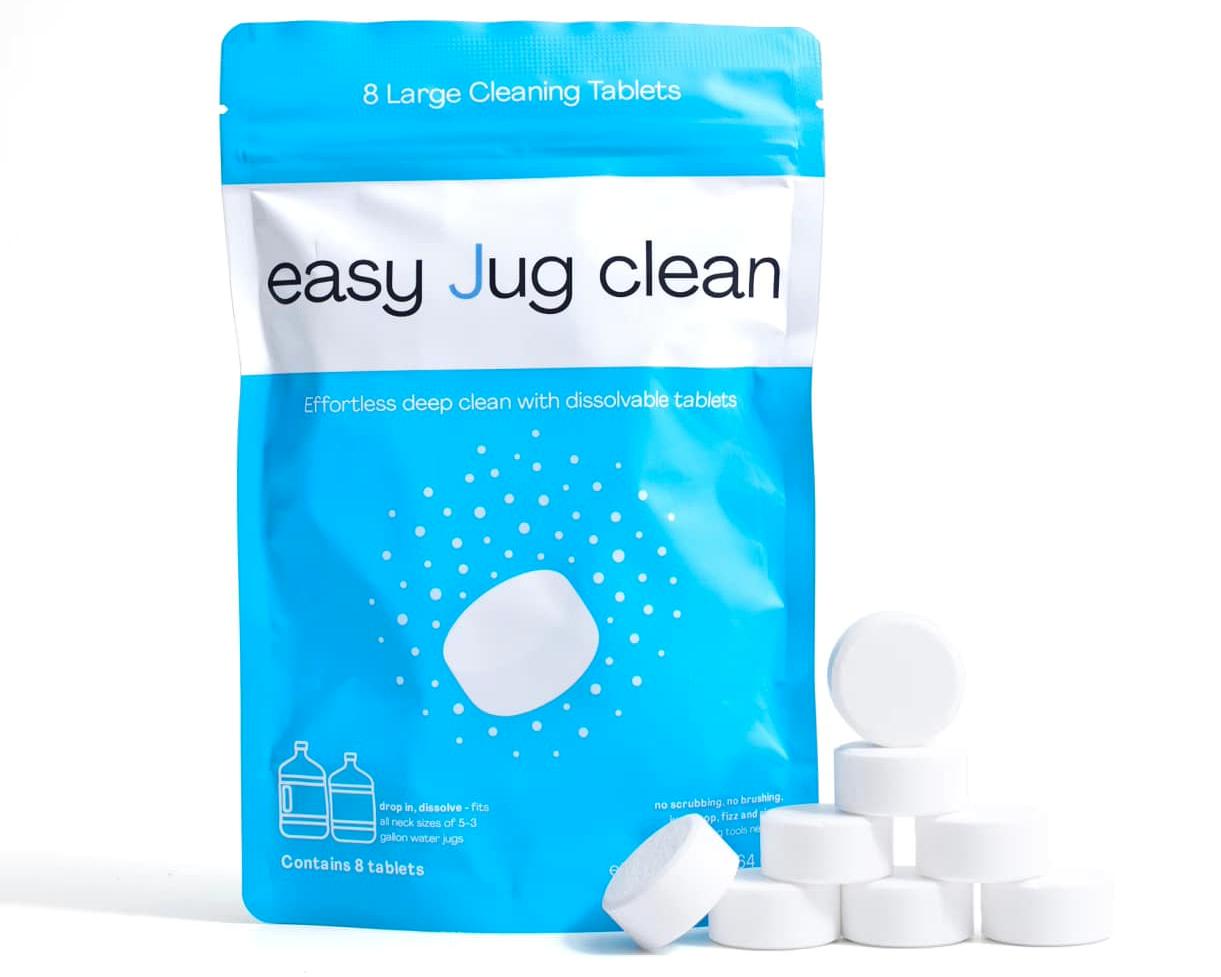
Why it's the right choice for pet households: Sodium percarbonate is widely used and explicitly recommended in veterinary guidance for sanitizing pet water bowls, bird baths, and animal waterers. Its breakdown products — water, oxygen, and sodium carbonate — are present in many pet-safe cleaning contexts. Sodium carbonate is used in aquarium pH adjustment (sodium carbonate is a component of many aquarium buffers). The cocoyl glucoside surfactant in Easy Jug Clean is as safe for pets as for human infants — it's used in pet-safe grooming products. The chelating agents (sodium citrate and sodium gluconate) are food-safe compounds with no veterinary toxicology concerns at water residue levels.
Confirmed applications: Sodium percarbonate tablets are used by veterinarians and humane shelters for sanitizing communal water bowls specifically because of their combination of effective sanitization and complete safety for subsequent animal water consumption.
Species-Specific Sensitivity Reference
| Pet Species | Bleach Residue | Dish Soap Residue | Vinegar Residue | Easy Jug Clean Residue |
|---|---|---|---|---|
| Dogs | Low concern at trace levels | Mild GI risk at higher residue | Safe; may cause taste rejection | Safe — veterinarian-confirmed |
| Cats | Taste rejection; small body mass risk | Moderate concern — metabolic sensitivity | Strong taste rejection; hydration risk | Safe — used in shelter protocols |
| Birds (avian) | High concern — airborne + water sensitivity | Use caution — avian GI sensitivity | Low concern at diluted levels | Safe — birdbath use confirmed |
| Small mammals (rabbit, guinea pig, hamster) | Use caution — smaller mass amplifies concentration | Use caution — residue sensitivity | Safe at trace levels | Safe — common in small animal husbandry |
| Reptiles | High concern — direct absorption through skin in water | Use caution | Use caution in soaking water | Safe — used in reptile enclosure cleaning |
Watch the right cleaning approach versus what a brush actually does to your jug:
✅ Safe for Every Member of Your Household — Including the Furry Ones
Q: How soon after an Easy Jug Clean treatment can I refill the jug and use it as a pet water source?
After completing the standard protocol — soak 20–30 minutes, rinse 2–3 times with clean water, invert to dry — the jug is safe to refill for both human and pet use immediately. No extended waiting period is required. The active chemistry has fully converted to food-safe breakdown products before the soak completes, and rinsing removes any remaining dissolved sodium carbonate to below detectable concentrations.
Q: Can I use Easy Jug Clean directly in my pet's water bowl or fountain?
Yes — this is one of the established applications for sodium percarbonate-based cleaning tablets. For a standard pet water bowl, use 1 tablet dissolved in warm water as a soak treatment. For pet water fountains with multiple components, disassemble and treat each component individually with a 1-tablet solution. Rinse thoroughly and refill with fresh water before returning to pet use.


 Order now — get it by