The Real Limits of Vinegar as a Water Jug Cleaner
By the Easy Jug Clean Research Team
Reading time: ~5 minutes | Vinegar Cleaning Limits Acetic Acid
Vinegar has legitimate chemistry. Acetic acid genuinely reacts with certain substances and has real household cleaning applications. The problem is that "has some effect" and "is the right tool for a water jug" are very different claims — and the specific requirements of cleaning a 5 gallon drinking water container expose vinegar's precise chemical limitations with uncomfortable clarity. Here, mapped across every cleaning task, is exactly where vinegar works and exactly where it stops.
Vinegar's Cleaning Capabilities: The Precise Boundary Map
Light calcium deposits (fresh)
PARTIAL Acetic acid reacts with calcium carbonate (CaCO₃ + 2CH₃COOH → Ca(CH₃COO)₂ + H₂O + CO₂). Fresh, thin deposits dissolve partially with extended soaking. Heavy or bonded scale requires longer exposure times than practical and more concentrated acid than household vinegar provides.
Heavy hard water scale
FAILS Established crystalline scale layers are resistant to 5% acetic acid at practical soak times. The acid dissolves the outer surface slowly but cannot penetrate fully to the substrate bond within a single cleaning session.
Biofilm EPS matrix
FAILS The polysaccharide EPS matrix is not acid-soluble at vinegar concentrations. Acetic acid cannot penetrate the matrix to reach bacteria within. Biofilm bacteria survive vinegar exposure and re-establish after treatment.
Free-floating bacteria (sanitizing)
FAILS 5% acetic acid is not classified as a sanitizer by the EPA and does not achieve 99.9% pathogen reduction. Studies confirm common waterborne pathogens survive household vinegar exposure at typical contact times.
Odor elimination
PARTIAL Vinegar neutralizes some organic acids that contribute to musty odors. It does not oxidize VOC compounds and cannot eliminate odors caused by active bacterial metabolism. Smell may temporarily improve then return as bacteria resume activity.
Residue-free rinsing
FAILS Acetic acid has mild plastic affinity and is difficult to fully rinse from a narrow-neck 5 gallon container. Residual acid alters water taste and slightly acidifies the water content of the next fill.
Surface protection
NONE Vinegar provides no surface conditioning or protective function. Repeated acid exposure on polycarbonate can contribute to minor surface haze over extended periods.
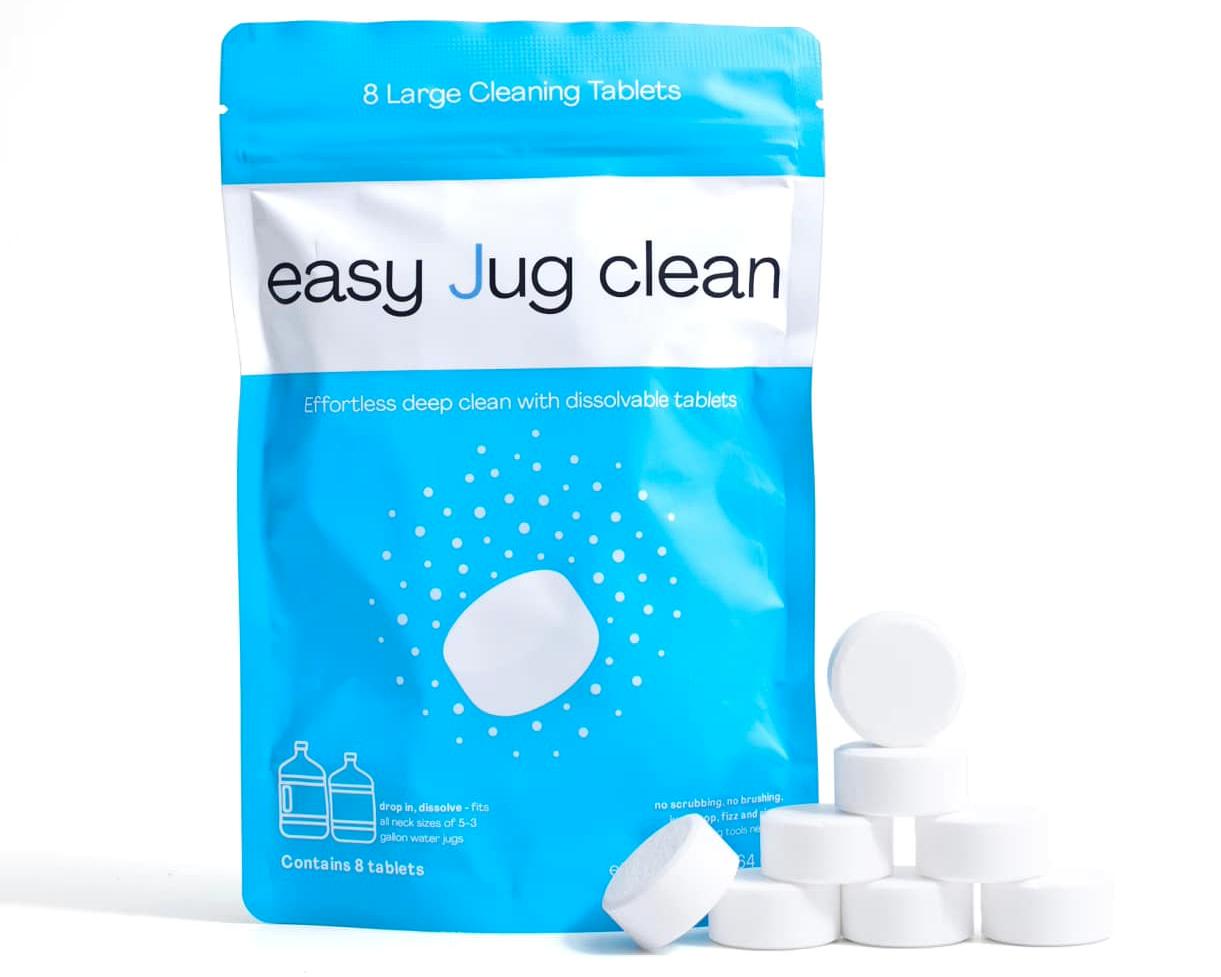
✅ What vinegar should be replaced with: Easy Jug Clean addresses every vinegar failure point — sodium percarbonate for sanitizing and biofilm destruction, sodium citrate and gluconate for complete scale chelation, plant-based surfactants for organic residue, glycerin for surface protection, and food-grade breakdown products that require no special rinsing. The complete solution in a single tablet, in 20 minutes.
See how Easy Jug Clean cleans a 5 gallon water jug in 20 minutes — no scrubbing required:


 Order now — get it by