What Is a Chelating Agent and Why Does Your Water Jug Need One?
ChelationMineral RemovalSodium Citrate · Reading time: ~7 minutes
Chelation Explained: The Molecular Claw Mechanism
The practical analogy:
Imagine a pair of molecular pliers that can grab onto a specific type of atom (calcium or magnesium), hold it tightly, and carry it into solution away from the surface where it was deposited. The pliers are the chelating agent — "chelate" comes from the Greek word for "claw." The mechanism works because the chelating molecule has multiple electron-donating groups arranged in space so they can simultaneously coordinate to (grip) a single metal ion, forming a very stable ring-shaped complex. Once in this complex, the metal ion stays in solution rather than re-precipitating onto the surface — the chelating agent effectively keeps the mineral dissolved and available for rinsing.
Acid-Based Descaling vs. True Chelation — Why They're Different
⚗️ Acid-Based Descaling (Vinegar, Citric Acid)
- Works by protonating carbonate ions: CaCO₃ + 2H⁺ → Ca²⁺ + H₂O + CO₂
- Requires acidic pH (below 7) to be effective
- Effectiveness drops as pH rises during the reaction
- Re-precipitation occurs as acid is consumed and pH rises
- Works against soft, fresh scale; ineffective against crystalline, old deposits
- Cannot be combined with pH-sensitive active oxygen chemistry
✅ True Chelation (Sodium Citrate, Sodium Gluconate)
- Works by metal ion coordination: chelate + Ca²⁺ → stable Ca-chelate complex
- Effective across a wide pH range, including the alkaline range optimal for active oxygen
- Maintains effectiveness throughout the soak as chelate-metal complexes are stable
- Prevents re-precipitation — chelated minerals stay in solution
- Penetrates into crystalline scale deposits by ion diffusion
- Fully compatible with simultaneous active oxygen sanitization
Why Easy Jug Clean Uses Two Chelating Agents
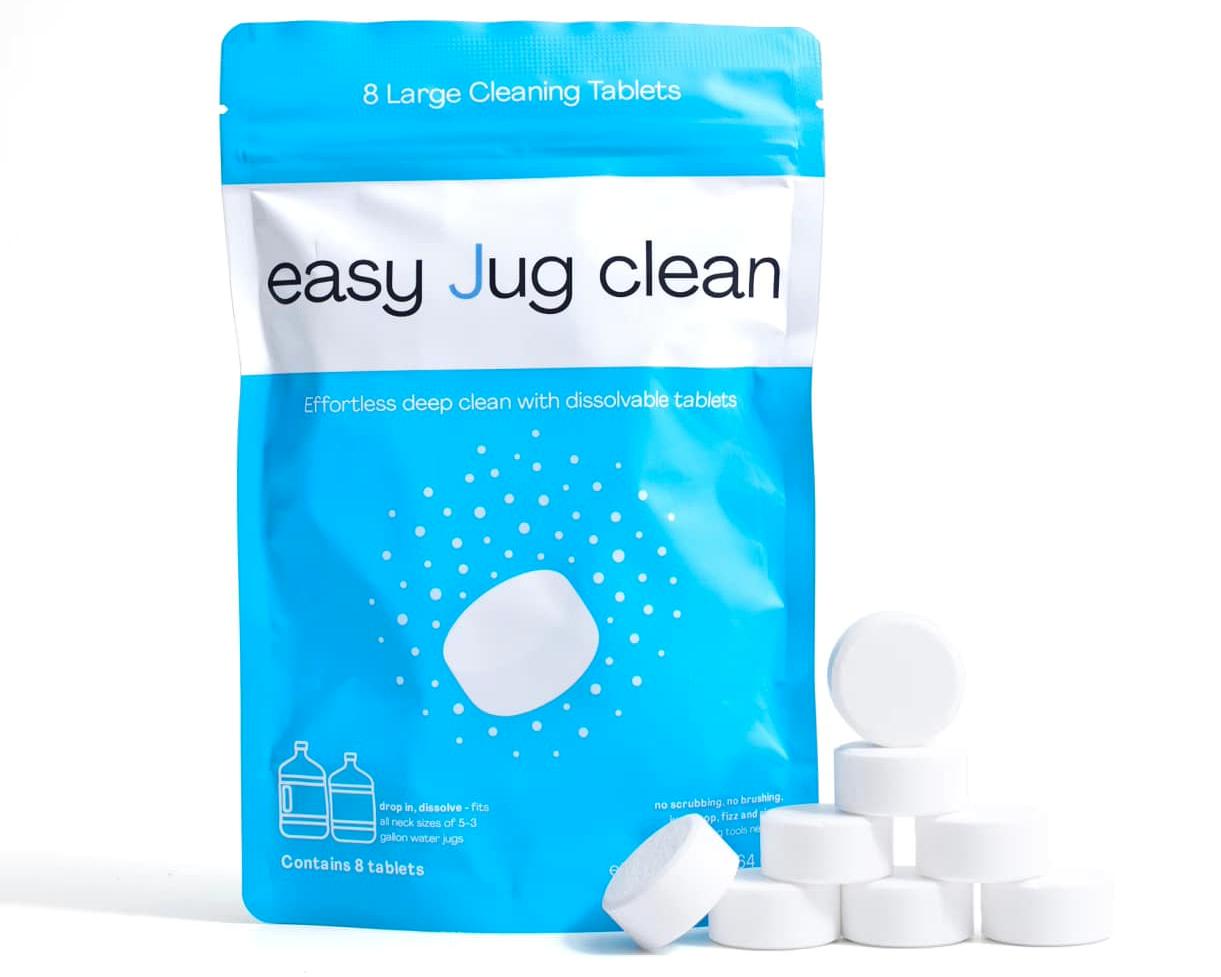
Easy Jug Clean contains both sodium citrate and sodium gluconate — not because either is inadequate alone, but because they have complementary metal-binding preferences that together provide broader coverage against the mineral profile of hard water.
Sodium citrate (the sodium salt of citric acid) is particularly effective at chelating calcium ions — the primary component of calcium carbonate scale. Its three carboxylate groups and one hydroxyl group form strong tetradentate coordination complexes with Ca²⁺. It is food-safe (used as a food additive E331), rapidly biodegradable, and produces citrate residues that are harmless at any trace level after rinsing.
Sodium gluconate targets a broader range of divalent and trivalent metal ions — including calcium, magnesium (the secondary hard water ion), iron, and manganese. It also has a secondary function as a corrosion inhibitor for metallic surfaces in the dispenser system that water contacts. Its six-carbon polyhydroxy structure provides multiple coordination sites that adapt to different metal ion geometries.
Together, these two chelating agents address the full mineral profile of hard water scale — calcium carbonate, magnesium carbonate, and trace iron or manganese deposits — with food-safe chemistry that works within the same pH and temperature range as the active oxygen and surfactant components.
Watch Easy Jug Clean dissolve scale and odor buildup in a single 20-minute treatment:
✅ The Only Consumer Jug Cleaner With True Chelating Chemistry
Q: Is chelated calcium in my rinse water safe to drink?
Yes — calcium citrate and calcium gluconate are both food-safe compounds. Calcium citrate is used as a dietary calcium supplement. Calcium gluconate is used in intravenous medical applications. Any trace chelate-mineral complexes remaining after rinsing are genuinely food-safe at the concentrations possible in a 5-gallon jug after thorough rinsing.


 Order now — get it by