Can You Use Hydrogen Peroxide to Sanitize a 5 Gallon Water Jug?
Reading time: ~6 minutes | Hydrogen Peroxide Sanitizing Options Water Jug Safety
The Chemistry: Where Hydrogen Peroxide Genuinely Works
Hydrogen peroxide achieves sanitization through free radical generation — it decomposes into water and oxygen (H₂O₂ → H₂O + O) while producing reactive oxygen species that oxidize bacterial cell membranes and EPS biofilm matrix components. At sufficient concentration and contact time, it achieves the 5-log pathogen reduction standard. It has no chlorine, leaves no toxic residue, and breaks down into water and oxygen — genuinely food-safe in principle.
These properties make it an attractive candidate for water container sanitization. The complications arise in the implementation details.
✅ What Works in Its Favor
- Genuine oxidizing sanitizer — real efficacy against bacteria and biofilm
- No chlorine — no trihalomethane formation concern
- Breaks down into water and oxygen — food-safe residue in principle
- Self-distributing in liquid form — covers full jug interior when used as soak
- Available commercially at food-grade concentrations (3%)
❌ The Practical Complications
- 3% household concentration may be insufficient for established biofilm penetration without extended soak (60+ minutes)
- No chelating action — no mineral scale removal
- No surfactant — does not lift disrupted organic debris from surface
- Concentration degrades rapidly in light and at room temperature — shelf-unstable product
- Higher concentrations (6–12%) create handling hazards
- Requires careful dosing — no pre-calibrated consumer format for jug use
The Biofilm Penetration Problem at 3% Concentration
Household hydrogen peroxide is sold at 3% concentration — appropriate for wound disinfection and surface sanitization with short contact times. For established biofilm, which has chemical resistance levels 10–1,000× higher than free-floating bacteria, 3% H₂O₂ requires substantially longer contact time to achieve equivalent penetration compared to higher-concentration applications used in commercial settings.
Research on biofilm resistance to hydrogen peroxide demonstrates that 3% concentration can reduce mature biofilm populations, but typically requires 60+ minutes of sustained contact for effective reduction — and does not necessarily achieve the 5-log reduction standard in all biofilm configurations. The practical consequence: using 3% hydrogen peroxide as a weekly jug sanitizer requires a substantially longer soak time than most users will maintain consistently.
Hydrogen peroxide has real limitations when it comes to contact time, concentration stability, and residue in a 5 gallon container. For the recommended sanitizing approach for a 5 gallon jug, the bar is higher.
The Missing Elements: Scale and Surfactant
Hydrogen peroxide addresses the biological contamination in a jug — bacteria and biofilm. It does not address mineral scale, because oxidizing chemistry has no mechanism for dissolving calcium carbonate or magnesium carbonate deposits. And it does not have a surfactant component to lift and suspend the organic debris left after biofilm oxidation.
This means a hydrogen peroxide treatment used as a standalone jug sanitizer leaves mineral scale intact. As documented in our biofilm vs. scale article, scale provides shelter for bacteria that recolonize faster on rougher, mineral-coated surfaces. A sanitizer that doesn't address scale solves half the problem.
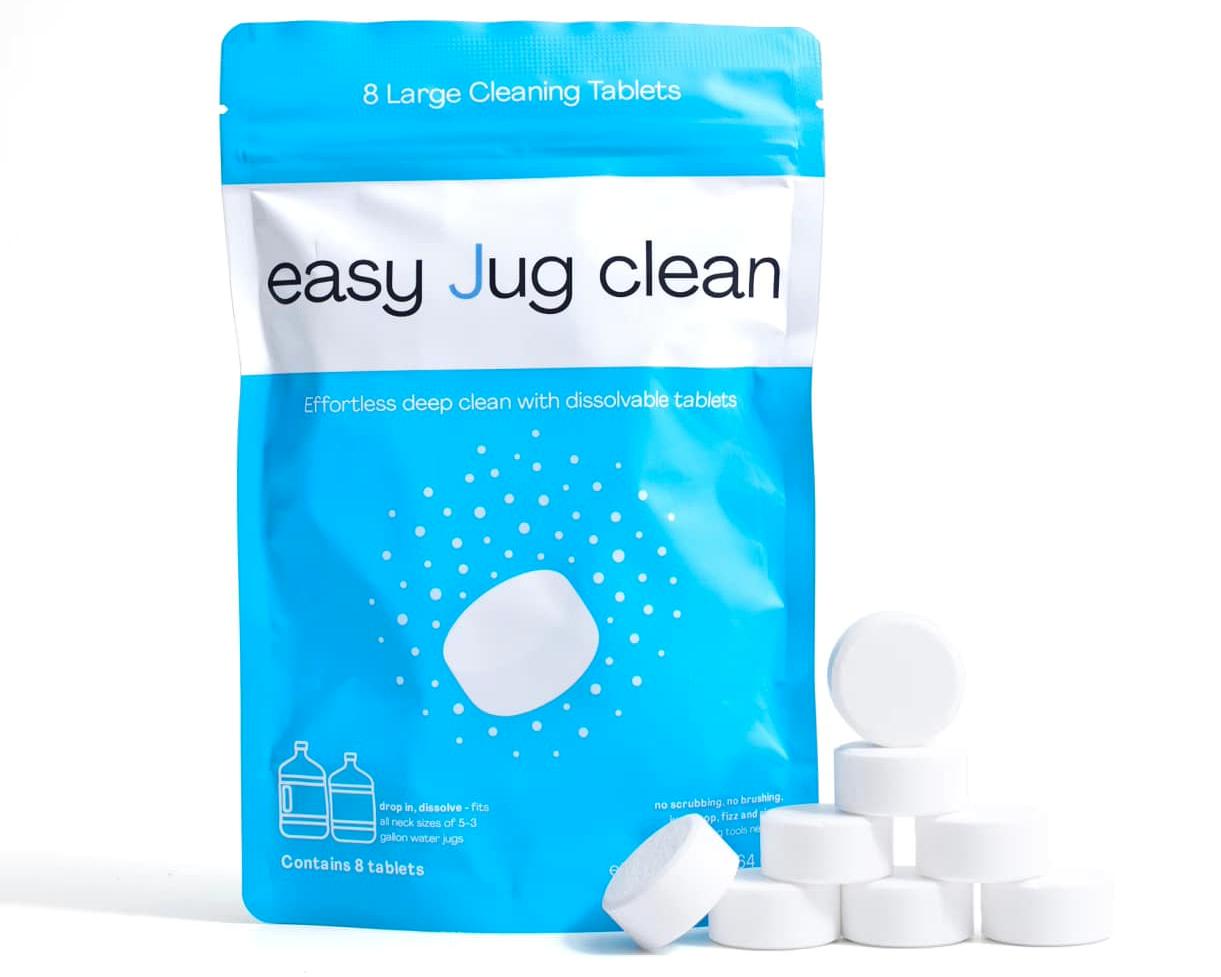
Watch Easy Jug Clean's active oxygen sanitize a 5 gallon water jug without scrubbing:
✅ All the Benefit of Peroxide Chemistry — Plus Everything It Doesn't Do
Q: What concentration of hydrogen peroxide is needed to effectively sanitize a 5 gallon water jug?
Studies suggest 3–6% concentration with 30–60 minutes contact time for meaningful biofilm reduction. Food-grade 3% is the safest option for drinking water containers; concentrations above 6% create handling hazards and require extremely thorough rinsing. For most households, the variable concentration and handling requirements make pre-formulated sodium percarbonate tablets a more practical and consistent option.


 Order now — get it by