What Is Biofilm in Water Jugs and Why Is It Dangerous?
Reading time: ~8 minutes | Water Safety Biofilm 5 Gallon Jug
Biofilm 101: What It Actually Is
The word "biofilm" sounds clinical, but the concept is something most of us have experienced without knowing the name. The slippery surface of a river rock. The coating inside a vase left with water for too long. The residue inside a water bottle you forgot in your gym bag for a week. All of these are biofilm.
In scientific terms, a biofilm is a structured community of microorganisms — primarily bacteria — that have attached to a surface and enclosed themselves in a self-produced matrix of extracellular polymeric substances (EPS). That matrix is the key to understanding why biofilm is so different from ordinary bacterial contamination, and why it's so hard to remove.
How Biofilm Forms in a 5 Gallon Water Jug: A Timeline
The progression from a freshly cleaned jug to a biofilm-colonized one happens faster than most people realize — and in conditions that are nearly impossible to avoid in normal jug use.
Why Biofilm Is Dangerous: The Health Risks You Need to Know
Not all biofilm bacteria are immediately pathogenic — some are relatively harmless nuisance organisms. But the structural properties of biofilm create danger regardless of which specific bacteria are present.
1. It Protects Dangerous Bacteria From Your Immune System and Water Treatment
2. Biofilm Creates a Reservoir for Harmful Pathogens
Established biofilm communities act as a reservoir that can harbor and protect pathogens including Legionella pneumophila (the bacterium responsible for Legionnaires' disease), Pseudomonas aeruginosa (a significant concern for immunocompromised individuals), E. coli variants, and opportunistic oral bacteria. These pathogens may enter the jug in very low numbers through normal use — and biofilm provides exactly the protected environment they need to establish, grow, and periodically release into the water column.
3. It Degrades Water Quality Even Without Causing Acute Illness
4. It Is Particularly Risky for Vulnerable Household Members
While healthy adults may tolerate low-level biofilm exposure without dramatic consequence, the same exposure carries meaningfully greater risk for infants and young children, elderly individuals with reduced immune function, anyone undergoing chemotherapy or immunosuppressive therapy, and people recovering from illness. For these household members, a biofilm-colonized water jug is not just unpleasant — it represents a genuine health hazard that standard cleaning routines routinely fail to address.
5. Biofilm Produces Taste and Odor Compounds
Even in the absence of harmful pathogens, biofilm bacteria produce volatile organic compounds (VOCs) as metabolic byproducts — specifically compounds like geosmin, 2-methylisoborneol, hydrogen sulfide, and short-chain fatty acids. These are the molecules responsible for the musty, earthy, stale, or "wet" smell and taste that develops in jugs that haven't been properly cleaned. These compounds cling to the plastic surface at a molecular level and cannot be removed by rinsing alone — which is why the smell returns quickly after a simple water rinse even when the jug looks visibly clean.
Why Standard Cleaning Methods Don't Remove Biofilm
Understanding why biofilm is so resistant to ordinary cleaning explains why so many people feel like they're cleaning their jug regularly but still dealing with the same problems.
The Only Thing That Actually Removes Biofilm: Chemistry That Penetrates the Matrix
True biofilm removal requires an agent that doesn't just contact the surface of the EPS matrix but chemically degrades it — breaking down the polymers that form the protective shield and exposing the bacteria within to lethal conditions. There are two categories of chemistry that can achieve this:
- Oxidizing agents — compounds that release reactive oxygen or chlorine species capable of degrading the EPS polymer structure (chlorine bleach, hydrogen peroxide, sodium percarbonate)
- Enzymatic treatments — agents that break down specific components of the EPS matrix (proteases for proteins, amylases for polysaccharides)
Chlorine bleach works — but at the cost of chlorine residue, plastic degradation, and handling hazards that make it inappropriate for regular use inside a drinking water container. Hydrogen peroxide works partially, at concentrations higher than household 3% and with longer contact times than most people allow.
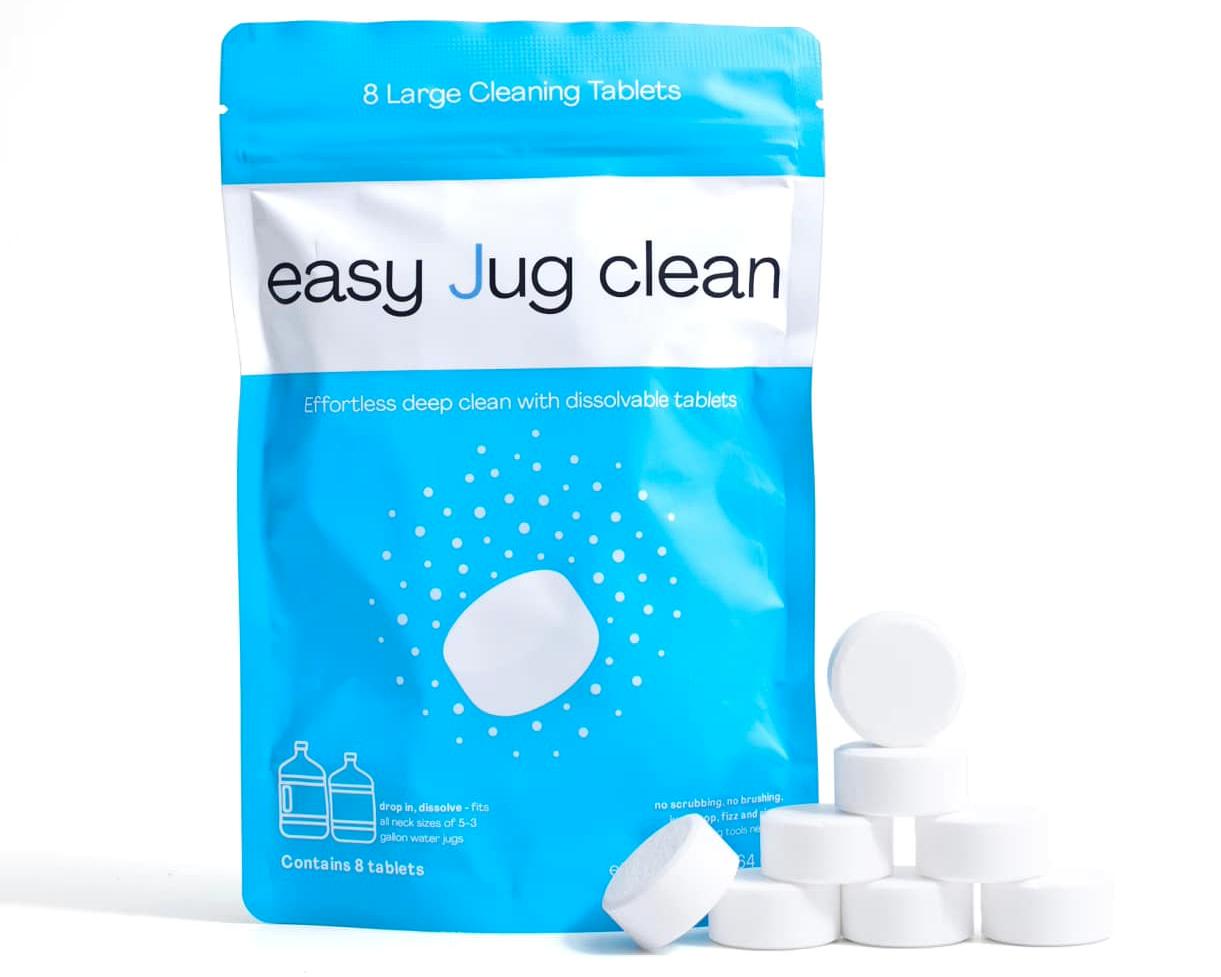
Easy Jug Clean's active ingredient — sodium percarbonate — releases active oxygen upon dissolving in water. This active oxygen is an oxidizing agent capable of degrading the EPS matrix that protects biofilm colonies, disrupting bacterial cell walls and oxidizing the metabolic byproducts that cause odors. Critically, it does this while being a food-grade compound that breaks down into water, oxygen, and sodium carbonate — leaving no toxic residue in your drinking water container.
The effervescent delivery mechanism ensures the active oxygen solution reaches every interior surface of the jug — including the curved bottom and narrow shoulder that brushes can't access — through 20–30 minutes of sustained contact. This combination of the right chemistry, complete coverage, and adequate contact time is what makes Easy Jug Clean the only practical solution for genuine biofilm removal in a 5 gallon water jug.
How to Tell If Your Jug Has Biofilm Right Now
You don't need a laboratory test. These are the reliable field indicators:
| Sign | What It Means | Severity |
|---|---|---|
| Slippery or slimy feel on interior walls | Mature biofilm with established EPS matrix | 🔴 Immediate cleaning needed |
| Musty, earthy, or stale odor | Bacterial VOC production — biofilm present and metabolically active | 🔴 Immediate cleaning needed |
| Water tastes flat or slightly off despite being freshly filled | Early biofilm activity or VOC contamination of water | 🟡 Clean within 24 hours |
| Visible dark or pink spots | Advanced biofilm with pigmented bacterial species (mold, Serratia) | 🔴 Immediate + aggressive treatment |
| Cloudy jug walls | Likely hard water scale combined with biofilm | 🟡 Clean within 24 hours |
| No obvious signs but jug unused for 5+ days | Biofilm likely developing even without visible indicators | 🟡 Clean before next use |
Preventing Biofilm: The Weekly Habit That Changes Everything
The most effective biofilm strategy is preventing mature colonization from forming in the first place. Weekly cleaning with an active oxygen tablet interrupts the biofilm lifecycle at the early attachment stage — before the EPS matrix has fully formed and before the colony has established the internal architecture that makes it so resistant to treatment.
A jug cleaned weekly with Easy Jug Clean never gives biofilm the time it needs to become a mature, resistant colony. The difference between weekly maintenance and monthly cleaning isn't just the frequency — it's the nature of what you're dealing with. Early-stage attachment responds to a standard treatment. Mature biofilm requires more aggressive intervention and may need multiple treatment cycles to fully resolve.
Two tablets. Twenty minutes. Once a week. That's the entire prevention protocol.
Watch the right cleaning approach versus what a brush actually does to your jug:
🔬 The Only Consumer Product Built to Remove Biofilm from a 5 Gallon Water Jug
Easy Jug Clean's active oxygen formula chemically penetrates and destroys the biofilm matrix that brushes, vinegar, and soap leave completely intact. Drop 2 tablets, wait 20 minutes, rinse. Done.
Frequently Asked Questions About Biofilm in Water Jugs
Q: Can biofilm in a water jug make you sick?
Yes — particularly for vulnerable individuals including infants, the elderly, and immunocompromised people. Even in healthy adults, biofilm-colonized jugs consistently deliver degraded water quality and may contribute to low-level gastrointestinal discomfort that users often don't associate with their water source. The risk is not always dramatic, but it is real and consistent.
Q: I can't see any biofilm — does that mean my jug is safe?
Not necessarily. Early-stage biofilm is invisible to the naked eye. By the time a jug feels slippery or develops an odor, biofilm colonization is already well-established. The absence of visible symptoms does not indicate the absence of biofilm, which is why regular scheduled cleaning — not symptom-triggered cleaning — is the correct approach.
Q: How quickly does biofilm grow back after cleaning?
Initial bacterial attachment can begin within hours of refilling a freshly cleaned jug. This is normal and unavoidable — bacteria are present in all water sources at low levels. The goal of weekly cleaning is not to achieve permanent sterility but to interrupt the biofilm lifecycle before early attachment progresses to mature, resistant colonization. A weekly cleaning cycle with Easy Jug Clean consistently prevents biofilm from reaching the dangerous maturation stage.
Q: Will boiling water kill the biofilm in my jug?
Boiling water kills free-floating bacteria effectively — but poured into a 5 gallon plastic jug it risks warping the container and still may not achieve the contact time and chemical penetration needed to disrupt the EPS matrix of established biofilm. It also provides no descaling action for mineral deposits that often co-occur with biofilm. It is not an appropriate biofilm treatment for a plastic water jug.
Q: Is the slippery feeling inside my jug definitely biofilm?
A slippery or slimy sensation on the interior walls of a water jug that has been in use is the most reliable field indicator of biofilm. It is the tactile result of the EPS matrix — the polysaccharide-rich protective coating that bacteria produce. Other causes of slippery surfaces (soap residue, mineral deposits) have different textures and are much less common in a jug used exclusively for water.


 Order now — get it by