The "natural therefore safe" assumption is one of the most persistent and consequential logical errors in consumer cleaning decisions. Arsenic is natural. Formaldehyde is naturally produced by the human body. Botulinum toxin is entirely natural. "Natural" describes origin, not safety profile — and the specific case of white vinegar in a 5 gallon drinking water jug demonstrates this gap between origin and actual safety behavior with frustrating clarity.
Myth vs. Reality: Five Common Vinegar Claims
MYTH: "Vinegar is completely safe to use in anything you eat or drink from"
Based on the reasoning that vinegar is a food ingredient, therefore using it as a cleaner in food containers is inherently safe — no different than washing with diluted acid we consume anyway.
Reality: Vinegar consumed as a food ingredient is diluted in the stomach within minutes. Vinegar as a cleaning residue in a plastic container sits in contact with the plastic surface and the water stored in it continuously. The acid residue that clings to plastic surfaces in a narrow-neck container that cannot be completely rinsed does two things that consuming food-grade vinegar does not: it slowly acidifies the water stored in the jug (shifting the pH downward), and it maintains a continuous low-level acid exposure against the plastic surface that, over repeated treatments, contributes to surface degradation — particularly in polycarbonate jugs.
MYTH: "Vinegar kills bacteria just like commercial sanitizers"
The claim that vinegar's antimicrobial properties make it equivalent to registered sanitizing agents for food-contact surface use.
Reality: This is addressed in detail in our companion article on whether vinegar qualifies as a sanitizer — but the short version: 5% acetic acid does not meet the EPA's 5-log reduction standard for food-contact surface sanitization against the pathogens relevant to drinking water. It has some antimicrobial activity against some species at some concentrations, but it does not qualify as a sanitizer under any regulatory framework.
MYTH: "Natural cleaning products don't have residue concerns"
The assumption that because vinegar isn't a "chemical" in the popular sense, it doesn't leave behind compounds of concern.
Reality: Acetic acid residue in a plastic container alters the pH of stored water. A study of acetic acid residue in PET bottles (structurally similar to the polymers used in some water jugs) found measurable acetaldehyde in water stored after vinegar cleaning — a naturally occurring compound but one with an established odor threshold and IARC Group 2B carcinogen classification at higher concentrations. "Natural" residues can still be concerning.
MYTH: "Vinegar is safer than bleach for drinking water containers"
A relative safety claim that treats vinegar as the better-of-two-imperfect-options for water jug cleaning.
Reality: This one is actually partially true — vinegar does not produce trihalomethanes, does not cause the same oxidative plastic degradation as bleach, and doesn't leave chlorine residue. But "safer than bleach" is a very low bar and says nothing about whether vinegar is an appropriate or effective cleaning agent for a drinking water container. It isn't dangerous in the way bleach is; it also doesn't clean in any meaningful sense.
The pH Problem: What Residual Vinegar Does to Stored Water
🔬 The chemistry: White vinegar has a pH of approximately 2.4–3.4. A residual vinegar film inside a 5 gallon jug — impossible to fully rinse from curved surfaces through gravity-rinsing alone — acidifies the water stored in the jug. The degree of acidification depends on the residual volume and the fill volume, but even small residual volumes can shift a 5-gallon water fill by 0.2–0.5 pH units toward acidity. Slightly acidified water is not dangerous, but it: (1) tastes noticeably different (the "flat" or "slightly sour" taste users sometimes report from vinegar-cleaned jugs), (2) increases the rate of calcium dissolution from any remaining scale deposits, and (3) accelerates the leaching of trace metals from any metal components in the dispenser's water pathway.
Why "Natural" Claims in Cleaning Products Deserve the Same Scrutiny as Any Other
The appropriate question to ask about any cleaning agent used in a drinking water container is not "is it natural?" but rather: Does it achieve meaningful pathogen reduction? Does it leave safe residues? Does it preserve the container's material integrity? Does it address the actual contamination present (scale, biofilm, organics)?
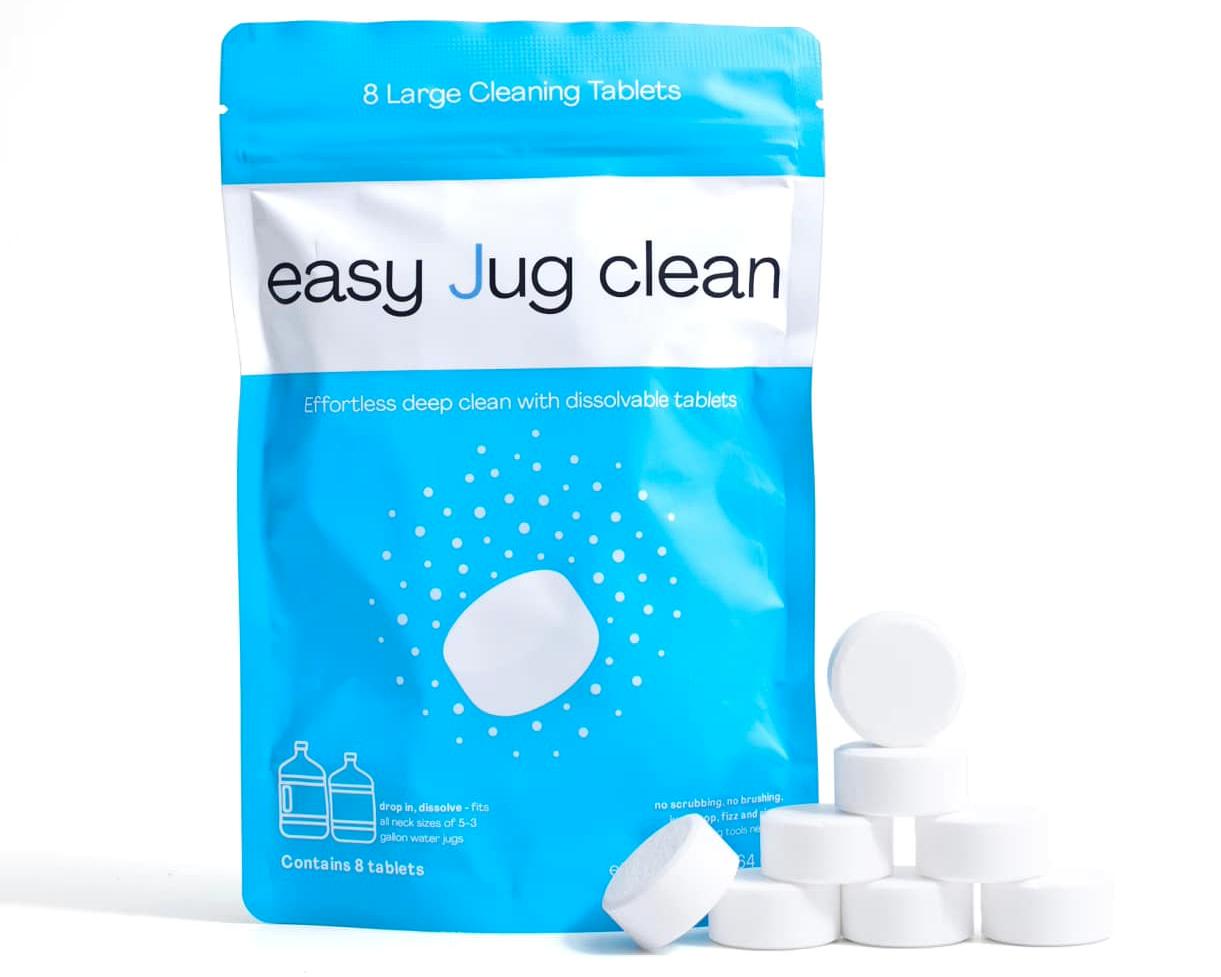
By these criteria, white vinegar scores: partial credit on the first question, qualified pass on the second, neutral to slight concern on the third, and a partial pass on the fourth (for scale, not for biofilm). Easy Jug Clean's active oxygen scores: yes on all four. The difference in safety and efficacy is not about natural vs. synthetic — it's about whether the specific chemistry matches the specific requirements of the application.
✅ The right framing: Origin (natural vs. synthetic) is irrelevant to safety evaluation. The relevant questions are application-specific. Easy Jug Clean's ingredients are evaluated on those application-specific criteria — each one selected because it does a specific necessary job safely. Sodium percarbonate is derived from sodium carbonate (a natural mineral) and hydrogen peroxide; cocoyl glucoside is derived from coconut oil. The plant-derived origin matters less than the fact that both are food-safe, non-carcinogenic, and effective at their respective functions in this application.
See how Easy Jug Clean cleans a 5 gallon water jug in 20 minutes — no scrubbing required:



 Order now — get it by