Oxidizing Cleaners vs. Surfactants: Which Actually Removes Biofilm?
By the Easy Jug Clean Research Team
Reading time: ~6 minutes | Oxidizing Chemistry Surfactants Biofilm Science
Two fundamentally different types of cleaning chemistry exist for dealing with microbial contamination: oxidizing agents and surfactants. Most household cleaning products — dish soaps, all-purpose cleaners, many "antibacterial" products — are surfactant-based. For free-floating bacteria on open surfaces, surfactants work adequately. For biofilm inside a 5 gallon water jug, surfactants are structurally incapable of the job. Here's exactly why.
How Surfactants Work — and Where They Stop
🔬 Surfactant mechanism: Surfactant molecules have hydrophobic (fat-attracting) tails and hydrophilic (water-attracting) heads. On open surfaces with mechanical assistance, they form micelles around fat, oil, and organic particles — surrounding them in a structure that water can carry away. For free-floating bacteria in water, surfactants can disrupt cell membranes by inserting the hydrophobic tail into the lipid bilayer. This is effective against planktonic (free-floating) bacteria. For biofilm, the EPS protective matrix — composed primarily of polysaccharides, not lipids — does not respond to surfactant chemistry. The hydrophobic tail finds nothing to insert into. The micelle-forming mechanism finds nothing to emulsify. The surfactant flows over the biofilm's outer surface without penetrating.
How Oxidizing Agents Work — Why They Can Penetrate Biofilm
🔬 Oxidizing mechanism: Oxidizing agents donate oxygen atoms to chemical bonds, breaking them. The EPS matrix is composed of polysaccharide polymers — long chains of sugar units connected by glycosidic bonds. Reactive oxygen species (from sodium percarbonate, hydrogen peroxide, or ozone) attack these glycosidic bonds directly, fragmenting the polymer chains that form the protective matrix. As the matrix degrades, bacteria within the colony are exposed to the full oxidizing concentration — and their cell membranes, also susceptible to oxidation, are then disrupted lethally.
Comparative Effectiveness Against Biofilm in a Water Container
| Chemistry Type | Examples | Penetrates EPS Matrix? | Kills Biofilm Bacteria? | Appropriate for Drinking Water Container? |
|---|---|---|---|---|
| Synthetic surfactants | Dish soap, most cleaners | ❌ No | ⚠️ Planktonic only | ⚠️ Residue concern |
| Chlorine oxidizer | Bleach (NaOCl) | ⚠️ Partial at household levels | ✅ Yes at effective concentration | ⚠️ Residue and plastic degradation risk |
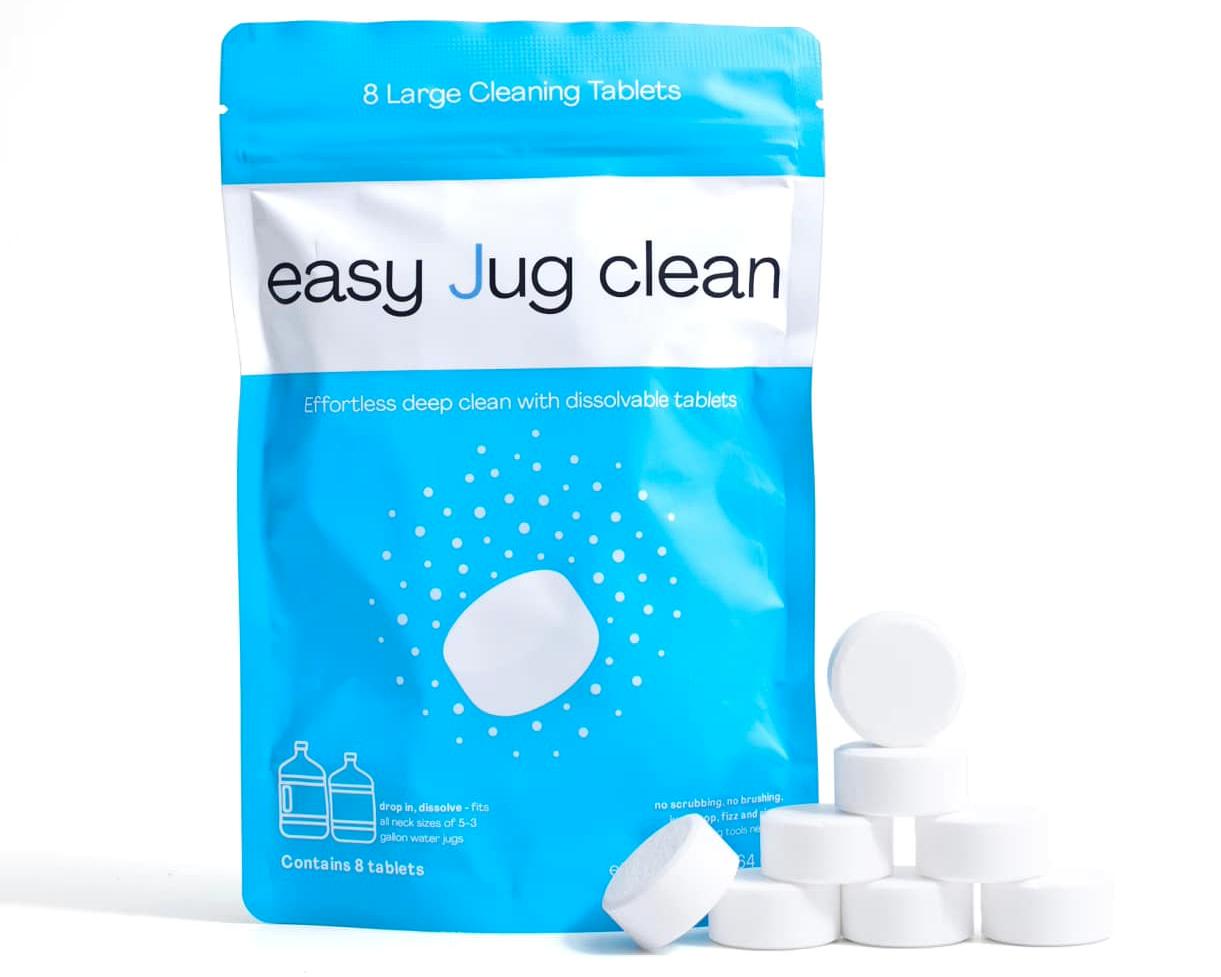
| Active oxygen oxidizer | Sodium percarbonate (Easy Jug Clean) | ✅ Yes | ✅ Yes | ✅ Food-grade breakdown products |
| Plant-based surfactant + oxidizer | Easy Jug Clean complete formula | ✅ Oxidizer disrupts first; surfactant lifts disrupted material | ✅ Yes | ✅ Fully food-grade |
Why the Best Approach Combines Both
Oxidizing agents destroy the biofilm matrix and kill bacteria within it. But the disrupted organic material — the remnants of the EPS matrix, the bacterial cell debris — still needs to be lifted from the surface and rinsed away. This is where the surfactant plays its legitimate role: after the active oxygen has done the destruction, the plant-based surfactant in Easy Jug Clean emulsifies and lifts the disrupted organic matter into suspension for rinsing. Oxidizing agent first, surfactant second — a genuine two-step mechanism in one 20-minute treatment.
✅ The complete answer: Surfactants alone cannot remove biofilm. Oxidizers alone remove it but may leave debris. The combination — active oxygen to destroy, plant surfactant to lift — is what achieves complete biofilm removal in a single treatment. This is the design logic behind Easy Jug Clean's multi-system formula.
Watch the right cleaning approach versus what a brush actually does to your jug:


 Order now — get it by