The Drying Problem: Why Large Water Bottles Can't Air-Dry Like Sports Bottles
Reading time: ~5 minutes | Drying Storage Container Geometry
Why Drying Matters Microbiologically
Active oxygen cleaning destroys most of the bacterial population on a jug's interior, but no cleaning method achieves perfect sterility. A small fraction of bacterial cells survive every treatment — typically in protected micro-environments like surface scratches or in the narrow neck where the cleaning solution didn't dwell as long. These survivors are the seed for re-colonization.
The seed only grows if it has water. Bacterial cell division requires liquid water — without it, surviving cells go dormant or die over time. A fully dried jug deprives the surviving population of the medium they need to multiply. A jug with residual moisture provides exactly the conditions they need.
Why Sports Bottle Drying Works
A 24-oz sports bottle has three properties that make air-drying easy:
- A wide opening allows good airflow into the interior, which carries moisture out as water vapor.
- A short interior depth means the water that drains has a short distance to travel, and capillary effects don't trap residual droplets.
- A simple cylindrical geometry means residual moisture pools at the lowest point and either drains or evaporates from a small surface area.
Inverted on a drying rack with a slight tilt, a sports bottle goes from "freshly rinsed" to "fully dry" in about 4 hours of room air exposure. The drying step isn't a problem.
Why Large Water Bottle Drying Doesn't Work the Same Way
Airflow Is Throttled by the Narrow Neck
A 5-gallon jug's 1.4-inch opening admits a fraction of the airflow that enters a 2.3-inch sports bottle opening. The interior atmosphere stays humid for far longer because evaporated water vapor can't exit fast enough. Until the interior humidity drops below the dewpoint of the surrounding air, evaporation effectively stalls.
The Curved Shoulder Creates Moisture Traps
When you invert a 5-gallon jug, the body diameter (11 inches) tapers down to the neck diameter (1.5 inches) through a curved shoulder. Water that doesn't drain through the neck collects in the inner curve of the shoulder — held there by surface tension and the angle of inversion. The shoulder zone holds residual water for 8–12 hours after the rest of the jug appears dry.
The Body Volume Holds Atmospheric Moisture
Even after liquid water has fully drained, the air inside a 5-gallon jug remains near 100% humidity for hours. Surfaces in contact with that humid air maintain a microscopic water film that's invisible but biologically functional — enough moisture to support bacterial activity even when the jug appears dry to the eye.
The Drying Time Comparison
| Drying Phase | Sports Bottle (32oz) | 5-Gallon Jug |
|---|---|---|
| Visible water draining | ~10 minutes | ~30 minutes |
| Surface moisture evaporation | ~2 hours | ~6 hours |
| Shoulder zone trapped moisture | None | ~8–12 hours |
| Interior humidity drops below 80% | ~3 hours | ~10 hours |
| Total time to fully dry | ~4 hours | ~12+ hours |
What Goes Wrong During the Drying Window
The 8–12 hour window during which a 5-gallon jug is "drying but still wet" is exactly the window in which surviving bacteria can re-establish and begin biofilm formation. Biofilm initiation begins within 24 hours of available moisture, and the warm, humid interior of a drying jug is more favorable to bacterial growth than the relatively cool environment of a freshly rinsed sports bottle.
The result: a jug that was thoroughly cleaned 12 hours ago, now refilled with clean water, can already have early-stage biofilm formation underway from the moisture-supported regrowth during the drying period. The cleaning effort isn't wasted, but it's diminished.
The Right Way to Dry a Large Water Bottle
- Invert at a slight angle, not straight down. A 30-degree tilt keeps the curved shoulder from forming a moisture trap and lets water flow continuously toward the lowest edge of the opening.
- Use a fan or improve airflow. A small desktop fan blowing toward the inverted opening accelerates the air exchange that's otherwise throttled by the narrow neck. Cuts drying time roughly in half.
- Allow at least 12 hours before refilling. Even with optimal positioning and airflow, 12 hours is the realistic minimum for full interior drying. Don't rush a freshly cleaned jug back to the dispenser.
- Do not store with the cap on. A capped freshly-cleaned jug seals in the residual humidity and creates an ideal moisture-supported environment for bacterial regrowth.
✅ Cleaning That Sets Up Drying Properly
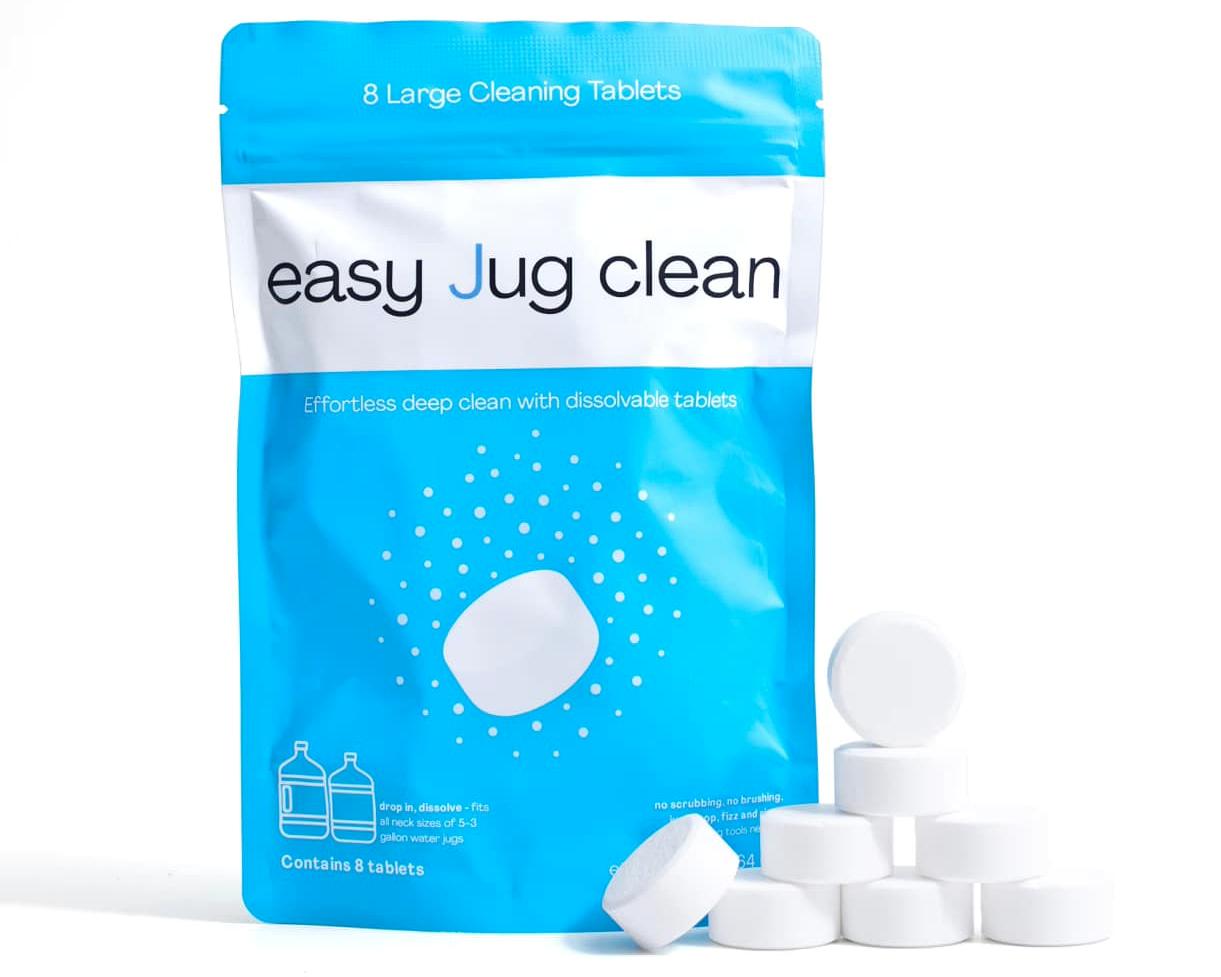
Easy Jug Clean rinses out cleanly so drying can complete properly. Two tablets, 20 minutes, two rinse cycles, then the proper drying setup. The full hygiene chain works because each step doesn't fight the next.
FAQ: Drying Large Water Bottles
Q: Can I dry a jug faster with a hair dryer or compressed air?
A hair dryer on cool setting works — driving warm air into the jug accelerates evaporation. Avoid hot settings, which can damage polycarbonate. Compressed air canisters work for surface moisture but don't help interior humidity.
Q: What if I need to refill the jug right away — same-day cleaning and reuse?
It's not ideal but it works. Refilling a still-damp interior with water that's already going to be in the container doesn't add new contamination — the water itself becomes the medium. The recently-cleaned interior just has a slightly higher starting bacterial load than a fully dried jug. Bring forward the next cleaning cycle by a day or two to compensate.
Q: Should I use towels to wipe the interior dry?
Generally no — towels introduce lint and bacteria that the cleaning just removed. Air-drying is more reliable.
The Bottom Line
Drying isn't a passive afterthought to cleaning — it's an active hygiene step that's mechanically harder to execute on a large water bottle than on a sports bottle. Plan for the 12-hour drying window, position the jug to break the shoulder moisture trap, and don't seal moisture inside with a cap. The full cleaning + drying protocol is what actually keeps a large water bottle clean — not just the cleaning portion.


 Order now — get it by