Water Cooler Jug Bacteria: What's Actually Growing in There?
Reading time: ~7 minutes | Bacteria in Water Jug Pathogens Water Safety
Water Cooler Jug Bacteria: What's Actually Growing in There?
The Bacterial Ecology of a Water Jug
Water cooler jugs aren't sterile environments. Even in a well-maintained jug, bacteria are present. The difference between a clean jug and a contaminated one isn't the presence of bacteria—it's the population level and the species composition.
How Biofilm Protects Bacterial Colonies
Bacteria don't exist as isolated cells in water. They form biofilm—a structured matrix of bacterial cells embedded in polysaccharides, proteins, and nucleic acids. This biofilm:
- Creates a protective barrier that shields bacteria from cleaning chemicals and sanitizers
- Allows bacteria to survive in nutrient-poor environments (like pure water)
- Enables different bacterial species to cooperate—some break down organic matter while others consume the byproducts
- Makes populations thousands of times more resistant to antibiotics or disinfectants than free-floating bacteria would be
This is why rinsing with water alone doesn't work. Water can't penetrate biofilm. You need active chemistry that disrupts the matrix itself—which is exactly what sanitizing water cooler jugs with active oxygen accomplishes.
The Most Common Bacterial Residents of Water Cooler Jugs
Pseudomonas (Environmental Risk)
What it is: Pseudomonas aeruginosa and related species are ubiquitous environmental bacteria. They thrive in moist environments and form robust biofilms.
Why it grows in water jugs: Pseudomonas is an opportunistic pathogen that doesn't require many nutrients. It can live in distilled water—literally just water, nothing else. This makes water cooler jugs a perfect habitat.
Health risk context: For immunocompetent individuals, exposure to Pseudomonas in water is typically low-risk. For people with compromised immune systems, chronic lung disease, or wounds, it poses a genuine infection risk. In a shared office setting, you don't know everyone's health status, making prevention important.
How Easy Jug Clean stops it: Active oxygen chemistry disrupts the Pseudomonas biofilm directly by oxidizing the polysaccharide matrix. This exposes the bacterial cells underneath, making them vulnerable to the second wave of oxidative damage.
Legionella (Specific Concern)
What it is: Legionella pneumophila causes Legionnaires' disease, a serious respiratory infection. It's a freshwater bacterium that grows inside amoebae (single-celled protozoans) in biofilm.
Why it grows in water jugs: Legionella requires specific conditions: warm water (77–108°F), nutrients, and biofilm. In an office water cooler that sits at room temperature in a dimly lit area, Legionella risk is lower than in hot water systems (like cooling towers). However, in warm office environments or near heat sources, Legionella can establish populations within amoebae inside the biofilm.
Health risk context: Legionnaires' disease is serious—it causes pneumonia-like symptoms and can be fatal in elderly individuals or those with compromised immunity. However, infection requires inhalation of aerosolized water containing the bacteria. Drinking contaminated water is much lower risk than breathing aerosolized particles from a hot water system. That said, preventing Legionella is important in shared water environments.
How Easy Jug Clean stops it: Active oxygen oxidizes the biofilm structure and the amoebae protecting Legionella. This prevents population establishment. Regular cleaning (every 5–7 days) ensures Legionella populations never reach dangerous levels.
Bacillus (Common Environmental Resident)
What it is: Bacillus species are spore-forming bacteria ubiquitous in soil and water. They're present in most water sources.
Why it grows in water jugs: Bacillus spores can survive standard water treatment and are extremely difficult to kill. They germinate in biofilm environments where nutrients accumulate.
Health risk context: Most Bacillus species are harmless environmental bacteria. B. cereus can cause food poisoning in very high populations, but exposure in water is typically low-risk for healthy individuals. The real issue is that Bacillus presence indicates biofilm formation—and if Bacillus is thriving, other organisms might be too.
How Easy Jug Clean stops it: While active oxygen doesn't reliably kill spores, it oxidizes the biofilm matrix where Bacillus germinates and establishes populations. Regular treatment prevents maturation of spore populations.
Coliforms (Contamination Indicator)
What it is: Coliforms are a broad group including E. coli. They're gram-negative, rod-shaped bacteria found in soil, vegetation, and animal waste.
Why it grows in water jugs: Coliform growth in a water jug indicates fecal or environmental contamination—either from the refill water source itself or from cross-contamination during jug handling or filling. In a properly refilled jug with clean water, coliform presence is unlikely unless the source water is contaminated.
Health risk context: Coliforms in drinking water is a red flag. E. coli can cause serious gastrointestinal infection. If you detect coliform growth in a water jug, the problem is likely the refill water source, not the jug itself. This is a reason to verify that your water cooler is using a trustworthy refill service.
How Easy Jug Clean stops it: Active oxygen kills coliforms effectively. However, if coliforms are in your refill water, cleaning the jug won't solve the root problem—you need to verify your water source.
Why Biofilm Makes Everything Worse
The bacterial species themselves are relevant, but the real danger in a water cooler jug is the biofilm ecosystem. Here's why:
- Protection: Biofilm protects bacteria from heat, disinfectants, and antibiotics. A bacterium floating free in water might be killed by one-tenth the dose of chlorine that would be needed to kill the same bacterium inside biofilm.
- Nutrient concentration: Biofilm creates zones where bacteria can access concentrated nutrients (from organic matter in the jug) while other zones allow them to survive on minimal nutrients. This supports diverse populations.
- Genetic exchange: Inside biofilm, bacteria share genetic material, including antibiotic resistance genes. This is how resistant populations develop.
- Oxygen gradients: The biofilm interior is anaerobic (oxygen-free), allowing anaerobic bacteria to establish alongside aerobic species. This increases ecosystem complexity and resilience.
Sanitization that works must target the biofilm matrix itself, not just the bacteria inside it. This is what distinguishes active oxygen chemistry from weak methods like vinegar or basic rinsing.
Temperature and Bacteria: Why Office Environments Matter
Most office water coolers are stored at room temperature (68–75°F). This temperature range is:
- Cold enough to slow bacterial growth compared to warm-water systems (which operate at 160°F+ and have much higher contamination risk)
- Warm enough that mesophilic bacteria (those that prefer moderate temperatures) thrive—especially if the jug sits in a warm area or near a heat source
- Ideal for biofilm formation because the stagnant water provides a stable environment where biofilm can mature
In a busy office where the 5-gallon jug empties in 2–3 days, biofilm doesn't have time to fully establish because the jug is replaced before contamination becomes severe. In a quiet office or home where the same jug sits for 7–14 days, biofilm matures substantially between uses.
Comparing Relative Risks
Not all bacteria in a water jug represent equal risk. Here's a practical breakdown:
| Organism | Biofilm Former | Infection Risk (Healthy Adult) | Infection Risk (Immunocompromised) | Why It Matters |
|---|---|---|---|---|
| Pseudomonas aeruginosa | Strong biofilm | Low | High | Opportunistic pathogen; vulnerable populations at risk |
| Legionella pneumophila | Strong (in amoebae) | Low | High | Serious disease; but water drinking is lower risk than aerosolization |
| Bacillus species | Moderate | Low | Low-Moderate | Indicates biofilm; generally harmless unless in very high populations |
| Coliforms / E. coli | Weak biofilm | Moderate | High | Indicates contamination; problem is water source, not jug |
How Easy Jug Clean's Active Oxygen Chemistry Disrupts This Ecosystem
Active oxygen (from tablets) works via oxidative chemistry:
- Disrupts polysaccharide matrix: The biofilm structure is held together by polysaccharides. Active oxygen oxidizes these compounds, breaking apart the protective matrix.
- Damages bacterial cell walls: Gram-negative bacteria (like Pseudomonas) have lipid membranes that are vulnerable to oxidative stress. Active oxygen penetrates the damaged biofilm and attacks these membranes directly.
- Disrupts enzyme function: Bacteria depend on enzymes for survival. Oxidative stress damages these proteins and disrupts metabolic processes.
- Prevents regrowth: Regular treatment (every 5–7 days) prevents biofilm maturation, keeping bacterial populations at baseline levels rather than allowing pathogenic blooms.
This is why the right chemistry matters in a water jug cleaner. Weak methods (vinegar, basic rinsing, plain soap) don't disrupt biofilm. Only active oxygen chemistry provides both biofilm disruption and bacterial cell damage.
Stop Bacterial Biofilm Before It Establishes
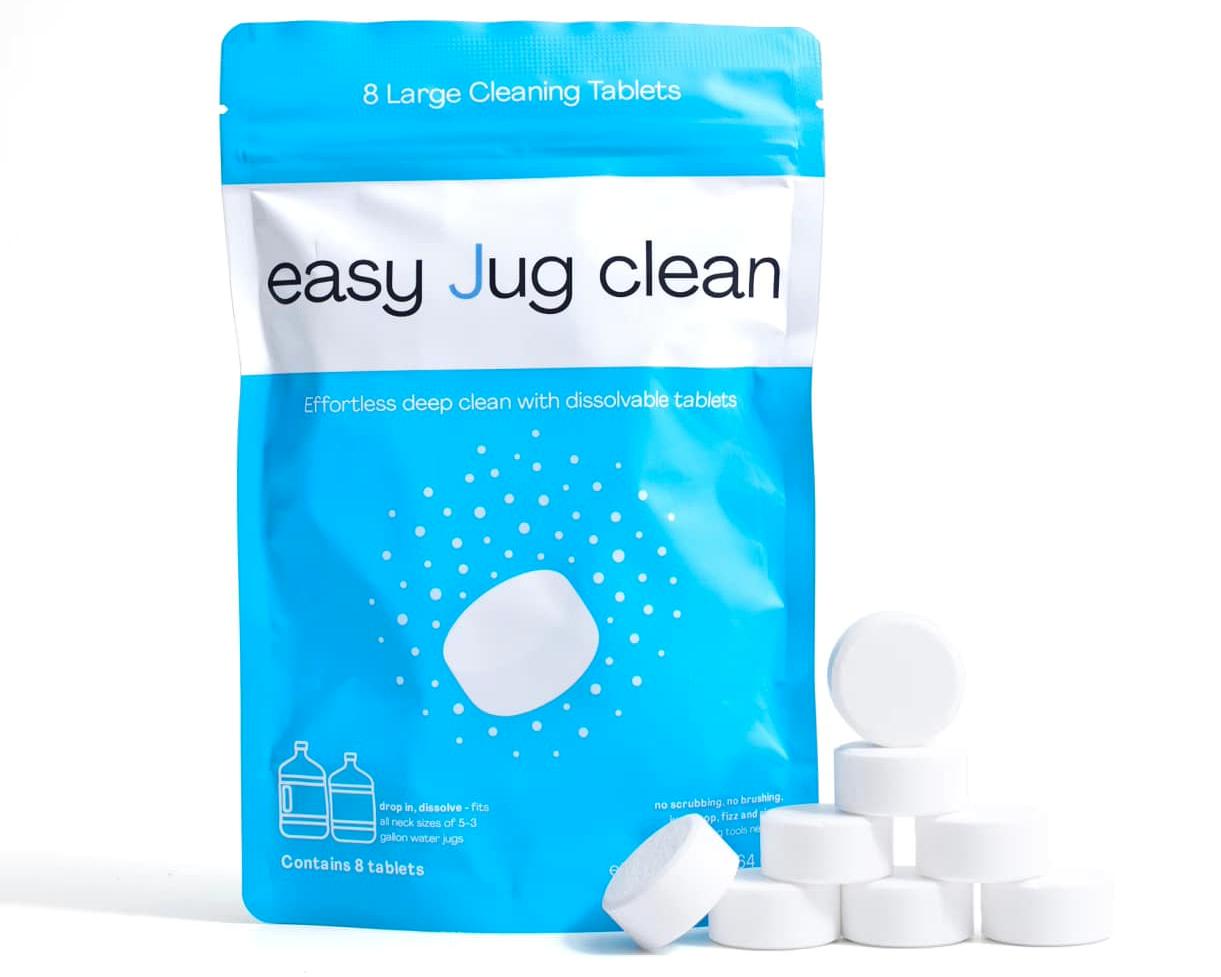
Easy Jug Clean's active oxygen chemistry breaks down the biofilm matrix and kills bacterial populations. Regular treatment prevents the conditions where pathogens like Pseudomonas and Legionella establish.
Get Easy Jug Clean – for 8 tablets
See how Easy Jug Clean eliminates the bacteria living inside your water cooler jug:
FAQ: Bacteria and Biofilm in Water Cooler Jugs
Can you get sick from drinking from a dirty water cooler jug?
It depends on the contamination and your health status. For a healthy adult drinking from a neglected jug with moderate biofilm, the risk is typically low but real. For immunocompromised individuals, elderly people, or anyone with chronic respiratory disease, the risk is significantly higher. Prevention through regular cleaning is always safer than exposure and hope.
Does boiling a water jug remove bacteria?
Boiling kills free-floating bacteria but doesn't remove biofilm. You can't boil a water jug interior anyway (it would damage the plastic). Regular chemical cleaning is far more effective.
Is Legionella a real concern in office water coolers?
Legionella risk is much higher in hot water systems (cooling towers, hot tubs, showers). In room-temperature water cooler jugs, risk is lower but not zero. Regular cleaning prevents population establishment. If your office is in a warm climate or the cooler sits near a heat source, treat the risk seriously.
What does it mean if the jug smells sulfurous?
Sulfur smell indicates bacterial metabolism of sulfur compounds or sulfate reduction by anaerobic bacteria in the biofilm. This is a sign of mature biofilm with diverse bacterial populations. It means the jug needs immediate deep cleaning.
Can you see bacteria or biofilm in water?
Not with the naked eye. Biofilm usually becomes visible only when it's very thick (appears as a slimy coating) or when it pigments (some Pseudomonas species produce green pigment). Most biofilm is invisible until it's quite mature.


 Order now — get it by