Safest Way to Clean a 5 Gallon Water Jug: What's Actually in Your Cleaner
By the Easy Jug Clean Research Team
Category: Water Jug Safety | Safe CleaningIngredientsNon-Toxic5 Gallon Jug
Here's a question most people never think to ask: what exactly am I putting inside my drinking water container when I "clean" it? Bleach, vinegar, dish soap, baking soda — these are the standard recommendations, and almost nobody stops to ask whether the residue they leave behind is safe to drink around, what they do to the plastic over time, or whether the chemicals involved are appropriate for a container used exclusively for drinking water. This pillar answers that question fully — starting with the ingredient science, and ending with the one formula that was built with your family's safety as the non-negotiable first principle.
Why "Safe to Use" and "Safe for a Drinking Water Container" Are Not the Same Thing
This is the distinction that changes everything. Most household cleaning products are designed to be safe in ventilated spaces, with gloves, rinsed away from surfaces you don't eat off. A 5 gallon water jug is a completely different environment — it's a sealed, narrow-neck container that holds nothing but the water your family drinks. Any cleaning agent used inside it must meet a higher bar:
Zero toxic residue after rinsing — even trace amounts matter when they accumulate in daily drinking water
No long-term chemical interaction with the plastic or glass — harsh chemicals accelerate plastic degradation and microplastic release
No fumes or handling hazards — a product used weekly inside the home must be safe to handle without protective equipment
Derived from ingredients with a clean safety profile — not just "not immediately harmful" but genuinely food-compatible
When you hold common DIY cleaning methods against these four criteria, the picture gets uncomfortable fast.
The Hidden Safety Risks of Popular DIY Jug Cleaning Methods
Bleach: The Residue Problem Nobody Talks About
⚠️ Safety verdict: Fails the drinking-water-container standard. Sodium hypochlorite (household bleach) is a legitimate disinfectant — but it was formulated for surfaces you don't drink from, in spaces where residue can be scrubbed away by hand. Inside a 5 gallon jug with a 48mm neck, "thorough rinsing" is an aspiration, not a guarantee. Chlorine residue left in drinking water is classified as a disinfection byproduct — the same category that municipal water suppliers must legally limit. Repeated low-level chlorine exposure has been linked in peer-reviewed literature to irritation of the gastrointestinal lining. Beyond residue, bleach is an oxidizing agent that reacts with polycarbonate and HDPE plastics to break down polymer chains over time — meaning every bleach treatment accelerates the very microplastic release you're trying to avoid by using a water jug in the first place.
Vinegar: The "Natural" Label Doesn't Mean Safe Residue
⚠️ Safety verdict: Misleading safety reputation. Vinegar earns its "natural" label fairly — it's acetic acid derived from fermentation. But natural origin does not equal safe residue in a drinking water context. Acetic acid that isn't fully rinsed from a 5 gallon jug acidifies the water you fill it with — affecting taste, yes, but also potentially interacting with the plastic surface in ways that increase leaching of plasticizers. More practically: vinegar is notoriously difficult to rinse completely from a narrow-neck container, and the lingering sour taste in your water is a direct indicator that the residue hasn't cleared. If you can taste it, you're drinking it.
Dish Soap: Surfactant Residue and the Gut Irritation Nobody Warns You About
⚠️ Safety verdict: Wrong product category for this application. Dish soaps contain synthetic surfactants — compounds designed to break surface tension and lift grease from solid surfaces. These are not formulated to be consumed, even in trace amounts. The challenge with a 5 gallon jug specifically is that surfactant molecules cling to plastic surfaces electrostatically and resist rinsing in a way they don't on a flat, open dish. Residual surfactants in drinking water are associated with gastrointestinal irritation, altered gut microbiome conditions, and a distinctly soapy taste that most users just accept as "normal" — when it's actually a sign of inadequate rinsing.
Baking Soda: Low Risk, But Also Low Effectiveness
⚠️ Safety verdict: Safe but largely pointless. Sodium bicarbonate is genuinely safe — it's food-grade, widely consumed, and leaves no harmful residue. The problem is that it isn't doing the job you need it to do. Baking soda has no sanitizing action , no ability to penetrate biofilm, no capacity to dissolve mineral scale, and no mechanism to reach the full interior of a narrow-neck container effectively. Being safe while accomplishing nothing is not a meaningful standard for a product meant to protect your family's drinking water.
See how Easy Jug Clean cleans a 5 gallon water jug in 20 minutes — no scrubbing required:
🔬 Built Safe From the Ingredient Level Up
Every ingredient in Easy Jug Clean was chosen because it is both powerfully effective and genuinely safe for a drinking water container. No chlorine. No harsh acids. No synthetic residue. Just food-grade chemistry that cleans, sanitizes, and leaves nothing harmful behind.
What's Actually Inside Easy Jug Clean: A Full Ingredient Breakdown
Most cleaning products hide behind the word "formula" and tell you nothing. Easy Jug Clean publishes every ingredient — because when the product is designed for your drinking water container, you deserve to know exactly what's going in it. Here is a plain-English breakdown of each ingredient, what it does, and why it's safe.
🧪 System 1: Alkaline Odor Neutralization
Sodium Bicarbonate ✅ Food Safe
Odor Neutralizer / pH Buffer
You know this as baking soda — one of the most widely consumed compounds on earth, used in food, medicine, and personal care. Inside Easy Jug Clean, sodium bicarbonate plays a precise role: it acts as a pH buffer , neutralizing the odor-causing organic acids that accumulate inside a reused water jug. It also contributes to the mild alkaline environment that supports the effervescent reaction when the tablet meets water.
Zero toxicity. GRAS (Generally Recognized As Safe) status with the FDA. Leaves no harmful residue after rinsing.
⚗️ System 2: Effervescent Activation & Descaling
Fumaric Acid ✅ Food Safe
Acidulant / Effervescence Driver
Fumaric acid is a naturally occurring organic acid found in many plants and produced naturally in the human body during cellular energy metabolism. In Easy Jug Clean, it serves as the acid counterpart that reacts with sodium bicarbonate to generate the controlled effervescent fizzing that drives the cleaning solution into every corner of the jug interior. It also contributes mild descaling action on fresh mineral deposits.
FDA-approved food additive (E297). Commonly used as a flavoring and acidulant in food and beverages. Safe for food-contact applications.
Sodium Citrate ✅ Food Safe
Chelating Agent / Hard Water Remover
Sodium citrate is the sodium salt of citric acid — the same acid that gives citrus fruits their tartness. As a chelating agent , it works by binding to calcium, magnesium, and other mineral ions that make up hard water scale, effectively pulling them away from the jug's interior surface and holding them in solution so they rinse away cleanly. This is the ingredient responsible for dissolving the chalky white residue that clouds the walls of regularly refilled jugs.
FDA-approved food additive widely used as a preservative, flavor enhancer, and acidity regulator in foods and pharmaceuticals. Completely safe in residual trace amounts.
🫧 System 3: Oxygen-Releasing Deep Clean
Sodium Percarbonate ✅ Food-Grade Grade
Oxygen Bleach / Sanitizing Agent
This is the powerhouse of the formula — and the ingredient that separates Easy Jug Clean from every DIY alternative. Sodium percarbonate is an adduct of sodium carbonate and hydrogen peroxide. When it dissolves in water, it releases active oxygen — the same oxidizing mechanism used in food-grade sanitizing applications across the beverage and food processing industries. This active oxygen breaks down organic residue, penetrates and disrupts biofilm matrix, and oxidizes odor-causing compounds at the molecular level. Critically, it does all of this without chlorine — it decomposes into water, oxygen, and sodium carbonate (soda ash), leaving no toxic byproducts behind.
Used in food-grade cleaning applications globally. No chlorine. No harmful breakdown products. Widely considered the gold-standard alternative to bleach for food-contact sanitizing.
🧴 System 4: Surface Conditioning & Material Protection
Glycerin ✅ Food Safe
Humectant / Surface Conditioner
Glycerin (glycerol) is a naturally derived compound found in fats and oils and is extensively used in food, pharmaceuticals, and personal care products. In the context of Easy Jug Clean, it acts as a surface conditioner — helping maintain the surface integrity of both plastic and glass after the active cleaning process. This matters because repeated exposure to harsh cleaning agents progressively degrades the smoothness of plastic, creating microscopic surface roughness that makes future cleanings less effective. Glycerin counteracts this, helping your jug stay smoother and cleaner-cleaning with every treatment.
GRAS status with FDA. Widely used in food and pharmaceutical applications. Completely non-toxic and safe in drinking water contact applications.
🧬 System 5: Tablet Stability & Manufacturing
Magnesium Stearate ✅ Food Safe
Tablet Binder / Flow Agent
Magnesium stearate is a salt of magnesium and stearic acid — a saturated fatty acid derived from plant or animal fats. Its role in Easy Jug Clean is purely structural: it ensures consistent tablet compression during manufacturing and controlled dissolution when the tablet enters water, preventing too-rapid or incomplete breakdown of the active ingredients. It has no cleaning function itself — it's the delivery mechanism that ensures every tablet performs identically.
Ubiquitous excipient in pharmaceutical tablets and food supplements. FDA-approved. Present in trace amounts; no residue concern.
Sodium Sulphate ✅ Food Safe
Tablet Filler / Dispersing Agent
Sodium sulphate (also known as Glauber's salt) improves tablet structural integrity and ensures the active ingredients disperse uniformly once the tablet dissolves. This uniform dispersion is what guarantees that the sanitizing chemistry reaches every part of the jug interior — not just where the tablet happened to land.
Food-grade and pharmaceutical-grade compound with extensive safety history. Used as a filler and dispersing agent across food and cosmetic applications.
🌱 System 6: Plant-Derived Surfactant System
Cocoyl Glucoside ✅ Plant-Derived
Mild Surfactant / Grime Lifter
Cocoyl glucoside is a coconut-derived surfactant produced from coconut oil and glucose (a natural sugar). It belongs to the alkyl glucoside family — some of the mildest surfactants available, routinely used in baby care products and sensitive-skin formulations because of their gentle profile. In Easy Jug Clean, it lifts grime, organic residue, and surface contamination without the harsh abrasion of synthetic surfactants, and without leaving the problematic residue that petroleum-derived surfactants do in food-contact applications. It's why the jug smells fresh after cleaning — not chemical or soapy, but genuinely clean.
Biodegradable. Derived entirely from plant sources. Non-irritating, non-toxic. Used in baby care and sensitive-skin personal care products.
Sodium Gluconate ✅ Food Safe
Sequestrant / System Stabilizer
Sodium gluconate is the sodium salt of gluconic acid — produced through the fermentation of glucose and widely used in food, pharmaceutical, and industrial cleaning applications. In Easy Jug Clean, it enhances mineral removal by sequestering (capturing) calcium and magnesium ions in the cleaning solution, working alongside sodium citrate to ensure hard water deposits dissolve completely and rinse away cleanly. It also stabilizes the overall cleaning system, ensuring all active ingredients work together at peak efficiency throughout the 20–30 minute soak.
FDA-approved food additive. Used as a sequestrant in food processing and as an ingredient in pharmaceutical preparations. Completely safe in residual trace amounts.
Side-by-Side Safety Comparison: Easy Jug Clean vs. DIY Methods
Ingredient / Method
Food Safe?
Residue Risk
Plastic Safe?
Fume / Handling Risk
Effective?
Household Bleach
❌ No
🔴 High — chlorine residue
❌ Degrades plastic
🔴 Fumes; skin/eye irritant
⚠️ Partial
White Vinegar
✅ Yes
🟡 Medium — acid residue affects taste
⚠️ Repeated use risks
✅ Low
❌ No — not a sanitizer
Dish Soap
❌ No
🔴 High — synthetic surfactant residue
✅ Safe
✅ Low
❌ No
Baking Soda
✅ Yes
✅ Minimal
✅ Safe
✅ Low
❌ No — deodorizer only
Hydrogen Peroxide (3%)
⚠️ Low concentration
🟡 Medium — oxidizing residue
⚠️ Some risk at higher concentrations
🟡 Mild irritant
⚠️ Partial — slow contact time
Easy Jug Clean
✅ All food-grade
✅ None — safe breakdown products
✅ Protects surface integrity
✅ None — no PPE needed
✅ Full sanitization
What "Food-Grade" Actually Means — And Why It's the Right Standard for a Water Jug Cleaner
The term "food-grade" gets used loosely, so it's worth being precise. A food-grade substance is one that has been assessed by a food safety authority — the FDA in the United States, EFSA in Europe — and determined to be safe for direct or incidental contact with food or beverages. This is a higher bar than "non-toxic," "natural," or "safe to use with gloves."
Every active ingredient in Easy Jug Clean meets this standard. The sodium percarbonate used as the sanitizing agent is the same compound used to clean equipment in breweries, juice processing facilities, and bottling plants — industries where the law requires that cleaning agents be safe for food contact surfaces. The plant-derived surfactant system uses coconut-derived compounds found in baby care products. The chelating and buffering agents are widely used FDA-approved food additives.
This is not a marketing claim — it is a published ingredient list you can verify yourself. When the product is going inside your drinking water container, that transparency should be the minimum standard you accept.
The Safety Case for Weekly Cleaning — and Why Skipping a Week Has Real Consequences
One of the reasons the safety of the cleaning product matters so much is that safe cleaning should be done frequently. Weekly sanitizing is the gold standard recommended by water safety professionals — but people are far less likely to clean weekly if the process involves measuring bleach, dealing with fumes, or wrestling with a long brush. The safety and simplicity of Easy Jug Clean are not separate benefits — they reinforce each other. A product that is genuinely safe to handle, produces no fumes, requires no protective equipment, and takes 20 minutes of hands-off time removes every friction point that causes people to skip their weekly cleaning cycle.
When cleaning gets skipped, biofilm matures. Mature biofilm is significantly harder to disrupt than early-stage colonization — and it takes progressively stronger or longer chemical exposure to achieve the same sanitizing result. A safe, easy weekly routine prevents the need for the more aggressive interventions that skipped cycles eventually require.
Particular Safety Considerations for Specific Households
Households with Infants and Young Children
Infants and young children are the demographic most at risk from residual cleaning chemicals in drinking water — their developing immune systems and lower body mass mean that trace exposures have proportionally greater effects. For households using jug water to prepare formula, tea, or drinking water for children under five, the food-grade safety profile of Easy Jug Clean is not optional — it's the correct standard for the application.
Households with Pets
Pets drink from the same water sources as humans and are often even more sensitive to chemical residues. Dogs and cats have lower body mass and higher water intake relative to size, meaning residual chlorine, synthetic surfactants, or acidic compounds in water have amplified effects. Easy Jug Clean's food-grade, no-residue formula is equally safe for pet-adjacent water sources.
Individuals with Chemical Sensitivities
People with fragrance sensitivities, asthma, or multiple chemical sensitivity (MCS) are particularly vulnerable to the fumes from bleach and the residue from synthetic surfactants. Easy Jug Clean produces no harmful fumes during use, requires no ventilation precautions, and leaves no synthetic fragrance or surfactant residue behind — it leaves jugs smelling clean because the odor-causing compounds have been neutralized, not masked.
How to Use Easy Jug Clean for Maximum Safety and Effectiveness
1
Empty your jug completely and do a visual check. Note any cloudiness, slippery interior walls, spots, or odor before you begin. These observations help you gauge cleaning progress and identify if a second treatment is warranted for a heavily neglected jug.
2
Fill halfway with warm water (40–50°C / 104–122°F). Warm water activates the sodium percarbonate's oxygen release faster and helps sodium citrate work more effectively on mineral deposits. Avoid boiling water — it risks plastic deformation and provides no additional cleaning benefit beyond warm water.
3
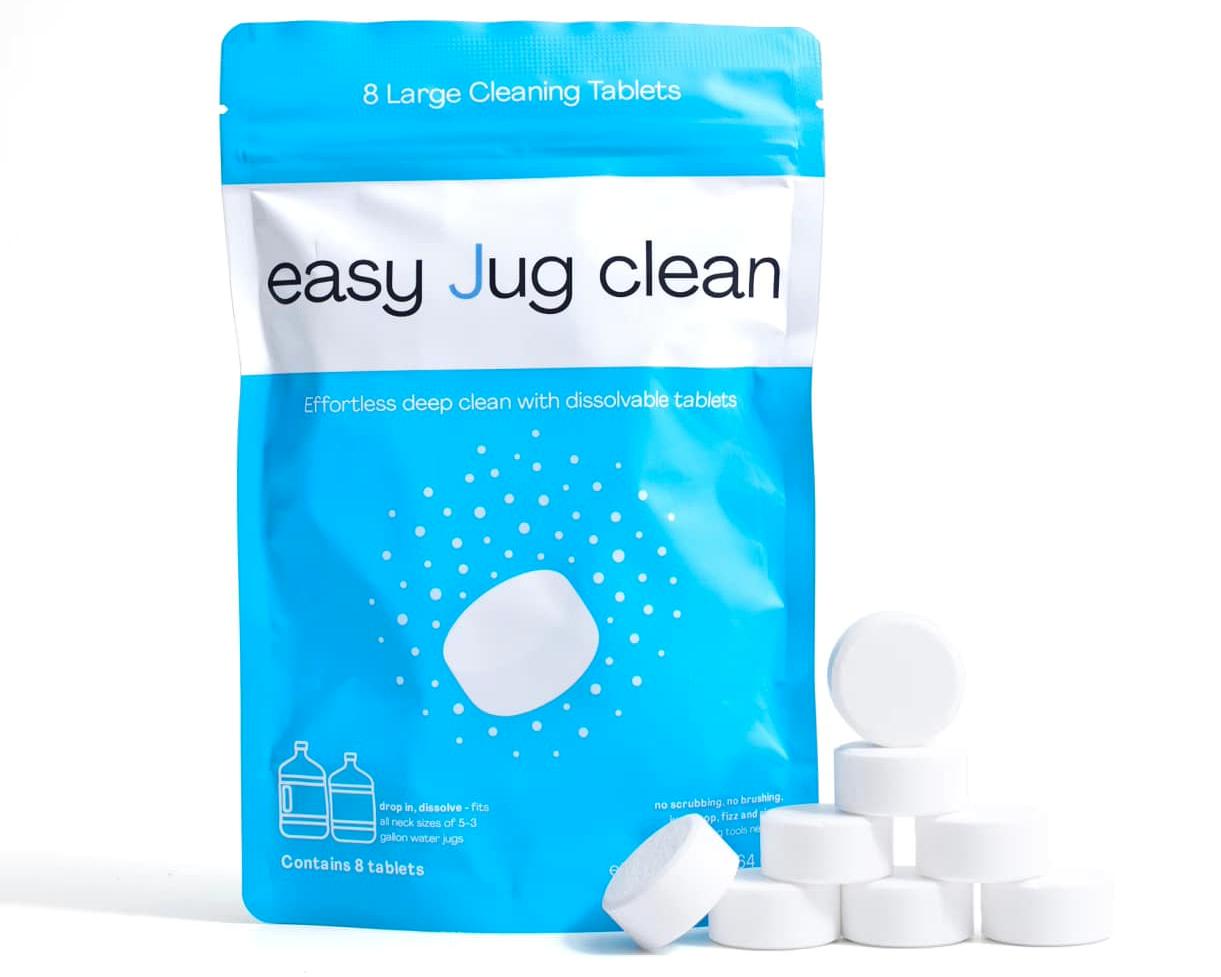
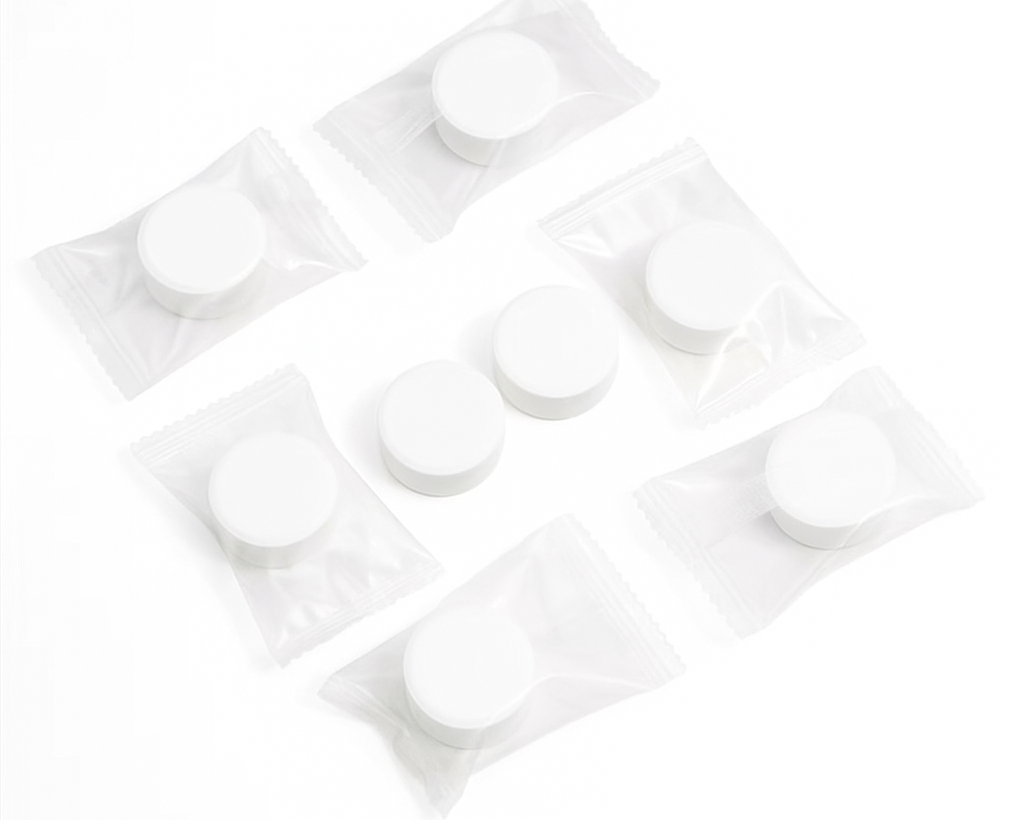
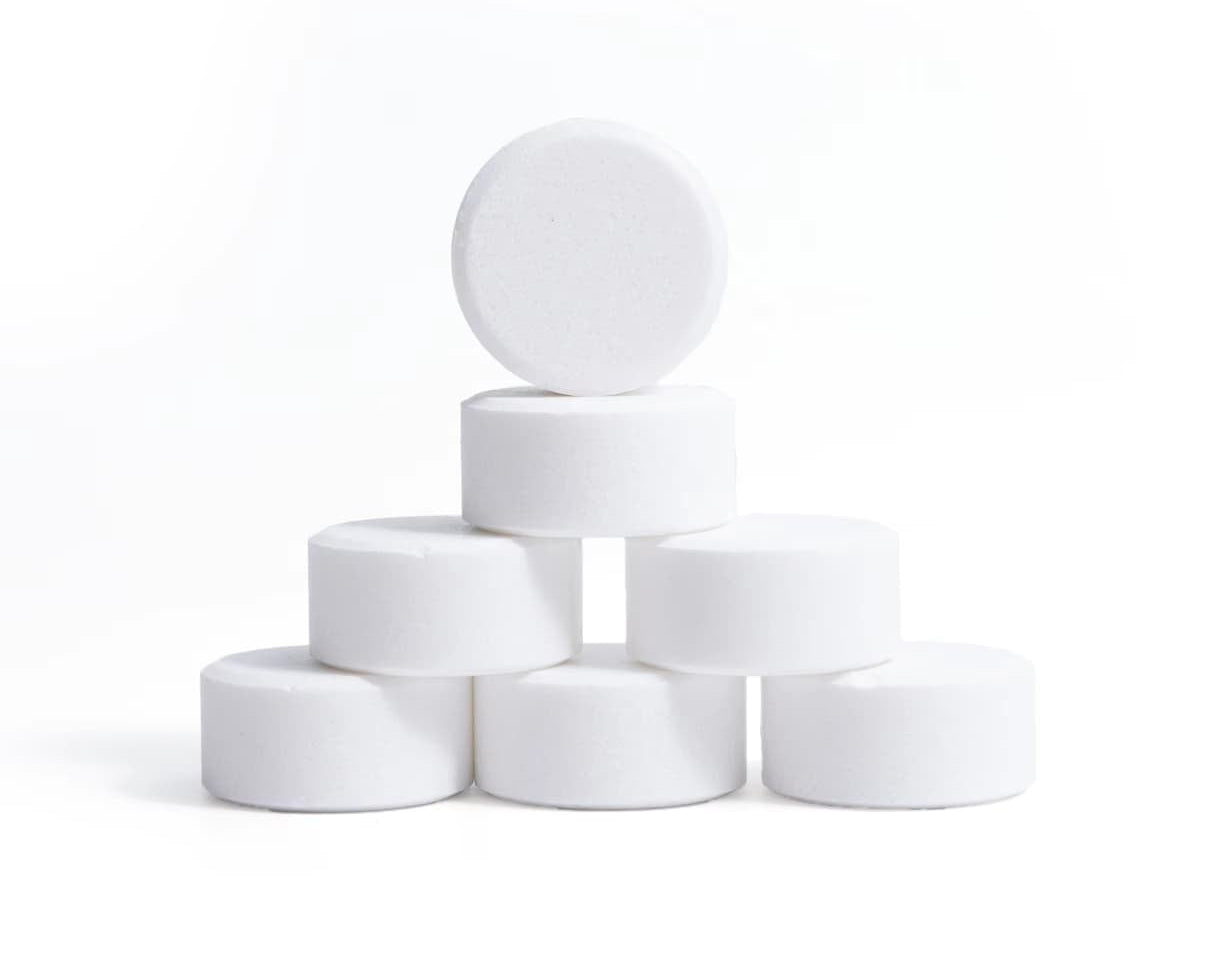
Drop 2 Easy Jug Clean tablets directly into the jug. No measuring, no mixing, no gloves required. The effervescent reaction begins within seconds as fumaric acid and sodium bicarbonate react, releasing CO₂ bubbles that distribute the cleaning solution across every interior surface while sodium percarbonate simultaneously releases active oxygen.
4
Allow to work for 20–30 minutes undisturbed. The sustained-release formula is designed for this window — it's not a quick reaction but a prolonged one that maintains active chemistry throughout. A gentle swirl at the 10-minute mark helps redistribute the solution for maximum wall coverage. No fumes. No need to leave the room. No protective equipment.
5
Drain and rinse 2–3 times with fresh water. Because all active ingredients break down into safe, food-compatible compounds (water, oxygen, sodium carbonate, citrates, gluconates), a standard 2–3 rinse cycle is completely sufficient. No extended rinsing protocols. No residue testing required.
6
Air-dry fully inverted before refilling. Allow 60+ minutes of air-drying before the next fill. A completely dry interior is the safest state for a stored water jug — bacteria require moisture to colonize.
Frequently Asked Questions About Safe 5 Gallon Jug Cleaning
Q: Is sodium percarbonate safe for a drinking water container?
Yes. Sodium percarbonate is the active sanitizing ingredient in Easy Jug Clean and is widely used in food and beverage industry cleaning applications for exactly this reason — it decomposes into water, oxygen, and sodium carbonate, leaving no toxic residue. It is recognized internationally as a safe alternative to chlorine-based sanitizers for food-contact surface cleaning.
Q: Are Easy Jug Clean tablets safe if a child accidentally touches one?
The ingredients are food-grade, but tablets should be stored out of reach of children as a standard precaution for any cleaning product. Contact with dry tablets should be followed by hand-washing. If a tablet is accidentally ingested, the food-grade ingredients are not expected to cause harm, but standard poison control guidance applies.
Q: Do I need gloves or ventilation when using Easy Jug Clean?
No. Unlike bleach or hydrogen peroxide, Easy Jug Clean produces no fumes, no skin irritants, and no volatile compounds during use. It can be used safely in any kitchen or utility space without protective equipment or special ventilation.
Q: Is Easy Jug Clean safe for BPA-free plastic jugs?
Yes. The formula is specifically designed to protect plastic surface integrity — including BPA-free materials like Tritan and HDPE. The glycerin in the formula actively conditions the plastic surface after cleaning, countering the surface roughening that harsher cleaners cause over time.
Q: How does Easy Jug Clean compare to other effervescent cleaning tablets on the market?
Most generic effervescent tablets rely on citric acid and sodium bicarbonate alone — which generates fizz but lacks the active oxygen release from sodium percarbonate needed for true sanitization, and the chelating action from sodium citrate and sodium gluconate needed for hard water scale. Easy Jug Clean's multi-system formula was designed specifically for the 5 gallon water jug cleaning challenge — not repurposed from a general cleaning tablet format.
The Safety Verdict: One Formula, Built for Drinking Water from the Ground Up
Safety in a water jug cleaner isn't a feature — it's the baseline requirement. Every ingredient in Easy Jug Clean was chosen because it meets the food-grade standard appropriate for a product used inside a drinking water container. No chlorine. No synthetic surfactant residue. No plastic degradation. No fumes. No guesswork about dilution ratios or contact times.
What you get instead: a published ingredient list you can verify, a formula built on the same active oxygen chemistry trusted by the food and beverage industry, and a cleaning result that protects both your family's health and the long-term condition of your jug. Drop two tablets. Wait 20 minutes. Rinse. That's what safe and effective looks like when it's done right.
It was really easy to clean, just drop it in and let it fizz and do its cleaning magic! The jug smelled and looked soooo clean after using this, I couldn’t believe it.



 Order now — get it by