Why Your Cleaning Routine Might Be Slowly Damaging Your Water Jug's Plastic
Routine Audit Plastic Safety Long-Term Damage · Reading time: ~7 minutes
The Five Plastic Damage Patterns — Diagnosed
Each damage pattern has a specific cause and a specific risk consequence. Identifying which patterns apply to your jug tells you which elements of your cleaning routine are the culprits.
Visual signs: Uniform haziness on jug walls visible in raking light; walls that were once glossy appear dull; walls that feel slightly rough to touch (you can feel micro-ridges with a fingernail)
Damage mechanism: Mechanical abrasion from bristle contact creating a population of micro-fractures at the surface layer. Each cleaning deepens existing scratches and creates new ones.
Consequence: Increased bacterial adhesion energy (rougher surface = more attachment sites = faster biofilm establishment). Increased microplastic release rate. Effectively permanent — scratches cannot be reversed.
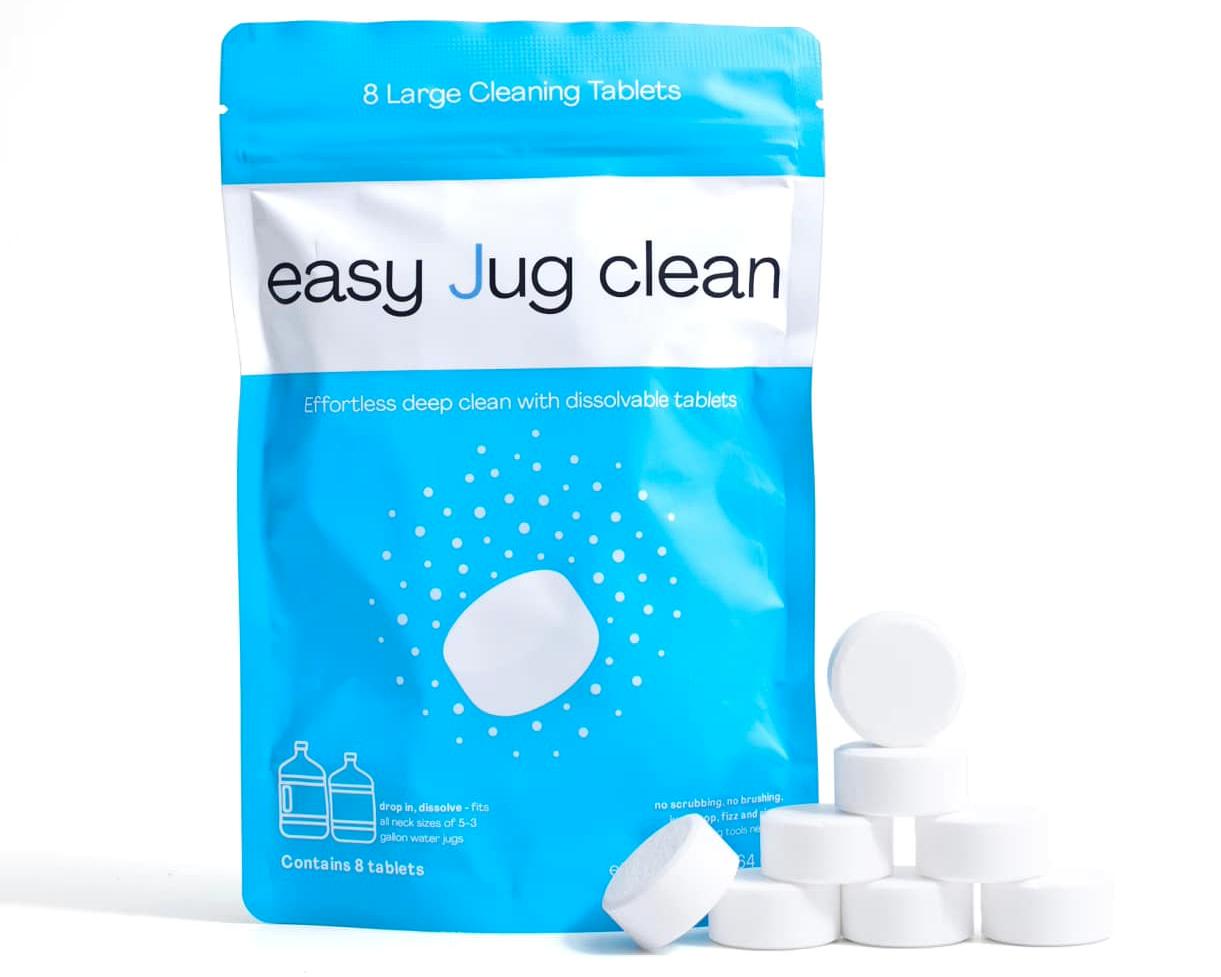
Fix: Stop brush use immediately. Switch to Easy Jug Clean. Glycerin surface conditioning will partially fill micro-fractures and reduce future bacterial adhesion advantage. Further scratch deepening stops from the first tablet treatment.
Visual signs: Jug that was originally clear or white now has a yellowish or amber tint, most visible when holding to a white background. More pronounced in polycarbonate than HDPE.
Damage mechanism: Bleach oxidation of aromatic groups in polycarbonate and some HDPE additives creates chromophoric groups — colored molecular structures that absorb blue light and reflect yellow/amber. Indicates significant polymer chain modification.
Consequence: Structural weakening, increased chemical migration rate, microplastic release at higher rates. Yellowed polycarbonate jugs have been shown to have higher BPA migration rates in some studies.
Fix: Stop bleach use. Yellowing cannot be reversed — the chromophoric groups are permanent. Consider replacement if yellowing is significant. Switch to Easy Jug Clean for all future cleaning to prevent further degradation.
Visual signs: Network of fine surface cracks, most visible in raking light or when the jug is gently flexed. Often appear as parallel lines running in stress directions of the plastic.
Damage mechanism: Bleach-induced embrittlement combined with mechanical stress (squeezing, flexing during cleaning) produces stress cracking. The oxidative chain scission reduces the polymer's crack propagation resistance.
Consequence: Crazed surfaces provide deep bacterial harboring sites that are unreachable by any chemistry. Structural integrity compromise. Significantly increased chemical migration.
Fix: Replace the jug — crazed plastic cannot be rehabilitated. Switch to Easy Jug Clean and gentle handling to prevent this in the replacement jug.
Signs: Water tastes of bleach, plastic, or "chemical" even after thorough rinsing. Smell from the interior even when empty. Smell/taste persists across multiple clean water fills.
Damage mechanism: Surface-bound organochlorines or volatile compounds from plastic degradation have adsorbed into the surface layer and continue releasing into water over time.
Consequence: Direct exposure to chemical migration products in drinking water. Persistent even after cleaning method change.
Fix: 3–4 consecutive Easy Jug Clean treatments to oxidize surface-bound compounds and lift them with surfactant action. May take 1–2 weeks to fully clear. If persistent after 6 treatments, replace the jug.
Signs: Walls remain glossy and smooth to touch. No discoloration. No persistent chemical smell. Internal walls feel slick (not rough) when running a fingertip along them during cleaning.
Maintenance method: Weekly Easy Jug Clean treatment, no brush use, no bleach, cool dark storage.
Action required: Continue. A jug in this condition will maintain its original surface properties indefinitely with consistent treatment, extending useful life by years compared to degradation-inducing methods.
See how Easy Jug Clean cleans a 5 gallon water jug in 20 minutes — no scrubbing required:


 Order now — get it by