cloudy dirty water jug for water dispenser needs to be cleaned

Cloudy Water Jug Walls: What's Causing It and How to Actually Fix It

Cloudy JugMineral ScaleDiagnosis Β· Reading time: ~6 minutes

Cloudy water jug walls look like a single problem but represent up to four distinct causes β€” and the treatment that resolves one type may be completely useless against another. The white cloudiness from mineral scale needs chelating chemistry. The grey cloudiness from micro-scratching needs surface conditioning and a permanent change in cleaning method. The milky cloudiness from soap film needs surfactant-specific treatment. Getting the diagnosis right is what makes the fix work β€” and this article gives you the complete diagnostic and treatment map.

Four Types of Jug Wall Cloudiness β€” Diagnosed

Type 1: Hard Water Mineral Cloudiness β€” Most Common

Appearance: White or off-white overall haziness, most concentrated at and below the waterline. May appear as a uniform film or as visible streaks and patches. Walls feel slightly rough or chalky to the touch.

Distribution: Typically heaviest at the waterline ring (where evaporation concentrates minerals), progressively lighter below, minimal above the waterline.

What's happening: Calcium carbonate and magnesium carbonate have precipitated from your hard water and deposited as a crystalline film bonded to the plastic surface. The cloudiness is the roughened scale surface scattering light rather than transmitting it.
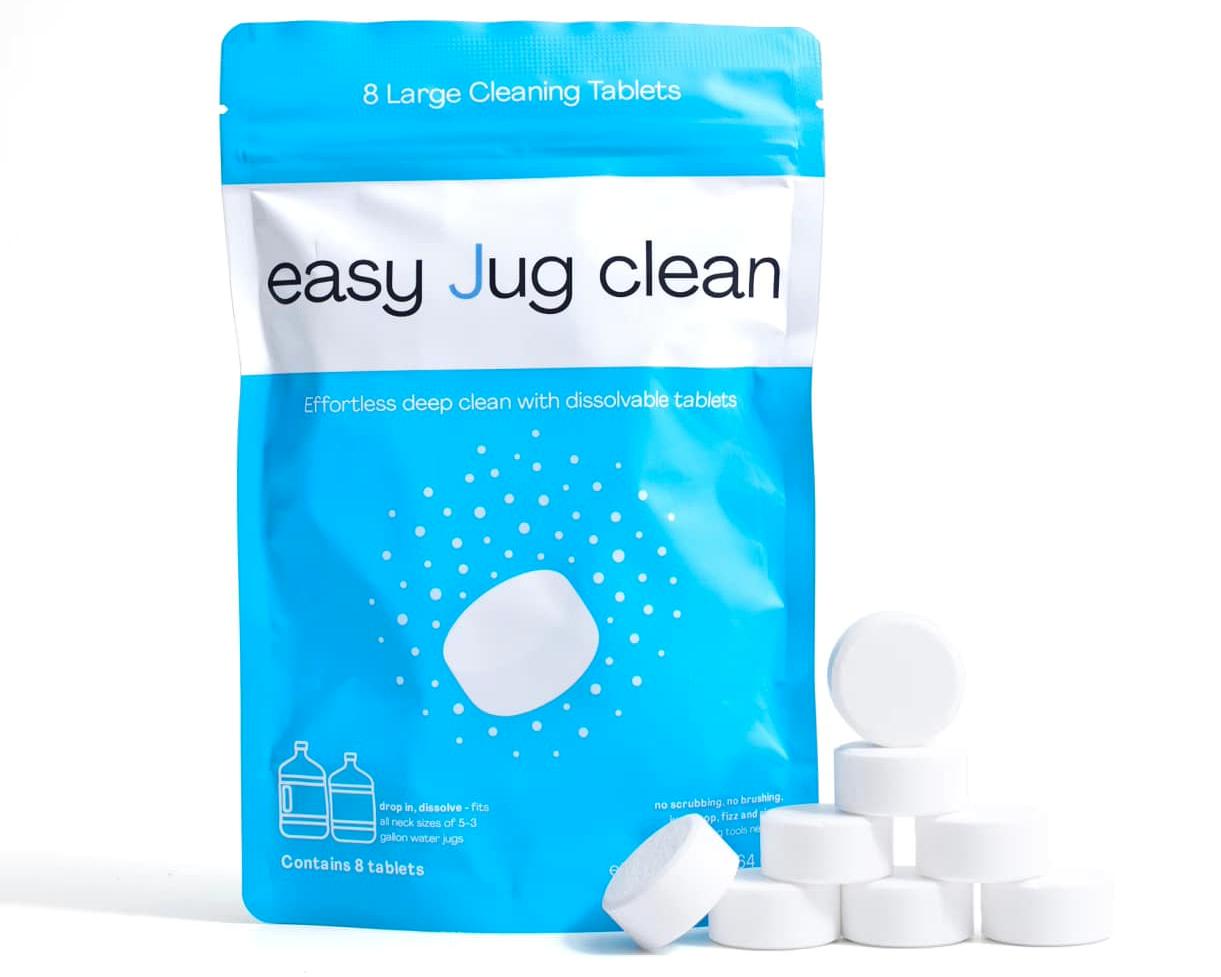
βœ… Fix: Easy Jug Clean's dual chelating system (sodium citrate + sodium gluconate) dissolves calcium and magnesium deposits by binding the mineral ions into soluble complexes. For light cloudiness: 1–2 standard treatments. For heavy buildup: 2–3 consecutive daily treatments. After treatment, the plastic should return to near-original transparency.
Type 2: Micro-Scratch Haze β€” Brush-Induced

Appearance: Fine, consistent haze distributed uniformly across wall surfaces β€” not concentrated at the waterline. Under strong raking light, fine parallel scratches may be visible. Walls feel slightly rough but in a different way than mineral scale β€” a surface texture rather than a deposit.

Distribution: Worst in the areas the brush has the most contact β€” upper walls and visible surface areas. Surprisingly consistent across surfaces rather than concentrated at waterlines.

What's happening: Repeated brush contact has created microscopic abrasion of the plastic surface layer. The micro-scratches scatter light that previously transmitted through the smooth surface, creating visible haze. This is physical damage to the plastic, not a deposit that can be removed.
βœ… Fix: This cloudiness cannot be fully reversed β€” the scratches are physical damage. Switching to Easy Jug Clean stops further scratch-deepening immediately, and the glycerin surface conditioner fills micro-fractures partially over several weeks of treatment, reducing the haze somewhat. If haze is severe, jug replacement may be the appropriate long-term answer.
Type 3: Biofilm Surface Film

Appearance: Slightly grey, irregular, patchy cloudiness that may be accompanied by a slippery feel when a finger runs along the wall. May have a faint brownish tinge in areas of dense colony development.

Distribution: Concentrated in low-turbulence zones β€” bottom corners, lower side walls, shoulder area. Often more pronounced where the jug has been still for extended periods.

What's happening: Mature biofilm EPS matrix has reached a thickness visible as surface cloudiness. The grey color comes from the accumulated organic matrix and bacterial mass.
βœ… Fix: 3-tablet aggressive Easy Jug Clean treatment (increased active oxygen concentration for established biofilm). Active oxygen destroys the EPS matrix, clearing the visual cloudiness along with the biological contamination. Confirm complete resolution by checking for absence of slippery feel after treatment.
Type 4: Soap Film Residue

Appearance: Iridescent or milky sheen distributed across wall surfaces. May appear more pronounced at certain viewing angles. Walls feel slick rather than rough. Often accompanied by a soapy taste in stored water.

Distribution: Relatively uniform β€” wherever the soap solution contacted the surface. Often most visible on upper walls where surfactant-water surface tension deposited a film on drying.

What's happening: Surfactant residue from dish soap has dried onto the plastic surface, forming a thin film that scatters light and dissolves slowly into stored water.
βœ… Fix: Easy Jug Clean treatment with an extended rinse protocol (3–4 rinse cycles instead of standard 2). The plant-based surfactant in Easy Jug Clean is more compatible with the plastic surface and rinses more completely than dish soap residue. Stop using dish soap for jug cleaning permanently.
Whether it's mineral scale or biofilm film or both, the cleaning process that addresses both causes uses chelation and active oxygen in combination.
βœ… The diagnostic shortcut: If the cloudiness is concentrated at the waterline and feels rough β€” mineral scale, treat with chelating chemistry. If it's uniform haze that appeared gradually over months and feels like surface texture β€” scratch damage, switch method and allow conditioning to work. If it's patchy and slippery β€” biofilm, aggressive active oxygen treatment. If it's uniform sheen with soapy feel β€” soap residue, thorough rinse and method change.

Β 

Watch Easy Jug Clean dissolve scale and odor buildup in a single 20-minute treatment:

Β 

βœ… Whatever's Clouding Your Jug β€” Easy Jug Clean Addresses It

β†’ Get Easy Jug Clean β€”

Related Reading


Back to blog