The Contamination Timeline: What Happens Inside a Water Cooler Jug Week by Week
Reading time: ~7 minutes | Contamination Timeline Week by Week Water Cooler Jug
The Contamination Timeline: What Happens Inside a Water Cooler Jug Week by Week
Day 1-2: The Jug is Installed
What's happening: A freshly cleaned jug is installed on the cooler or filled with water for the first time. The plastic is clean, but it's now exposed to air, microorganisms in the environment, and contact with hands and equipment.
Bacterial count: Near-zero to a few hundred per millilitre. The clean jug contains mostly planktonic bacteria (free-floating) rather than biofilm.
What you notice: Nothing. The water looks clear, tastes fine, has no odour.
What's actually happening at the microscopic level: Bacteria from the environment are beginning to settle on the plastic surface. Roughly one in a million surface bacteria stick permanently. This is called initial adhesion. Bacteria are beginning to sense their environment and express genes that allow them to attach more firmly.
Day 3-7: Initial Biofilm Formation
What's happening: Bacteria that have adhered to the plastic begin producing extracellular polysaccharides (EPS) — a sticky matrix of sugars and proteins. This matrix is the early biofilm. Bacteria also begin dividing, creating microcolonies.
Bacterial count: Rises to 10,000–50,000 per millilitre. Most are now attached to surfaces rather than free-floating.
What you notice: Still nothing obvious. Maybe a very slight cloudiness to the water if you look closely, or the faintest hint of an earthy smell if you bury your nose in the jug.
The danger: The biofilm is thin enough to avoid detection, but thick enough that it's now protected from antibacterial cleaners and your immune system. The bacteria inside the matrix can survive disinfectants that would kill planktonic bacteria instantly.
Week 2-3: Biofilm Matrix Establishes
What's happening: The biofilm layer thickens and develops internal structure. Channels form within the matrix, allowing nutrients and oxygen to flow through. Different bacterial species colonise different regions — some prefer the outer aerobic zone, others the anaerobic depths. The biofilm becomes a mini-ecosystem.
Bacterial count: Now in the millions per millilitre. A single square centimetre of biofilm can contain 100 million bacteria.
What you notice: The water begins to taste slightly different — maybe a hint of plastic, or a flat taste. The smell is now detectable if you pay attention. A slight sliminess might be visible on the jug walls if the biofilm is thick in certain areas. Many people still don't notice because they've been drinking from the same jug for two weeks and have normalised the gradual change.
The science: Bacteria are now producing volatile organic compounds (VOCs) as waste. Geosmin-producing bacteria create that earthy, musty smell. Sulfur-reducing bacteria produce hydrogen sulfide (rotten egg smell). Acetic acid bacteria create vinegar notes. Your sense of smell is detecting these chemical signals.
Month 1: Mature Biofilm, First Mineral Deposits
What's happening: The biofilm reaches full maturity — up to 100 micrometres thick (about the thickness of a human hair, though invisible to the eye). Mineral salts from the water (calcium, magnesium, silica) begin to crystallise within and on top of the biofilm, creating scale deposits.
Bacterial count: Stabilises at 10 million to 100 million per millilitre in the biofilm itself. Planktonic bacteria in the water remain lower (thousands to tens of thousands) because the biofilm is now a dominant ecological niche.
What you notice: The jug definitely smells now — earthy, musty, slightly off. The water has a noticeably different taste. If you look closely at the interior, especially the flat bottom and around the valve area, you might see a thin film or slight discolouration. The smell becomes obvious if you open the cap and inhale directly.
The deeper problem: At this stage, simple sanitisation is no longer sufficient — the mineral deposits protect bacteria underneath, and the thick matrix resists chemical penetration. You need active oxygen and mechanical action to break through.
Month 2-3: Resistant Biofilm, Visible Contamination
What's happening: The biofilm is now heavily mineralised and multi-layered. Dead bacterial cells accumulate within the matrix, adding to the structural complexity. Some areas have become anaerobic (oxygen-depleted), supporting a completely different bacterial ecosystem than the aerobic outer layers.
Bacterial count: Total biofilm load is likely 1–10 billion bacteria per jug. The water itself contains millions of planktonic bacteria.
What you notice: The smell is now strong and unmistakable — noticeably musty or off. The water tastes obviously different. You might see visible discolouration: brown, grey, or yellowish tints on the interior walls, especially near the bottom where moisture collects. The jug looks dirty even though it "looks clear" because most of the contamination is microscopic biofilm, not particulates.
Health risk escalation: At this bacterial load, you're consuming millions of microorganisms per glass of water. While most remain non-pathogenic, the probability of pathogenic species being present and active is rising. Vulnerable populations (immunocompromised, very young, elderly) face increased risk of infection.
Month 6+: Structural Discolouration, Persistent Contamination
What's happening: The biofilm has broken down some of the plastic polymer itself in certain areas. Degradation products (from UV exposure, heat cycles, or acidic bacterial waste) are visible as permanent discolouration. The biofilm is now so thick and complex that it's not just a surface — it's integrated into the material itself.
Bacterial count: 10–100 billion bacteria total. Some species have died and been replaced; others persist for months as spore-forming or highly resilient bacteria. The biofilm contains distinct ecological zones with different species composition at different depths.
What you notice: The smell is strong and unpleasant. The water tastes noticeably off. The interior of the jug is visibly discoloured and may have slime that you can feel if you touch it. At this point, most people would say "this jug needs cleaning" — but cleaning would have been far easier at month one or even at the initial biofilm stage.
Why cleaning becomes harder: The mineralised, thick biofilm resists standard cleaning methods. You might need longer soak times, stronger oxidising agents, or even mechanical scrubbing to break through. A simple tablet soak might not fully restore the jug at this stage.
The Weekly Cleaning Reset
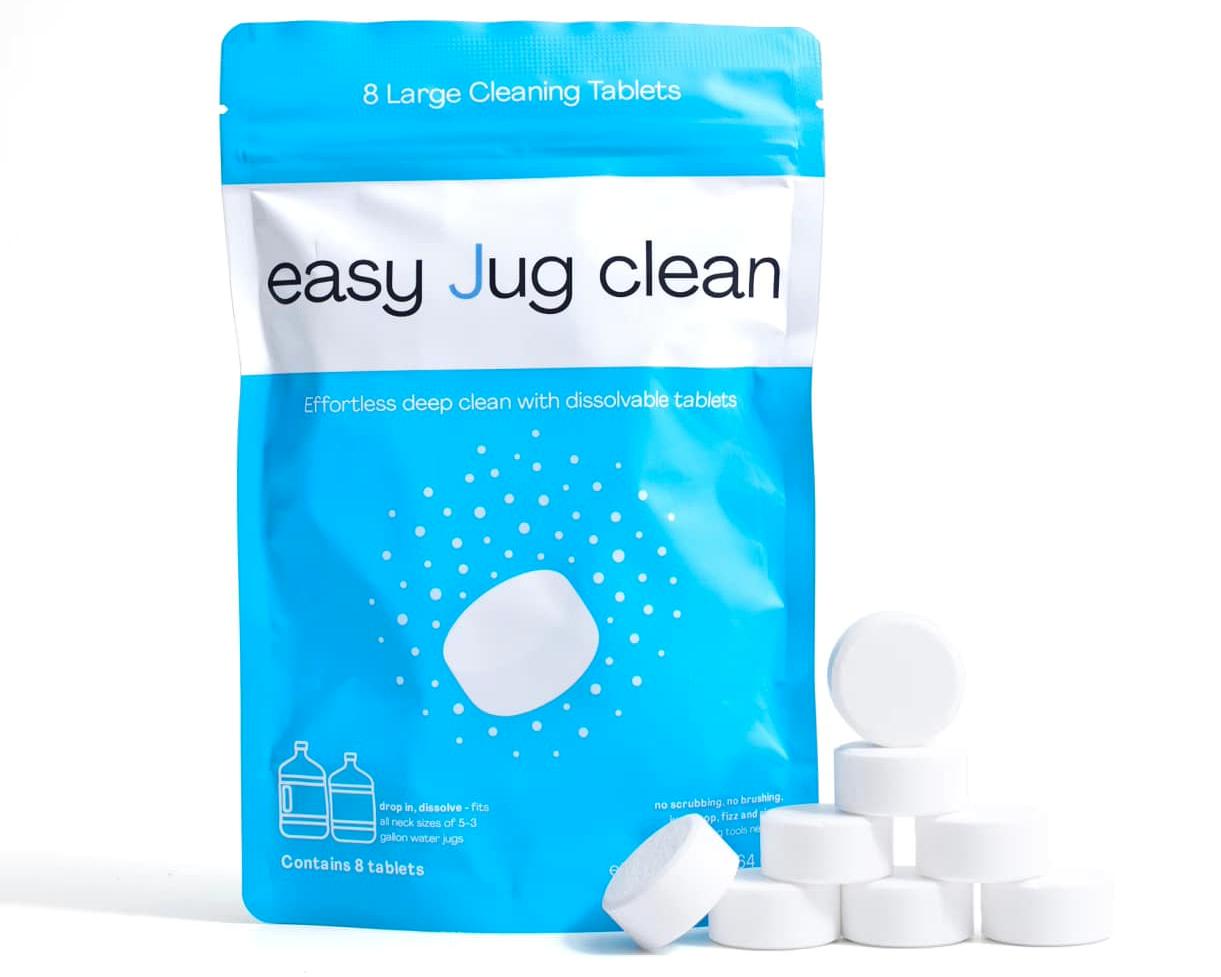
Here's what changes if you clean with active oxygen sanitisation like Easy Jug Clean on a weekly schedule:
Week 1 status: Initial biofilm is forming. No smell, no visible problem.
Clean with Easy Jug Clean. The active oxygen oxidises all bacteria and breaks apart the EPS matrix. The jug returns to near-zero contamination. The biofilm is completely disrupted before it reaches the thick, resistant stage.
Week 2-7 status: Biofilm restarts from Day 1. It never reaches the point where it becomes visible, produces strong smell, or becomes resistant to cleaning.
The result: You're essentially resetting the contamination timeline every week, before the biofilm reaches dangerous or difficult-to-clean stages. Your jug never smells, the water never tastes off, and you're never consuming billion-scale bacterial loads.
Why Monthly or Less-Frequent Cleaning Fails
If you clean every month instead of weekly, you're allowing the biofilm to reach Month 1 stage before resetting. At that point:
- The smell is obvious and unpleasant
- Mineral deposits have begun forming (harder to clean)
- Pathogenic species may have established themselves
- Cleaning takes longer and requires more aggressive methods
- People drink contaminated water for 25 of the 30 days
This is why offices with a weekly cleaning station have dramatically better water quality than offices that clean "as needed" (which rarely means "as often as actually needed").
The Science-Based Cleaning Schedule
Based on biofilm growth rates and the timeline above, the optimal cleaning frequency is:
- Home use: Every 2–3 weeks, or immediately upon any detected smell
- Office use: Weekly (higher contamination from multiple users, higher health risk)
- High-use commercial: Every 3–5 days
Weekly cleaning for offices isn't overcleaning — it's science-based prevention that keeps the biofilm timeline perpetually reset before it reaches visible, problematic, or dangerous stages.
Stay Ahead of the Timeline
Easy Jug Clean resets contamination to zero. Weekly cleaning means your jug never reaches the stages where biofilm becomes visible, smell becomes obvious, or pathogens thrive. Just for 8 tablets.
Shop Easy Jug Clean
Watch Easy Jug Clean stop the contamination cycle — week after week:


 Order now — get it by