What Hard Water Does to Your 5 Gallon Water Jug Over Time
Reading time: ~7 minutes | Hard Water Long-Term Effects 5 Gallon Jug
The Progressive Timeline: From First Fill to Deterioration
Invisible mineral film forms
Calcium and magnesium carbonates begin precipitating onto the interior surface with every fill and evaporation cycle. At this stage, the deposit is microscopically thin — a molecular-level roughening of the previously smooth plastic surface. No visual change is detectable. The surface is already becoming fractionally more hospitable to bacterial attachment than it was when new.
Waterline ring becomes visible
The area where water meets air — the waterline — accumulates deposits fastest because evaporation concentrates minerals at this zone. A faint white or chalky ring becomes visible around the interior, often most pronounced at the fill line. The surface beneath the waterline is now rough enough to significantly accelerate biofilm attachment compared to week one. Bacteria colonize scale surfaces 2–3× faster than smooth plastic.
General cloudiness develops throughout
Scale deposits extend beyond the waterline ring to cover the full interior surface area. The jug walls develop visible cloudiness visible in normal lighting. The rough scale texture now provides thousands of anchor points per square centimeter for biofilm EPS matrix attachment. Hard water scale and biofilm have begun their co-amplification cycle — scale accelerates biofilm formation, and biofilm provides nucleation sites for additional scale deposition.
Scale layers thicken; bacteria become encapsulated
With ongoing deposition, scale layers build to a thickness where bacterial colonies become physically encapsulated beneath mineral crust. This is the point where standard sanitizing agents — even strong ones — may fail to reach bacteria that are now sealed under calcium carbonate layers. The water in the jug may begin showing faint mineral turbidity or white particles from flaking scale.
Scale etching and permanent surface damage
Extended scale accumulation on plastic eventually causes permanent etching of the surface — particularly if acidic cleaning attempts (vinegar, citric acid products) have partially dissolved and re-precipitated mineral layers repeatedly without fully clearing them. The plastic surface now has microscopic pitting that cannot be reversed by any cleaning chemistry. Biofilm establishes faster after every clean, requiring more aggressive treatment to achieve the same result.
The Scale-Biofilm Amplification Cycle: Why Each Makes the Other Worse
How Hard Water Affects Different Jug Materials Differently
| Material | Scale Adhesion | Long-Term Surface Effect | Best Maintenance Approach |
|---|---|---|---|
| HDPE (standard blue/white jugs) | Moderate | Surface roughening accelerates with age | Weekly chelating treatment essential |
| Tritan copolyester (clear) | Lower — smoother surface | More resistant to etching | Weekly treatment; visible cloudiness sooner |
| Polycarbonate (older jugs) | Moderate-high | Scale deposits in micro-cracks | Weekly + consider replacement if old |
| Glass | Low — non-porous surface | Scale rinses more easily; no surface etching | Weekly treatment; easier to restore |
What Hard Water Hardness Level Does to Your Cleaning Timeline
Your local water hardness is the single biggest variable in how aggressively you need to clean your jug. The scale accumulation rate scales roughly linearly with mineral content — meaning a jug in Phoenix (very hard water, 300+ mg/L) accumulates scale in about one-third the time of the same jug in Seattle (soft water, 20–40 mg/L).
The Right Treatment for Hard Water Jug Damage
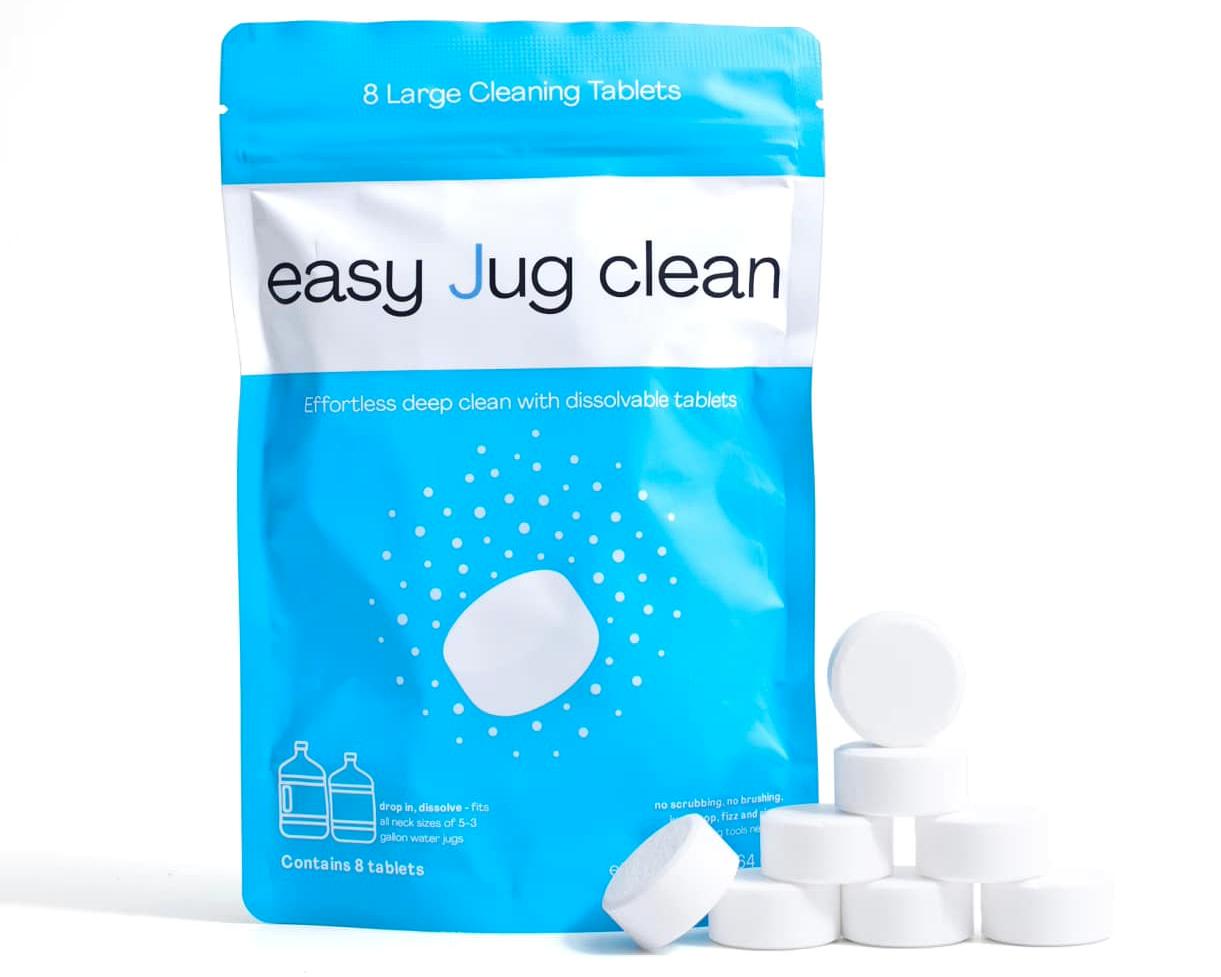
Reversing hard water damage requires chelating chemistry — agents that bind the calcium and magnesium ions in the scale deposits and hold them in solution so they rinse away. Easy Jug Clean contains two chelating agents specifically for this purpose:
- Sodium citrate — binds calcium ions preferentially, dissolving the calcium carbonate that forms the primary component of hard water scale
- Sodium gluconate — complementary chelation targeting additional mineral species, stabilizing the cleaning system and preventing re-deposition during the rinse phase
For a jug with significant accumulated scale — months of buildup in a hard water area — two consecutive treatment cycles on back-to-back days may be needed to fully restore transparency. After that, weekly maintenance prevents the cycle from restarting.
Watch Easy Jug Clean dissolve scale and odor buildup in a single 20-minute treatment:
✅ Stop the Timeline Before It Starts
Easy Jug Clean's dual chelating formula dissolves mineral deposits before they compound — keeping your jug in week-one condition month after month. for a full month of weekly treatments.
Frequently Asked Questions
Q: Can I reverse years of hard water damage in a single treatment?
Moderate scale accumulation (up to a few months) typically clears in 1–2 Easy Jug Clean treatments. Extensive multi-year buildup may require 3–5 consecutive treatments over a week, allowing each treatment to dissolve layers progressively. Permanent surface etching — the microscopic pitting that develops after years of neglected scale — cannot be reversed by cleaning chemistry, but the surface can be stabilized and future damage prevented through weekly maintenance.
Q: Does water softener installation eliminate the need for jug cleaning?
A water softener dramatically reduces scale formation by replacing calcium and magnesium ions with sodium ions. It does not eliminate biofilm risk, which persists regardless of water softening. Weekly Easy Jug Clean treatment remains appropriate — though in very soft water households, the descaling interval could potentially extend to 10 days for the scale-removal component. The sanitizing function remains weekly.


 Order now — get it by