Why Hand-Washing Works for a Sports Bottle But Fails Completely on a Large Water Bottle
Reading time: ~5 minutes | Hand-Washing Mechanical Cleaning Geometry
What Hand-Washing Actually Requires
Hand-washing assumes four conditions:
- Hand or tool access to interior surfaces. The opening admits a hand, brush, or sponge that can physically contact the walls.
- Mechanical force application. The user can apply pressure with the cleaning tool to dislodge biofilm and lift residue.
- Visual feedback. The user can see what's clean and what isn't, adjusting effort accordingly.
- Adequate rinse capability. Water can flow through the container with enough turbulence to carry away soap residue and dislodged debris.
Sports bottles satisfy all four. Wide-mouth opening, accessible interior, visual inspection possible, fast water flow during rinsing. Hand-washing works as expected.
Why Each Condition Fails for 5-Gallon Jugs
Hand and Tool Access — Fails
Mechanical Force Application — Fails
To scrub effectively, you need a tool you can press against the surface and move with significant force. A long-handled brush in a 5-gallon jug provides almost no force at the brush head — the long handle introduces flex, and the awkward access angle prevents the user from pressing inward against the wall. Even when the brush contacts the surface, the contact pressure is far below what's needed to dislodge mature biofilm.
Visual Feedback — Fails
The 1.4-inch opening doesn't provide useful visual access to the 800-square-inch interior. You can't see most of the wall surface. You can't tell which areas are clean and which aren't. Visual feedback is the diagnostic loop that tells you when hand-washing is done — and the loop is broken in narrow-neck containers.
Adequate Rinse Capability — Fails
The same narrow neck that limits cleaning access also limits rinse turbulence. Water enters and leaves a 5-gallon jug slowly during rinsing. The flow rate isn't sufficient to lift soap residue from interior surfaces or carry away dislodged debris. Soap residue clings to the walls long after rinsing, affecting taste in subsequent water.
The Hand-Washing Sports Bottle Routine vs. Its 5-Gallon Equivalent
| Cleaning Step | Sports Bottle | 5-Gallon Jug |
|---|---|---|
| Apply soap to interior | Pour soap, swirl — coats everything | Pour soap, sinks to bottom — coats nothing in upper walls |
| Scrub with brush/sponge | Reach all surfaces, apply force | Reach 50% of surfaces, apply minimal force |
| Visually inspect | Easy through wide opening | Impossible through narrow neck |
| Rinse thoroughly | High water turbulence carries soap out | Low water turbulence leaves soap behind |
| Air-dry inverted | 4 hours, fully dry | 12+ hours, residual moisture |
| End result | Clean | Cleaner than before, but not clean |
The Compounding Problem of Repeated Hand-Washing
Each unsuccessful hand-washing attempt leaves the jug slightly worse than the previous one:
- Soap residue accumulates from each cycle's incomplete rinse
- Brush use creates micro-scratches that harbour future bacteria
- The "clean enough" perception means the jug doesn't get treated with effective methods
- Biofilm continues to mature between cleaning attempts
After months of regular hand-washing, a 5-gallon jug can be in worse hygienic condition than one that was simply rinsed without any soap or brushing — because the soap residue and scratch damage compound while the underlying bacterial problem isn't being addressed.
Why Tablet Cleaning Replaces Hand-Washing for Large Bottles
The four conditions hand-washing requires aren't met by 5-gallon jug geometry. The cleaning method that works has to satisfy a different set of conditions:
- Self-distributing chemistry that contacts surfaces no tool can reach.
- Active oxidation that destroys biofilm without mechanical force.
- Diagnostic-by-result rather than diagnostic-by-visual — the cleaning solution discoloration tells you what's been lifted.
- Clean-rinsing chemistry that doesn't leave residue clinging to inaccessible walls.
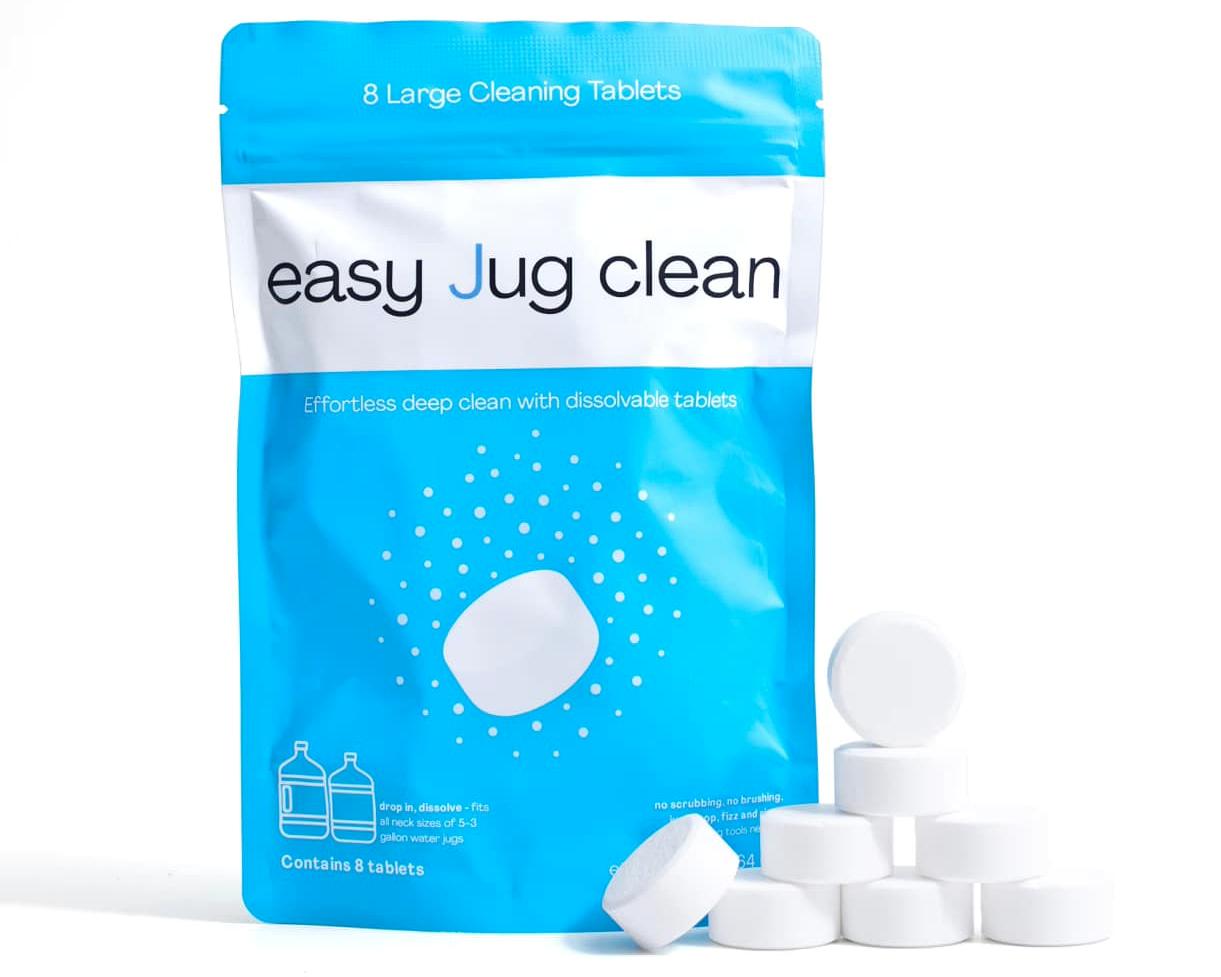
✅ Cleaning That Doesn't Need Your Hands Inside the Container
Drop two tablets in warm water. Wait 20 minutes. Rinse. The cleaning method built for the geometry your hands can't reach.
FAQ: Hand-Washing Limitations
Q: Should I still hand-wash the exterior of my 5-gallon jug?
Yes. The exterior gets handled, dust-coated, and benefits from a soapy wipe. Just don't confuse exterior cleaning with interior cleaning — they're separate problems with separate methods.
Q: Is there any version of hand-washing that works for 5-gallon jugs?
Not effectively. The engineering reason 5-gallon jugs cannot be adequately cleaned by hand covers this thoroughly. Even commercial bottling facilities don't hand-wash 5-gallon jugs — they use rotating spray nozzles inserted through the neck, which requires equipment most consumers don't have access to.
Q: What about using a high-pressure hose into the jug?
It helps but doesn't solve the problem. Pressurized water dislodges loose material but doesn't penetrate biofilm. And the pressure can damage the polycarbonate over time. Active oxygen chemistry handles the biofilm part of the problem in a way pressure alone cannot.
The Bottom Line
Hand-washing is a technique that depends on container geometry. When the geometry permits it — wide mouth, accessible interior, visual inspection — it works beautifully. When the geometry doesn't permit it — narrow neck, inaccessible interior, no visual feedback — the same technique fails completely. Use the cleaning method matched to the container geometry, and the limitation stops being a problem.


 Order now — get it by