The Engineering Reason 5 Gallon Water Jugs Cannot Be Adequately Cleaned by Hand
Reading time: ~9 minutes | Engineering 5 Gallon Jug Design Cleaning Physics
The Engineering Reason 5 Gallon Water Jugs Cannot Be Adequately Cleaned by Hand
Problem Definition: The Paradox of the Narrow-Mouth Deep Container
A 5-gallon water jug presents a classic fluid handling challenge: it's a deep, narrow-mouth container designed for storage and easy portability, not for cleaning. The design optimizes for these goals at the expense of cleanability.
The typical jug dimensions are approximately 12 inches in height and 8-9 inches in diameter, with a neck opening of roughly 1.5-2 inches. This geometry creates several independent physical and chemical problems that compound when you attempt manual cleaning.
I. Access Physics: The Leverage and Reach Problem
The Constraint: A bottle brush is typically 8-16 inches long with a head diameter of 2-3 inches. A 5-gallon jug opening is 1.5-2 inches. This is a severe geometric mismatch.
The Physics: When inserting a brush through the neck, you lose mechanical advantage. A brush is designed to be held at the handle and pushed downward, relying on gravitational force and arm-applied pressure. Once inserted into a jug, the effective lever arm becomes the exposed portion of the brush (typically 3-6 inches), and you cannot apply force perpendicular to the jug walls effectively because your arm/hand cannot reach past the neck opening.
Angular Coverage: The human arm cannot maintain contact with all interior wall surfaces simultaneously. From the standing position holding a jug, your brush can effectively contact approximately 40-60% of interior wall area if you're diligent about rotating the jug and moving the brush up and down. The lower curves and the bottom-center region remain perpetually under-reached.
Force Distribution: Manual brushing applies concentrated force at discrete contact points. The pressure is not uniform across the jug surface. Corners and lower curves receive significantly less contact pressure than upper walls, which means biofilm in these low-pressure areas survives the cleaning attempt.
II. Fluid Dynamics: Why Water Movement Alone Cannot Achieve Sanitization Contact Time
The Requirement: Sanitization chemistry requires contact time. Most disinfectants need 5-20 minutes of continuous contact with a contaminant to achieve microbial kill rates above 99%. This is a documented requirement in water treatment science.
The Manual Problem: When you rinse your jug by pouring water in and sloshing it around, the water follows turbulent and laminar flow patterns that do not guarantee contact with all interior surfaces. Water movement in a cylindrical container creates preferential flow paths.
The Fluid Dynamics Detail: Water poured into a vertical cylinder tends to flow along the sides in a helical pattern if you're rotating the jug, or down the center if you're simply pouring and draining. The boundary layer (the thin layer of fluid in contact with the surface) near the jug walls is extremely thin — on the order of 0.1-0.5 millimeters in turbulent flow. This thin boundary layer receives poor mixing and renewal during simple rinsing.
Biofilm exists in protected layers within the jug wall's microstructure. The flow patterns from manual rinsing do not generate sufficient shear stress at the wall to dislodge biofilm. Shear stress required to remove biofilm is typically in the range of 1-5 Pascal units. Manual rinsing generates shear stress of approximately 0.01-0.1 Pascal — roughly 10-100 times insufficient.
The Turbulence Problem: Turbulent flow theoretically provides better mixing, but achieving turbulence in a tall, narrow jug via manual motion is difficult. Most home rinsing produces laminar or transitional flow, which is the worst-case scenario for biofilm removal because fluid simply slides past contaminated surfaces without disrupting the biofilm matrix.
III. Chemical Constraints: Surface Adhesion and Biofilm Chemistry
Biofilm Matrix Composition: Biofilm is not a simple layer of cells. It's a complex polysaccharide matrix secreted by bacteria. This matrix is hydrophobic on the outer surfaces and has both ionic and covalent interactions with the plastic substrate.
The Plastic Problem: Polycarbonate and similar plastics used for water jugs have surface energy characteristics that favor microbial adhesion. The polymer chains provide chemical bonding sites for biofilm exopolysaccharides. Once established, biofilm is not simply "dirty" — it's chemically bonded.
What Manual Methods Cannot Do: Brushing provides mechanical force that can break weak adhesions, but it cannot break chemical bonds. Water alone cannot displace biofilm because water molecules are polar and biofilm matrix is partially hydrophobic. The hydrophobic portions actively repel water.
Biofilm also exhibits what's called the "persister cell" phenomenon. Within a biofilm, a small percentage of cells enter a dormant state with thickened cell walls. These persister cells are resistant to both mechanical disruption and chemical attack. Manual cleaning cannot eliminate persister cells because they're shielded by the matrix itself.
IV. Surface Chemistry: Why Scratched Plastic Gets Progressively Worse
The Micro-Scratch Problem: Bottle brush use creates micro-scratches in the jug's plastic surface. These scratches are typically 1-10 micrometers deep. This may sound trivial, but at the microbial scale, these scratches become canyons.
Biofilm Preference for Roughened Surfaces: Bacteria preferentially colonize rougher surfaces because roughness increases surface area and provides protective pockets. A smooth plastic surface has a specific surface area of approximately 1 unit. The same surface with brush-induced micro-scratches has increased effective surface area by 30-50%, depending on scratch depth and density.
The Self-Perpetuating Problem: As scratches accumulate, surface area increases, biofilm colonization increases, and biofilm presence accelerates further scratching (biofilm produces acids that degrade polymer). This creates a positive feedback loop where the jug becomes progressively more prone to contamination with each manual cleaning attempt.
Brush Bristle Cleanliness: Bottle brush bristles are notoriously difficult to clean between uses. Biofilm and organic material lodge between bristles and dry there. When you use a brush on your "clean" jug, you're potentially transferring biofilm from the brush itself to the jug. This is a well-documented problem in food safety literature.
V. Thermodynamic Constraints: Temperature and Chemical Reaction Rates
The Temperature Requirement: Chemical reaction rates follow the Arrhenius equation, which states that reaction rate approximately doubles for every 10°C increase in temperature (the Q₁₀ rule). At room temperature (20°C), most disinfectant chemistry proceeds slowly. At elevated temperature (45-50°C), reaction rates are significantly faster.
The Manual Problem: When you rinse your jug with tap water, you're using whatever water temperature comes from your tap — typically 40-50°C at best, and cooler if you start with stored tap water. This temperature is maintained for only a few minutes (during your rinsing action). The moment you stop rinsing, temperature begins to drop.
Sanitization Requirements: To achieve 99.9% microbial kill rates (the practical standard for drinking water containers), most sanitizers require either (a) specific chemical concentrations at room temperature for 10-20 minutes, or (b) lower chemical concentrations at elevated temperature (50-60°C) for 5-10 minutes. Manual rinse water cannot maintain adequate temperature and concentration simultaneously.
Thermal Mass Problem: A 5-gallon jug holds 19 liters of water, weighing roughly 19 kilograms. This large thermal mass means that when you pour in hot water, it cools rapidly as it contacts the room-temperature plastic walls. The effective sanitization temperature is typically 5-10°C lower than your starting water temperature within 2-3 minutes.
VI. Time and Dose Requirements: Why "Good Enough" Doesn't Exist
The Sanitization Standard: The EPA and NSF International define sanitization as achieving at least a 3-log (99.9%) reduction in target microorganisms. This is not a guideline — it's a standard. For drinking water containers, the target is typically Escherichia coli, Staphylococcus aureus, and common mold/yeast species.
The Dose-Time Relationship: Achieving a 3-log kill requires a specific combination of disinfectant dose and contact time. For bleach-based sanitizers, this might be 100 ppm for 10 minutes. For oxidizing agents, it might be 200 ppm for 5 minutes. There is no "partial" sanitization that's still acceptable — below the threshold, you get either microbes or you don't, and there's no safe middle ground for drinking water.
The Manual Impossibility: Manual cleaning cannot deliver consistent dose and time across all interior surfaces. The top of the jug might receive higher sanitizer concentration than the bottom. The interior walls receive contact for varying durations as you move the brush or rinse water around. Some areas get overdosed; others get under-dosed. By definition, under-dosed areas do not achieve sanitization.
Why Tablet-Based Cleaning Solves These Constraints
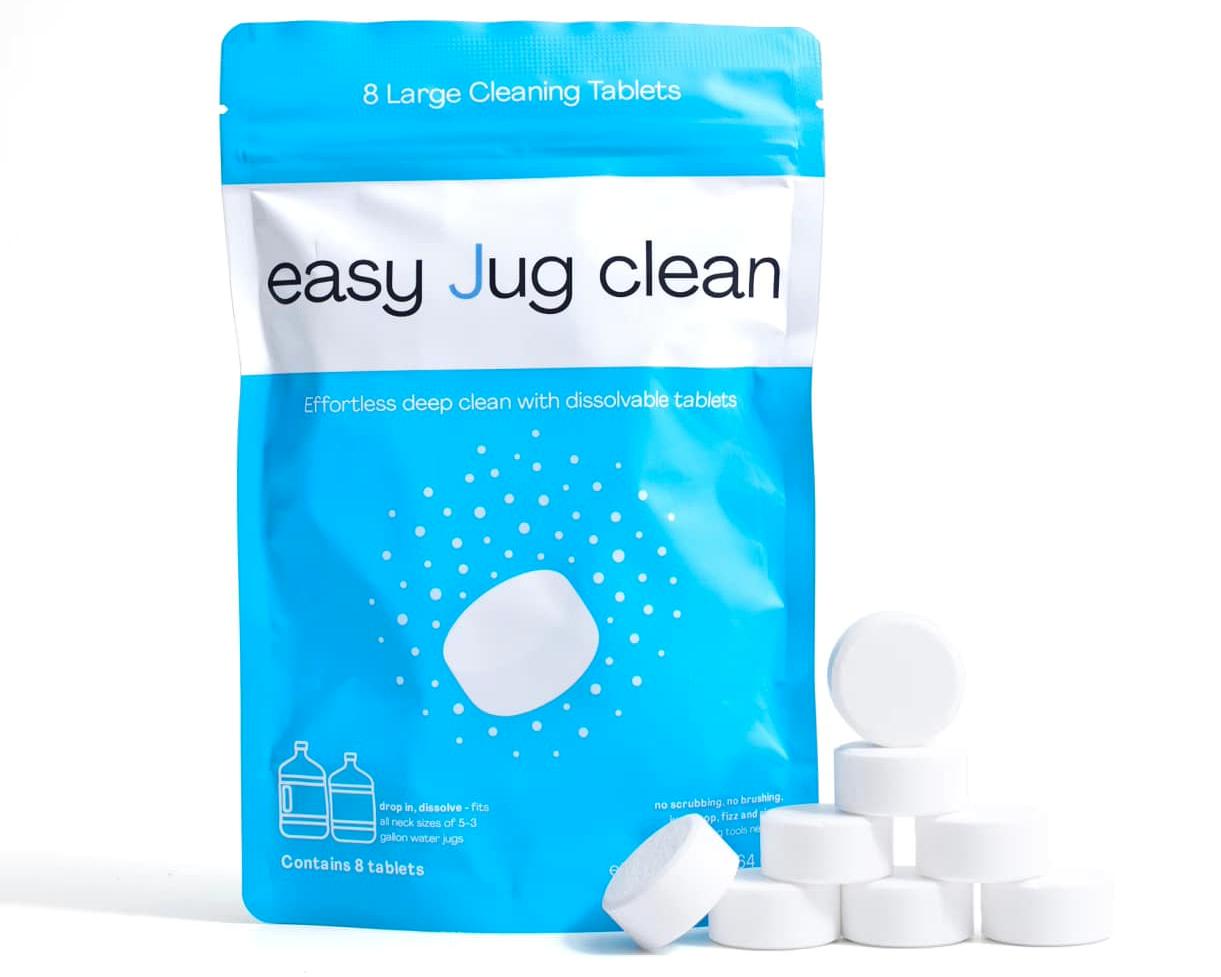
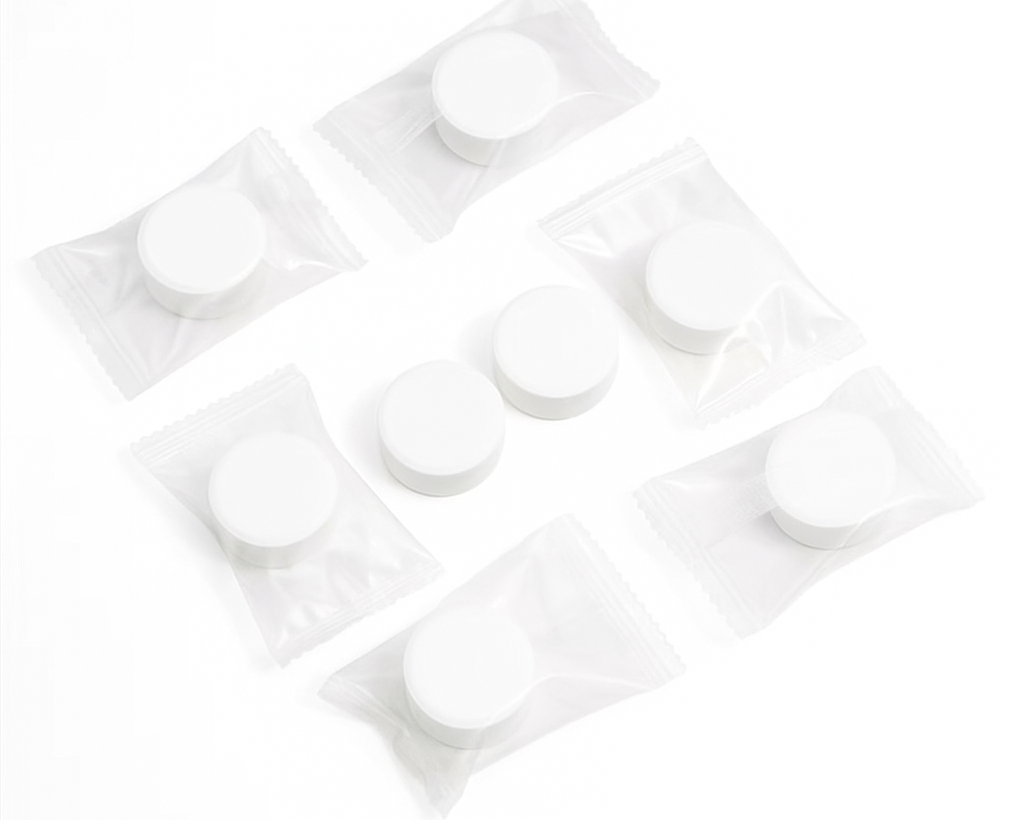
Easy Jug Clean tablets work because they address each engineering constraint directly:
- Access: Tablets don't require manual positioning. The chemical solution self-distributes throughout the entire jug volume through diffusion and convection.
- Fluid dynamics: The fizzing action from effervescence creates micro-turbulence throughout the jug, generating shear stress in all boundary layers and dislodging biofilm.
- Chemistry: The active oxygen and chelating agent formulation breaks biofilm matrix bonds and kills persister cells through oxidative mechanisms that manual cleaning cannot achieve.
- Surface chemistry: The chemistry works without creating micro-damage, so it doesn't create roughened surfaces that promote future biofilm colonization.
- Thermodynamics: The reaction proceeds at room temperature, which means you don't need to maintain elevated water temperature. The chemical reaction rate is engineered into the tablet formulation.
- Dose and time: Each tablet delivers a known chemical dose that's distributed throughout the jug volume. The 20-minute reaction time is calibrated to achieve consistent 3-log kill rates across all interior surfaces simultaneously.
The tablet approach is not "better brushing." It's a fundamentally different solution that bypasses the physical and chemical impossibilities of manual methods.
Frequently Asked Questions
Q: Could improved brush technique overcome the access problem?
No. The fundamental constraint is geometric — a brush's lever arm and the human arm's reach are limited by the jug's 1.5-2 inch opening diameter. No technique can overcome this. The bottom 20-30% of the jug interior is unreachable by brush from the top. The lower curves (where the flat bottom meets vertical walls) are inherently difficult to contact with adequate pressure.
Q: What if I use hotter water for rinsing?
Hotter water helps temporarily because it increases chemical reaction rates and can help dissolve some biofilm components. However, it doesn't solve the fundamental problems of incomplete coverage (access physics), insufficient contact time (fluid dynamics), or the chemical bonding nature of biofilm adhesion. You'd need sustained elevated temperature for 15-20 minutes with a disinfectant chemical, not just hot tap water for 2-3 minutes.
Q: If I scrub longer and more vigorously, can I achieve sanitization?
No. Longer brushing creates more micro-scratches, which actually makes the problem worse by increasing surface roughness and biofilm adhesion sites. Additionally, brushing is mechanical force, not chemical, so it doesn't kill persister cells within the biofilm. More effort amplifies the damage-to-benefit ratio.
Q: Why not combine manual brushing with chemical sanitizers?
You could, and some people do. However, brushing introduces the micro-scratch problem and carries risk of transferring bacteria from the brush itself. If you're going to use a chemical sanitizer anyway, the tablet-based approach is simpler, safer, and doesn't create the surface damage that future cleanings must remediate.
Conclusion: Engineering Has a Solution
The reason 5-gallon water jugs cannot be adequately cleaned by hand is not a matter of effort or technique — it's a matter of physics, chemistry, and thermodynamics. The jug's geometry prevents adequate access and force delivery. Its surface chemistry promotes biofilm adhesion that mechanical force cannot break. Achieving sanitization requires dose-time relationships that manual contact cannot guarantee.
This isn't a failure of the user. It's a fundamental engineering constraint of the jug design itself. The solution isn't to try harder with a brush — it's to use a method that doesn't depend on manual labor: Easy Jug Clean's tablet-based chemistry, which achieves complete sanitization in 20 minutes by addressing every engineering constraint simultaneously.
Physics doesn't negotiate. Chemistry does.
✅ The Engineering Solution for an Engineering Problem
Manual cleaning fails because of physics and chemistry, not technique. Easy Jug Clean solves the unsolvable: it reaches every interior surface, maintains consistent sanitizer concentration, kills microorganisms reliably, and doesn't damage the jug in the process. This is why sanitization professionals use tablet-based methods.


 Order now — get it by