Why Water Jug Mold Is Different from Bathroom Mold (You Might Be Surprised)
Reading time: ~5 minutes | Mold Comparison Species Differences Cleaning Context
What "Mold" Actually Refers To in Each Context
Mold isn't a single thing. The word covers thousands of fungal species across hundreds of genera, each with its own preferred environment. The species that establish in bathroom grout are largely different from the species that grow inside a sealed water container. The reason is simple: they prefer different food, different humidity profiles, and different surface chemistry.
Bathroom mold is most often Cladosporium, Aspergillus, occasionally Aureobasidium (the pinkish "shower curtain mold"), and on damaged drywall, Stachybotrys chartarum. These species thrive on cellulose-containing materials — caulk, paint, drywall, fabric — and on the soap and skin-cell residue that accumulates on bathroom surfaces.
Water jug mold is most often Cladosporium, Penicillium, certain Aspergillus species, and rarely Fusarium. These species can survive on inorganic substrates like polycarbonate plastic, drawing nutrients from trace organic compounds in the water and from biofilm communities formed by bacteria.
There's species overlap — Cladosporium shows up in both contexts — but the dominant ecology is different. The bathroom is a "rich substrate" environment with abundant food and intermittent moisture. The water jug is a "lean substrate" environment with constant moisture and limited food, selecting for the species that can colonize plastic and survive on biofilm-derived nutrients.
Five Specific Differences That Matter
1. The Substrate
Bathroom mold grows on porous, organic-rich surfaces — caulk, grout, paint, fabric. The substrate provides physical anchor points and nutrient sources directly. Water jug mold grows on smooth polycarbonate or PET plastic, which has no organic content and minimal anchor texture. The mold has to either build on top of biofilm (a bacterial layer that does provide anchor and nutrients) or anchor in surface scratches that provide micro-attachment points.
2. The Moisture Pattern
Bathrooms experience moisture cycles — wet during showers, drying between uses. Mold colonies in this environment are adapted to intermittent saturation. Water jugs experience continuous moisture — the interior is wet from waterline to bottom, with humidity near saturation in the air space above the water. Water jug mold species are continuous-moisture specialists.
3. The Air Exposure
Bathroom mold colonies are exposed to ambient air, which provides oxygen and disperses spores efficiently. Water jug mold colonies are in a sealed or semi-sealed environment with restricted airflow through the narrow neck. The reduced oxygen environment selects for species that tolerate low-oxygen conditions, and slows the dispersal of spores during growth.
4. The Health Exposure Pathway
Bathroom mold primarily exposes you through inhalation of airborne spores during use of the bathroom. Water jug mold primarily exposes you through ingestion of contaminated water and the spores it carries. The exposure pathway changes both the relevant species (some are more pathogenic via inhalation, others via ingestion) and the relevant safety thresholds.
5. The Cleaning Access
Bathroom mold is on accessible surfaces — you can spray it, scrub it, even cut out and replace contaminated material. Water jug mold is inside a narrow-neck container where mechanical cleaning is impossible and visual confirmation is limited. The cleaning access constraint is what makes water jug mold its own challenge.
Why Bathroom Mold Cleaners Often Fail in Water Jugs
Walk down the bathroom cleaning aisle and you'll find dozens of mold-killer sprays — most based on bleach (sodium hypochlorite) or quaternary ammonium compounds. These products are formulated to:
- Apply to a visible surface that can be sprayed and wiped
- Tolerate residue on a non-food-contact surface (you don't drink shower water)
- Use aggressive chemistry without concern for the substrate's chemical resistance
- Be active for the brief contact time of a spray-and-wipe application
Each of these design assumptions fails for water jugs:
- You can't spray and wipe inside a 5-gallon jug
- Residue concerns are critical for a drinking water container
- Polycarbonate is more chemically vulnerable than ceramic tile
- The cleaning has to work for 20–30 minutes of liquid contact, not 60 seconds of spray
What Water Jug Mold Cleaning Actually Requires
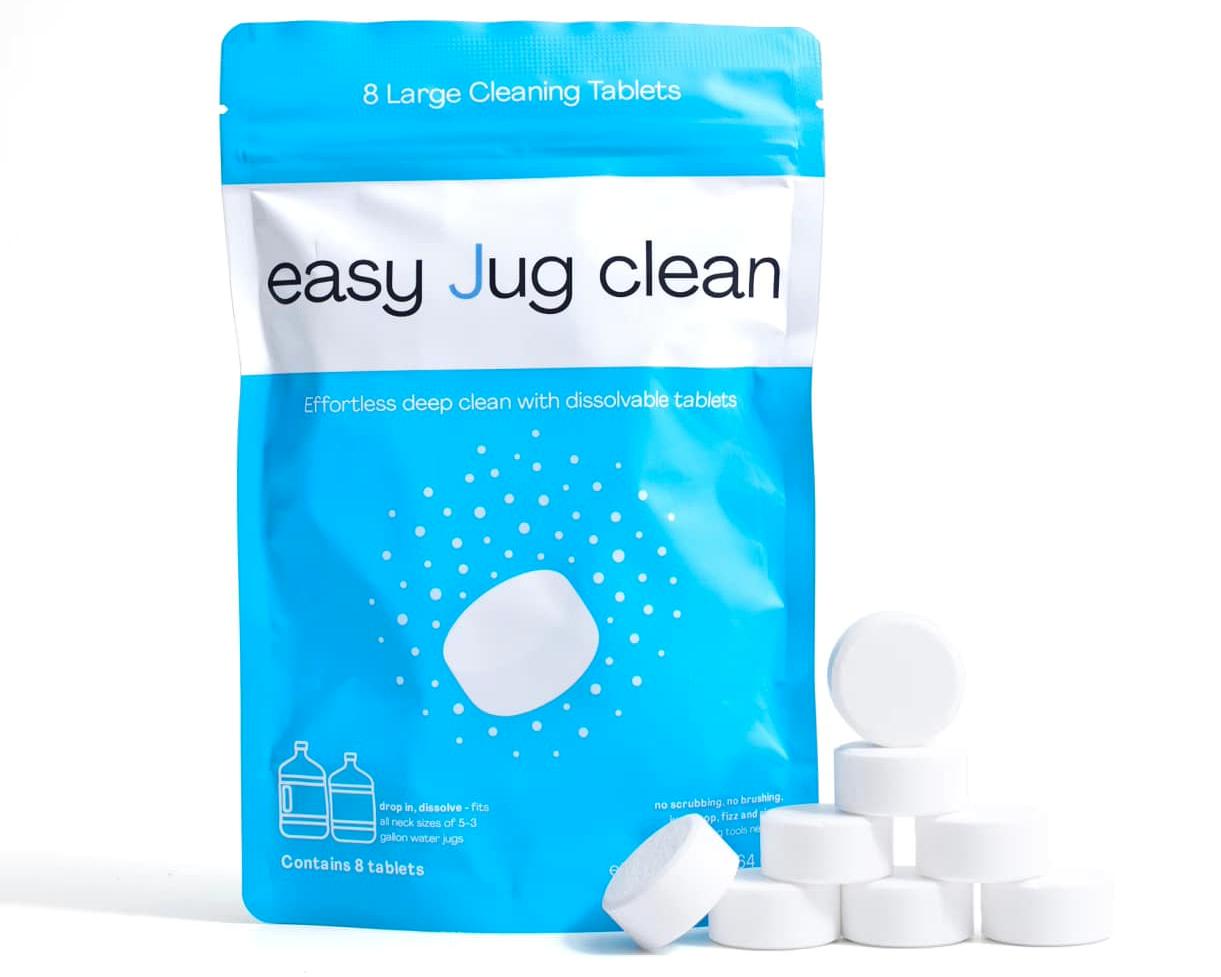
The chemistry has to be food-grade safe (the container holds drinking water), substrate-safe (polycarbonate doesn't tolerate aggressive oxidizers long-term), self-distributing (can't be applied mechanically), and effective at the lower mold-cell concentrations typical of water container colonies. Easy Jug Clean's active oxygen formulation matches all four constraints — sodium percarbonate releases hydrogen peroxide and oxygen-radical species that destroy mold while leaving the polycarbonate substrate intact.
✅ The Right Cleaner for the Right Mold Problem
Bathroom mold gets bathroom cleaners. Water jug mold gets food-grade active oxygen chemistry. Easy Jug Clean fits the second category exactly. Two tablets, 20–30 minutes, rinse.
FAQ: Bathroom vs. Water Jug Mold
Q: I successfully treated bathroom mold with bleach. Why won't that work for my water jug?
It can work, technically — bleach kills mold in any environment. The reason it's the wrong tool for water jugs is the residue concern (you ingest from a jug; you don't ingest bathroom surfaces), the substrate damage (polycarbonate degrades faster than ceramic with repeated bleach exposure), and the recurrence pattern (bleach treats the visible colony but not the biofilm scaffold beneath it).
Q: Is the same mold I have in my bathroom likely growing in my water jug?
Possibly the same genus (especially Cladosporium, which is everywhere) but probably not the same colony. Bathroom and water jug environments select for slightly different strains even within the same species.
Q: Do I need to worry about the same health risks as bathroom mold?
The species are similar enough that the general risk profiles overlap. The exposure pathway differs — ingestion vs inhalation — which changes which symptoms are more likely. For most healthy adults, both are nuisance-level rather than acute danger; for sensitized or immunocompromised people, both warrant urgent treatment.
The Bottom Line
Bathroom mold and water jug mold are different problems with different species, different conditions, and different cleaning constraints. The chemistry that fits a tile shower doesn't fit a polycarbonate water container. Use the cleaning approach designed for the specific environment, and you avoid both the substrate damage and the residue concerns that come from mismatched products.


 Order now — get it by