How Many People Share a Water Cooler Jug — And What That Means for Bacteria
Reading time: ~6 minutes | Shared Water Cooler Bacteria Risk Office Hygiene
How Many People Share a Water Cooler Jug — And What That Means for Bacteria
The Contamination Multiplier: Why Shared Means Exponential Risk
Most people assume that contamination scales linearly. More people = more bacteria. Simple math. Five users, five times the contamination load. Right?
Wrong. Contamination in shared water systems scales exponentially—and that's the core reason why how to clean a water cooler jug is so much more urgent in an office environment than at home.
Here's why: The contamination risk isn't just about how many bacteria each person *adds*. It's about how many different bacterial species are being introduced, how they interact, and how quickly they establish biofilm once they're inside the jug.
When 20 people use a water cooler, you're not getting 20 times the bacteria from one person. You're getting a microbial ecosystem—oral bacteria, respiratory bacteria, gut bacteria transferred via hands, environmental bacteria from that person's workspace. That's 20 different bacterial profiles, many of which can work together to establish infection and evade your immune system in ways a single strain cannot.
The Shared Water Cooler Jug: Home vs. Office
Let's compare two scenarios:
Home Water Jug (2 Users)
A household jug—usually just the primary adult user and maybe a spouse. Sometimes a child. That's 2–4 people with roughly similar oral bacteria, living in the same environment with similar immunity. Each time the jug is used, it receives a familiar contamination load. Biofilm develops slowly over 3–4 weeks. Visual contamination (discoloration, taste changes) appears early, signaling a need to clean the 5 gallon water jug.
Office Water Cooler Jug (20+ Users)
An office cooler touches 20, 50, or 100+ people per day. Each person brings a different microbial profile:
- The person who just came from the sick bathroom (bacteria from surfaces)
- The person with a cold (respiratory viruses)
- The person who shakes hands constantly (pathogenic bacteria from clients)
- The person who didn't wash hands after lunch (food-borne bacteria)
- The person wearing yesterday's unwashed clothes (extended bacterial load)
Each interaction adds not just bacteria—but biodiversity. The jug becomes an ecosystem where different bacterial species feed off byproducts created by other species, creating an environment where dangerous pathogens thrive faster than they would in isolation.
The Math of Bacterial Accumulation in Shared Spaces
Here's a simplified illustration of how bacterial load accelerates in a shared system:
| Days Since Last Cleaning | Home Jug (2 users) | Office Cooler (30 users) | Risk Level |
|---|---|---|---|
| 1 day | ~10,000 bacteria | ~150,000 bacteria | Low |
| 7 days | ~100,000 bacteria | ~5,000,000+ bacteria | Moderate |
| 30 days | ~500,000 bacteria | ~500,000,000+ bacteria | High |
| 90 days | ~2,000,000 bacteria | ~10+ billion bacteria | Critical |
These numbers are approximations based on biofilm growth models. Actual counts depend on temperature, water chemistry, and spigot design. The key insight: office coolers reach dangerous contamination thresholds within 2–3 weeks, while home jugs take months.
This is why office water cooler jugs are the most contaminated in any building. The sheer number of contact points accelerates the timeline to bacterial critical mass from months to weeks.
Every User Interaction Contributes to Contamination
Let's break down exactly what each person contributes when they use a shared water cooler:
Hand Contact with the Spigot
The button or lever is a direct hand-to-water-system contact point. Human hands harbor ~200+ species of bacteria. Most are harmless; some are not. A single unwashed hand deposits millions of bacteria directly onto the spigot. That bacteria then transfers to the water stream, the internal jug surfaces, and biofilm establishes around that point.
Breath and Respiratory Aerosols
When someone leans down to fill a cup, they breathe. Respiratory droplets travel up to 8 feet and settle inside the jug's opening. During winter cold and flu season, this becomes a major contamination vector. A person with asymptomatic COVID could deposit viral particles into the jug—and those particles can survive on plastic surfaces for hours.
Splash and Drip Contamination
Water splashes back as the cup fills. If that water has bacteria or biofilm already established, it re-contaminates the spigot and the bottle neck. The drip tray becomes a stagnant water reservoir that amplifies contamination and creates mold—which then re-contaminates the jug through splashing.
Saliva Contamination
If someone has sipped directly from the spigot, or if a cup was filled with an open mouth right above the opening, saliva particles enter the jug. Saliva is loaded with bacteria. Streptococcus, Staphylococcus, and other species thrive in saliva's nutrient-rich environment. This is a fast-track to biofilm establishment.
Why Shared Responsibility Creates Exponential Contamination
There's another multiplier effect at play: responsibility fragmentation.
In a home, one person—usually the one who noticed the jug needs cleaning—does the job. The decision is made, the action happens, the timeline resets.
In an office, nobody owns the jug. The admin thinks facilities does it. Facilities assumes it's someone's personal duty. Team members assume someone in management handles it. Months pass. When the jug finally gets used so heavily that someone complains, nobody remembers when it was last cleaned—or if it's ever been properly sanitized at all.
So contamination doesn't just accumulate biologically. It accumulates temporally. A home jug might be cleaned every 3 weeks. An office jug might go 6 months. That difference alone could account for a 50-fold increase in bacterial load.
Threshold Events: When Contamination Becomes Detectable
In a home jug, humans usually notice contamination before it reaches critical levels. The taste changes. Visible sediment appears. Someone says, "This water tastes weird," and action is taken.
In an office jug shared by 30 people, contamination can reach critical levels invisibly:
- Bacterial count in the billions: Humans can't taste this. Biofilm is invisible to the naked eye.
- Pathogenic bacteria like Legionella: Odorless, colorless, tasteless. Can cause serious respiratory infections.
- Mold and mildew in the jug interior: Invisible on the inside; visible only when the jug is emptied and light hits the interior.
- Mineral scale protecting bacteria: The jug looks sparkling clear, but hard water minerals have created a crusty layer where pathogens hide and thrive.
This is why the difference between rinsing and sanitizing a water cooler jug is critical. You can't assess the jug's actual contamination status by sight or taste. You need active chemical sanitization.
How Easy Jug Clean Resets the Contamination Baseline
The challenge with shared water coolers is that the contamination load climbs relentlessly. More users = compressed timeline to dangerous levels. More users = harder to motivate cleaning (shared responsibility = no one does it).
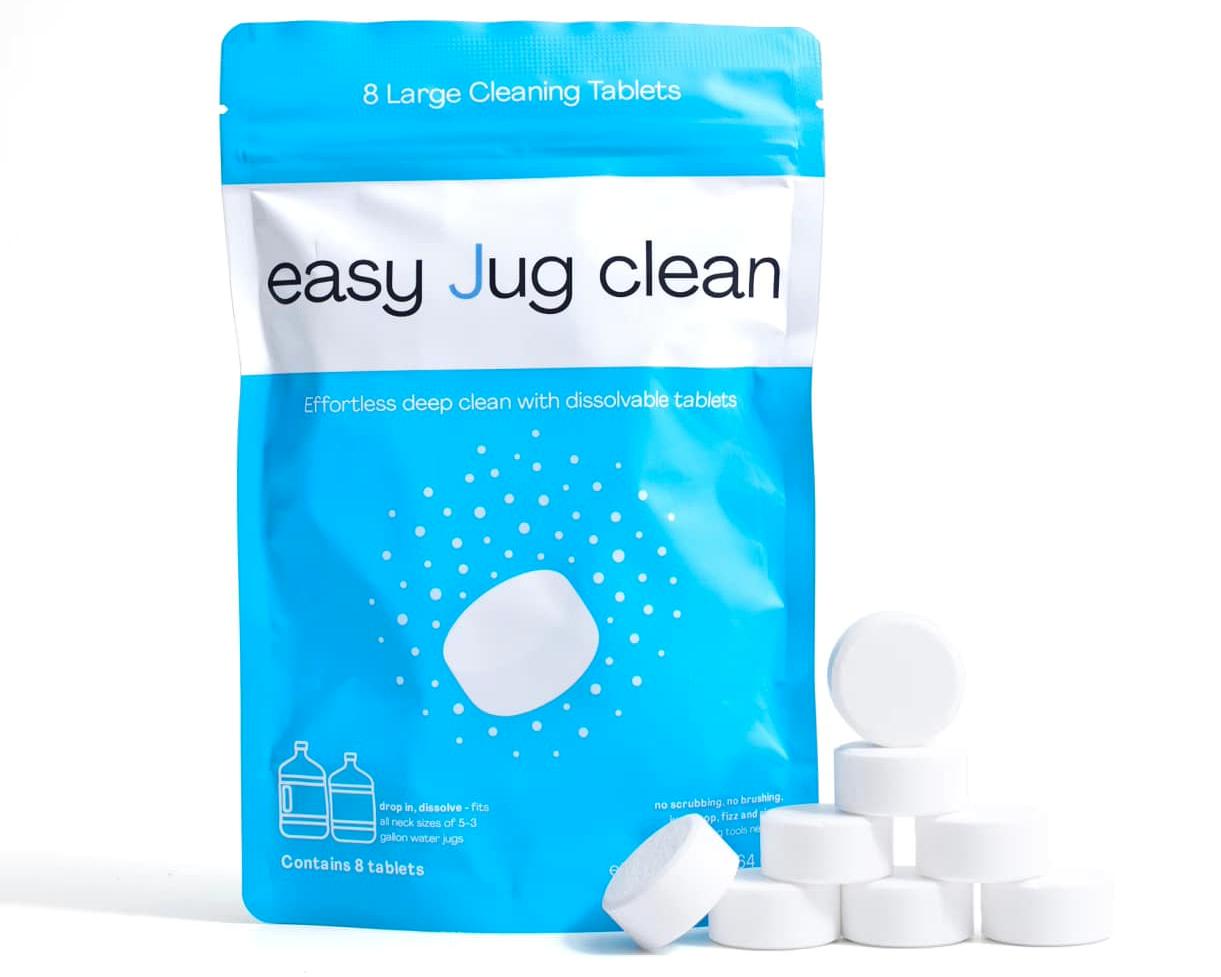
Easy Jug Clean addresses both problems:
A 30-person office doesn't need to accept the exponential contamination risk. With consistent sanitization every week, the jug stays below the danger threshold. The bacteria don't get time to establish mature biofilm. Pathogens are eliminated before they spread.
What Every Office Leader Should Know
Your shared water cooler jug is a hot spot for contamination—not because your office is dirty, but because it's shared. The more people using it, the faster pathogens accumulate. The longer it goes without proper sanitization, the higher the risk.
Scale matters. Twenty users don't create 20× the risk; they create exponentially higher risk. And that risk compounds with every day of neglect.
The solution isn't to stop drinking water. It's to sanitize regularly, with a method simple enough that your team will actually use it.
✅ Eliminate the Exponential Risk
Every person sharing your water cooler jug adds to the bacterial load exponentially. Easy Jug Clean breaks that cycle by dissolving biofilm and sanitizing the jug in 20 minutes. Two tablets, one reset, clean water for your entire team—no matter how many people use it.
Watch Easy Jug Clean tackle bacteria inside a shared water cooler jug:
The Takeaway
Contamination in shared water cooler jugs isn't linear—it's exponential. Every additional user doesn't just add bacteria; they add microbial diversity, competing species interactions, and acceleration toward biofilm maturity. An office jug with 30 users reaches dangerous contamination levels in weeks, while a home jug with 2 users takes months. Easy Jug Clean resets that clock weekly and keeps your team's water actually safe.


 Order now — get it by