The Environmental Case for Cleaning and Reusing Water Cooler Jugs
Reading time: ~6 minutes | Environmental Impact Reusable Jugs Sustainable Hydration
The Environmental Case for Cleaning and Reusing Water Cooler Jugs
The Reusable Jug vs. Single-Use Bottle Problem
If you've ever looked at the mountain of plastic water bottles generated by a home or office, the appeal of a 5-gallon reusable jug is obvious. One jug replaces hundreds of single-use bottles. But that sustainability advantage only holds if the jug stays in active use—and that requires keeping it clean.
Neglected, contaminated jugs often get discarded and replaced. Jugs damaged by harsh cleaners degrade faster. Jug hygiene directly affects jug lifespan, which directly affects the environmental math of your water system.
Let's break down where the real environmental benefit lives.
The Carbon Footprint: One Jug vs. Hundreds of Bottles
A typical 5-gallon reusable cooler jug is used for about 1 year per refill cycle. During that year, it replaces approximately 260 single-use 16.9 oz plastic bottles (based on average office consumption).
Manufacturing carbon footprint per unit:
- One 5-gallon jug: approximately 0.5–0.7 kg CO2 equivalent
- 260 single-use bottles: approximately 7–10 kg CO2 equivalent (for production, not counting transportation)
- Net savings per year: 6–9 kg CO2 per jug per year
But this calculation assumes the jug stays in rotation. A jug that becomes contaminated and is discarded at 6 months instead of 12 months loses half its environmental benefit. Proper cleaning extends jug lifespan and maximizes this carbon saving.
The Plastic Waste Problem
Single-use water bottles create immediate, tangible waste: 260 bottles per year per office cooler, most of which end up in landfills or oceans. That's visibility—everyone knows plastic bottles are wasteful.
But the plastic waste equation gets more interesting when you factor in jug degradation.
Jug lifespan depends heavily on cleaning chemistry:
- Harsh cleaners (bleach, aggressive scrubbing): degrade polycarbonate plastic, leading to faster jug replacement (3–4 year lifespan)
- Gentle but effective cleaners (active oxygen): kill contamination without polymer breakdown, extending lifespan to 5–7 years
- Improper cleaning (allowing contamination to fester): can lead to permanent staining or odour, forcing premature replacement (2–3 year lifespan)
A jug that lasts 7 years is replaced 50% less often than one that lasts 3 years. The difference in plastic waste over a decade is enormous.
| Cleaning Method | Typical Jug Lifespan | Jugs Replaced (10 years) | Total Plastic Waste |
|---|---|---|---|
| Harsh chemicals (bleach) | 3–4 years | 3–4 jugs | 1.5–2 kg plastic |
| Gentle effective (active oxygen) | 5–7 years | 1–2 jugs | 0.5–1 kg plastic |
| Neglected (contamination allowed) | 2–3 years | 3–5 jugs | 1.5–2.5 kg plastic |
The environmental winner: gentle but effective cleaning chemistry that doesn't degrade the plastic. Active oxygen cleaners meet this standard—they sanitise without harshness.
Water Usage in Manufacturing
Most people don't think about the water cost of producing water bottles, but it's significant.
- Single-use plastic bottle manufacturing: approximately 3 liters of water per 1 liter of bottled water produced (for cooling, processing, cleaning)
- 5-gallon jug manufacturing: approximately 0.4 liters of water per gallon of capacity (economies of scale in polycarbonate production)
Over a year, the water cost comparison for a typical office cooler:
- 260 single-use bottles: approximately 780 liters of water consumed in manufacturing
- One 5-gallon jug: approximately 20 liters of water consumed in manufacturing
- Net savings: 760 liters per year
That's water saved just by choosing a reusable jug. The choice of gentle cleaning chemistry (which doesn't damage the jug) multiplies that saving over the jug's lifespan.
The Packaging Waste Factor
Single-use bottles come with plastic cases, shrink wrap, and cardboard boxes. A 260-bottle year creates significant packaging waste beyond the bottles themselves.
A 5-gallon jug, when delivered, typically arrives with minimal packaging—sometimes just a cardboard sleeve. The packaging waste per refill is negligible.
Annual packaging waste:
- 260 bottles + packaging: approximately 5–8 kg of cardboard and plastic per year
- One jug + packaging: approximately 0.3–0.5 kg per year
- Net savings: 4.5–7.5 kg per year
The Chemistry Factor: Why Cleaner Choice Matters
Not all jug cleaners are equal from an environmental standpoint.
Bleach-based cleaners:
- Harsh on polycarbonate plastic (shortens jug lifespan)
- Toxic runoff into water systems
- Require rinsing repeatedly (more water usage)
- Persistent chemical residue
Vinegar-based cleaners:
- Acidic (can degrade seals and internal components)
- Less effective against biofilm than stronger chemistry
- Often ineffective, leading to re-cleaning and jug replacement
- Acetic acid runoff (acidifies water systems)
Active oxygen cleaners:
- Breaks down into water and oxygen (zero toxic residue)
- Gentle on polycarbonate (extends jug lifespan)
- Highly effective (reduces re-cleaning and premature replacement)
- Biodegradable with no persistent environmental impact
- Minimal rinsing required (saves water)
The "Clean More, Replace Less" Principle
There's a direct environmental equation: higher cleaning frequency = longer jug lifespan = lower overall environmental footprint.
This might seem counterintuitive (aren't you using more cleaner?), but the math works out because:
- Frequent gentle cleaning prevents biofilm establishment and jug damage
- Contaminated, damaged jugs get discarded early, losing years of reuse potential
- One extra cleaning per month (using biodegradable cleaner) has less environmental impact than replacing a jug 2 years early
Office and Multi-Family Benefits
In multi-person settings (offices, apartment buildings), the environmental difference scales dramatically.
Small office (50 people, 4 coolers):
- Single-use bottle system: 260 bottles/cooler × 4 = 1,040 bottles per year = approximately 4–6 kg of plastic waste
- Reusable jug system with proper maintenance: 4 jugs, replaced every 5–7 years = approximately 0.6 kg of plastic waste per year
- Net savings: 3.4–5.4 kg plastic waste per year
- 10-year savings: 34–54 kg of plastic kept out of landfills
That's real environmental impact. And it depends entirely on keeping the jugs in active use through proper, consistent cleaning.
The Environmental Choice Is Also the Safety Choice
Interestingly, the most environmentally responsible approach—frequent cleaning with gentle, biodegradable chemistry—is also the safest approach for drinking water.
Best practice for environment AND health:
- Clean every 7 days with active oxygen tablets
- Use chemistry that breaks down to water and oxygen
- Extend jug lifespan to 5–7 years through gentle maintenance
- Prevent contamination before it forces premature jug replacement
You don't have to choose between environmental responsibility and drinking water safety. The best way to clean a water cooler jug supports both.
Bottom Line: Cleanliness Is Sustainability
The environmental case for reusable 5-gallon water jugs is compelling—but only if those jugs stay in active use for years, not months. That requires keeping them clean.
Every time a contaminated or damaged jug is replaced prematurely, the environmental math shifts. Manufacturing a replacement jug costs carbon, water, and plastic. Gentle, regular cleaning prevents that waste.
The environmental choice isn't between single-use bottles and reusable jugs. It's between short-lived, poorly-maintained jugs and long-lived, well-maintained jugs. Choose the latter—it's better for the planet and your water safety.
Clean Your Jug, Save Your Planet
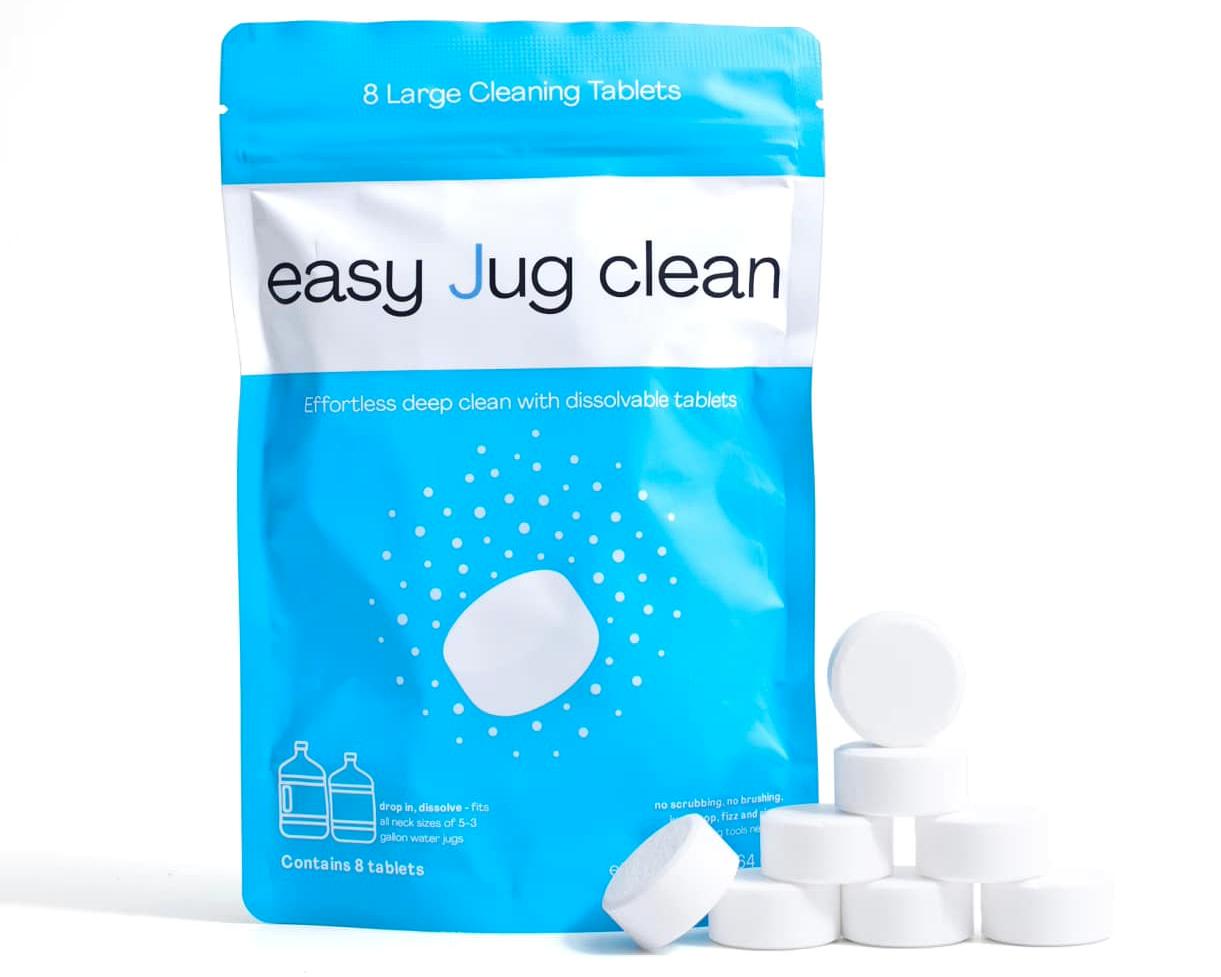
Easy Jug Clean tablets clean effectively while breaking down to water and oxygen. Extend your jug's lifespan by 2–3 years and keep thousands of single-use bottles out of landfills.
Get Easy Jug Clean Now – /8 tablets
See why Easy Jug Clean is the sustainable choice for water cooler jug cleaning:


 Order now — get it by