Why Visually Clear Water Cooler Jugs Can Still Be Contaminated
Reading time: ~6 minutes | Visual Inspection Hidden Contamination Water Cooler Safety
Why Visually Clear Water Cooler Jugs Can Still Be Contaminated
The Visual Inspection Trap
Clear water and a transparent jug are powerful psychological signals of safety. We've been trained since childhood to trust what we see: clean water looks clean, and dirty water looks dirty. If you can't see contamination, there probably isn't any.
For drinking water safety, this logic fails catastrophically.
Bacterial contamination—the most common threat in water cooler systems—is invisible at the quantities needed to cause serious illness.
This isn't a minor gap in perception. It's a fundamental problem with using your eyes as a safety testing device. Your jug could harbour dangerous microbes and still look absolutely spotless.
The Minimum Infectious Dose Problem
Let's talk about what "contaminated" actually means in microbiology.
Safety standards for drinking water are based on something called the minimum infectious dose—the smallest number of pathogenic organisms needed to make you sick. For many bacteria:
- E. coli: as few as 10–100 cells can cause infection
- Legionella (Legionnaires' disease): can be dangerous in very low concentrations, especially in warm water
- Listeria: infectious dose is extremely small; even "clean-looking" water can harbour dangerous counts
- Mycobacteria: some species only need a few hundred cells to establish infection
Here's the problem: 10 cells of bacteria are completely invisible to the human eye. You cannot see them. You cannot perceive them. A jug with a billion invisible bacteria sitting inside looks identical to a jug with zero.
The infectious dose isn't "a lot" of bacteria. It's often surprisingly small. And therein lies the trap of visual inspection: bacteria thrive at concentrations far below the threshold of visibility.
Where Biofilm Hides
Even when visible contamination does occur—cloudiness, odour, visible slime—the majority of bacteria aren't floating free in the water at all. They're embedded in biofilm on the jug's interior walls.
Biofilm is a protective matrix of bacteria, mucopolysaccharides, and organic matter that adheres to plastic surfaces. From the inside of a transparent jug, it can be:
- Microscopically thin — present but not visible without magnification
- Clear or translucent — blending with the water rather than creating obvious cloudiness
- Loosely distributed — scattered across the interior in patches you can't easily see through the plastic
- Early-stage — in its first few days of formation, biofilm is virtually invisible
A jug can look perfectly clear while harbouring active, dangerous biofilm on its walls. You're literally looking through plastic at something too small and too transparent to detect.
The "Early-Stage Contamination" Window
Here's a timeline of what actually happens inside a water cooler jug, unseen:
- Day 1–2: Bacteria begin attaching to the jug's interior surface. Completely invisible. Water looks perfect.
- Day 3–5: Biofilm is forming but still in early stages. No visible changes. No odour. The water still tastes fine.
- Day 6–10: Biofilm is becoming established. Bacterial counts are rising significantly, but the jug still appears clear. This is the most dangerous window—high contamination, zero visible warning signs.
- Day 10–14: Odour or slight cloudiness might appear. By this point, the jug may already have bacterial counts well above safe limits.
The window between "contaminated enough to cause illness" and "visibly contaminated enough to notice" is days wide. In many cases, you'll never see a warning sign until you're already sick.
Appearance Varies by Contamination Type
Not all dangerous contamination produces visible changes. Here's what different microbial culprits actually look like:
| Contamination Type | Visible Signs | Invisible Phase |
|---|---|---|
| Bacterial biofilm (E. coli, Legionella) | Cloudiness, very faint film on walls | First 5–10 days—invisible even at dangerous counts |
| Mould (Aspergillus, Penicillium) | Black or green spots, fuzzy coating | First 3–5 days—spores present but no visible growth |
| Algae (in direct sunlight) | Green tint or cloudiness | Very early stages—green hue before visible coating |
| Legionella biofilm | Usually no visible sign until very advanced | Often invisible even in mature colonies—especially dangerous |
Notice the pattern? The most dangerous organisms—Legionella, E. coli, certain moulds—often leave no visible evidence until they're already an advanced problem.
Why "It Looks Fine" Isn't a Hygiene Standard
The food and beverage industry abandoned "visual appearance as a safety metric" decades ago. Here's why:
Once they started actually testing visually-clean food and water, they found contamination everywhere. Restaurants that passed visual inspections still gave customers food poisoning. Water systems that looked pristine harboured pathogens.
The lesson was hard-won: sight is a terrible predictor of microbial safety.
This is why food safety moved to time-temperature protocols, controlled sanitising processes, and regular microbial testing. It's not about what something looks like. It's about what's actually happening at the microbial level.
Your water cooler jug deserves the same standard. The only reliable approach is a scheduled sanitising protocol, not conditional cleaning based on how the jug looks.
The False Reassurance of a Taste Test
Some people justify visual inspection by adding a taste test: "If it tastes fine, it must be clean."
This is equally unreliable. Many bacteria and their toxins are odourless and tasteless. Legionella-contaminated water tastes normal. E. coli at dangerous levels tastes normal. Early-stage biofilm biofilm doesn't produce noticeable flavour changes.
Your tongue is not a microbiology lab. Taste is an even worse safety metric than appearance.
What Actually Works: Scheduled Sanitation
The strategy is simple:
- Clean every 7 days — regardless of how the jug looks
- Use proven antimicrobial chemistry — active oxygen, not just water and a brush
- Target both biofilm and free bacteria — a complete kill, not a rinse
- Never skip a cycle — consistency matters more than intensity
This removes contamination in the early, invisible stage before it reaches dangerous levels. You never have to wait for visible signs, because you're preventing the problem systematically.
The Bottom Line: Trust the Schedule, Not Your Eyes
Your water cooler jug can look flawless and still be dangerously contaminated. Bacteria work at the microbial level, invisible to human perception. Biofilm grows in the early stages with zero visible warning signs.
Visual inspection isn't just unreliable—it's actively dangerous, because it creates false confidence that allows contamination to advance unchecked.
The safest approach is a regular sanitising routine with active chemistry that kills what you can't see. That's how food safety professionals handle this problem. That's how you should too.
Stop Waiting for Signs of Contamination
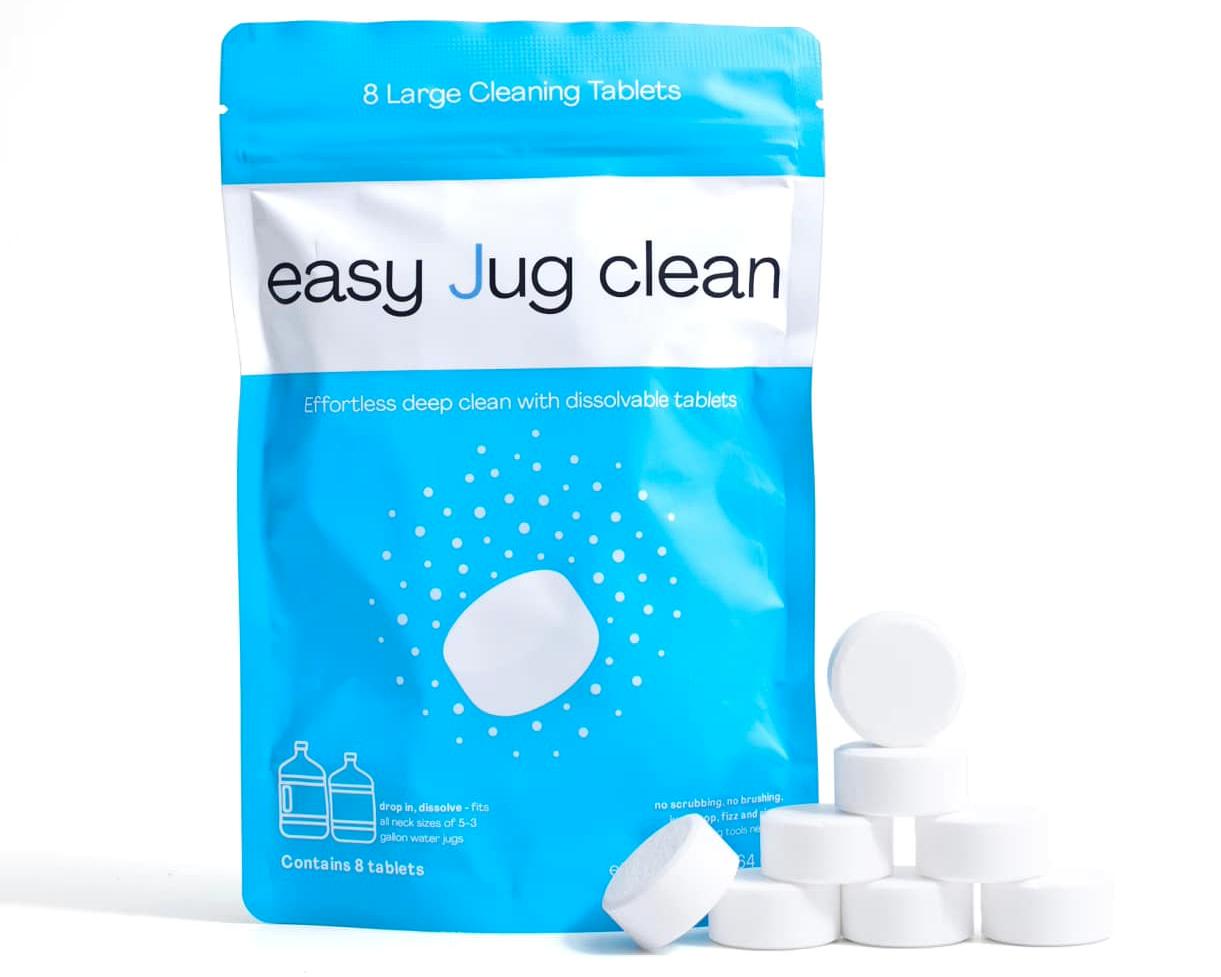
By the time your jug looks dirty, dangerous contamination has already begun. Easy Jug Clean sanitises what you can't see—invisible bacteria, early-stage biofilm, and developing microbial colonies.
Get Easy Jug Clean Now – /8 tablets
See why Easy Jug Clean is the only method that actually sanitizes the inside:


 Order now — get it by