How to Clean a Water Dispenser: Why the Jug Matters More Than the Machine
The System Most Households Are Cleaning in the Wrong Order
A 5 gallon water dispenser system has four distinct contamination zones: the water jug, the internal machine reservoir, the spigots and nozzles, and the drip tray. Each accumulates bacterial contamination. Each needs regular maintenance. But they are not equally important — and the cleaning industry's habit of marketing dispenser-cleaning products while ignoring jug hygiene has produced households that clean the least-critical component while neglecting the most-critical one.
The contamination hierarchy, in honest order of importance:
- The 5 gallon water jug — the highest contamination risk, the largest surface area, the container that holds the most water the longest, and cleaned least often in most households
- The dispenser spigots and nozzles — high-touch surfaces with permanent moisture and direct contact with every glass dispensed
- The internal machine reservoir — a real but secondary concern; quarterly maintenance is adequate
- The drip tray — lowest contamination risk, simplest maintenance, and paradoxically the component most people clean most conscientiously
The mismatch between household attention and actual contamination risk is the central problem in water dispenser hygiene. This guide corrects it.
Why the Water Jug Is the Contamination Crisis Nobody Talks About
The 5 gallon water jug is a 600–800 square centimeter enclosed environment that is permanently moist, often warm, poorly accessible for cleaning, and continuously replenished with water you and your family drink. These conditions make it the ideal environment for biofilm formation inside your water dispenser system — the bacterial colony structure that makes waterborne contamination genuinely dangerous — and it is maintained, in most households, using methods that fail, or not maintained at all.
The Invisible Contamination Timeline
Biofilm doesn't announce itself. Within hours of a clean jug being filled, bacteria from the water column and surrounding air begin attaching to interior surfaces. The process is completely invisible — no smell, no discoloration, no detectable change in water quality. By 48–72 hours at room temperature, a mature biofilm colony has established, with a protective polymer matrix (EPS) that makes the bacteria inside it 10 to 1,000 times more resistant to sanitizing agents than free-floating bacteria of the same species. By Day 3–4, the colony is actively dispersing daughter bacteria into your drinking water.
By the time a jug looks or smells different, it has been contaminated for days. Understanding why a jug can test visually clean while still producing contaminated water is one of the most important insights in household water hygiene — and one of the most routinely missed.
What Most People Use to Clean Their Jug — And Why Every Popular Method Fails
Before covering the solution, the villain methods deserve honest treatment — because they don't merely fail to clean. Several of them make the contamination problem worse over time.
The Bottle Brush
A brush inserted through a 48mm neck operates at a 1:5 mechanical disadvantage. It physically cannot reach the bottom corners, lower side walls, or the shoulder zone below the neck — precisely the areas with the highest biofilm colonization risk. Beyond what it misses, every scrubbing session creates micro-abrasions that progressively increase bacterial adhesion, making the jug harder to clean with every use. And the brush itself — stored damp between sessions — accumulates its own bacterial colony that it reintroduces into the jug at the next cleaning session. The tool meant to clean your jug contaminates it. See: Why Your Bottle Brush Is Spreading Bacteria Instead of Removing It.
Household Bleach
Bleach sanitizes under the right conditions — precise concentration, adequate contact time, complete rinsing. In a 5 gallon narrow-neck container, none of these conditions are reliably achievable at home. Over-applied bleach leaves chlorine residue that cannot be fully gravity-rinsed from surfaces you cannot reach. Every treatment also oxidizes the plastic polymer chains — a progressive degradation process that accelerates microplastic release, increases chemical migration, and eventually produces the yellowing and crazing that signals an end-of-life jug. Learn what this chemical process actually looks like inside your container: What Bleach Does to the Inside of Your Water Jug Over Time.
White Vinegar
Vinegar has genuine chemistry — 5% acetic acid reacts with fresh calcium deposits and has limited antimicrobial properties in specific conditions. What it cannot do is sanitize by any regulatory definition. It does not achieve the 99.999% pathogen reduction required for food-contact surface sanitization. It does not penetrate biofilm EPS matrices. And it leaves an acid residue in a container whose narrow-neck geometry makes complete rinsing practically impossible — slightly acidifying stored water in ways users normalize without realizing it's avoidable. The deeper problem: Why Vinegar Cleaning Your Water Jug Gives a False Sense of Security.
Dish Soap and Hot Water
Dish soap is optimized for removing fat and oil from flat, open surfaces you can physically wipe and inspect. In a 5 gallon jug, it has no bactericidal chemistry, no biofilm penetration capability, and no descaling mechanism. Its synthetic surfactants adsorb electrostatically to plastic surfaces and resist gravity-rinsing — the only rinse mechanism available in this container format. The soapy taste many users normalize is the direct sensory evidence of surfactant residue dissolving into drinking water. More on why this is harder to fix than it sounds: How to Get Rid of Soapy Taste in a 5 Gallon Water Jug.
The Right Way to Clean a 5 Gallon Water Jug
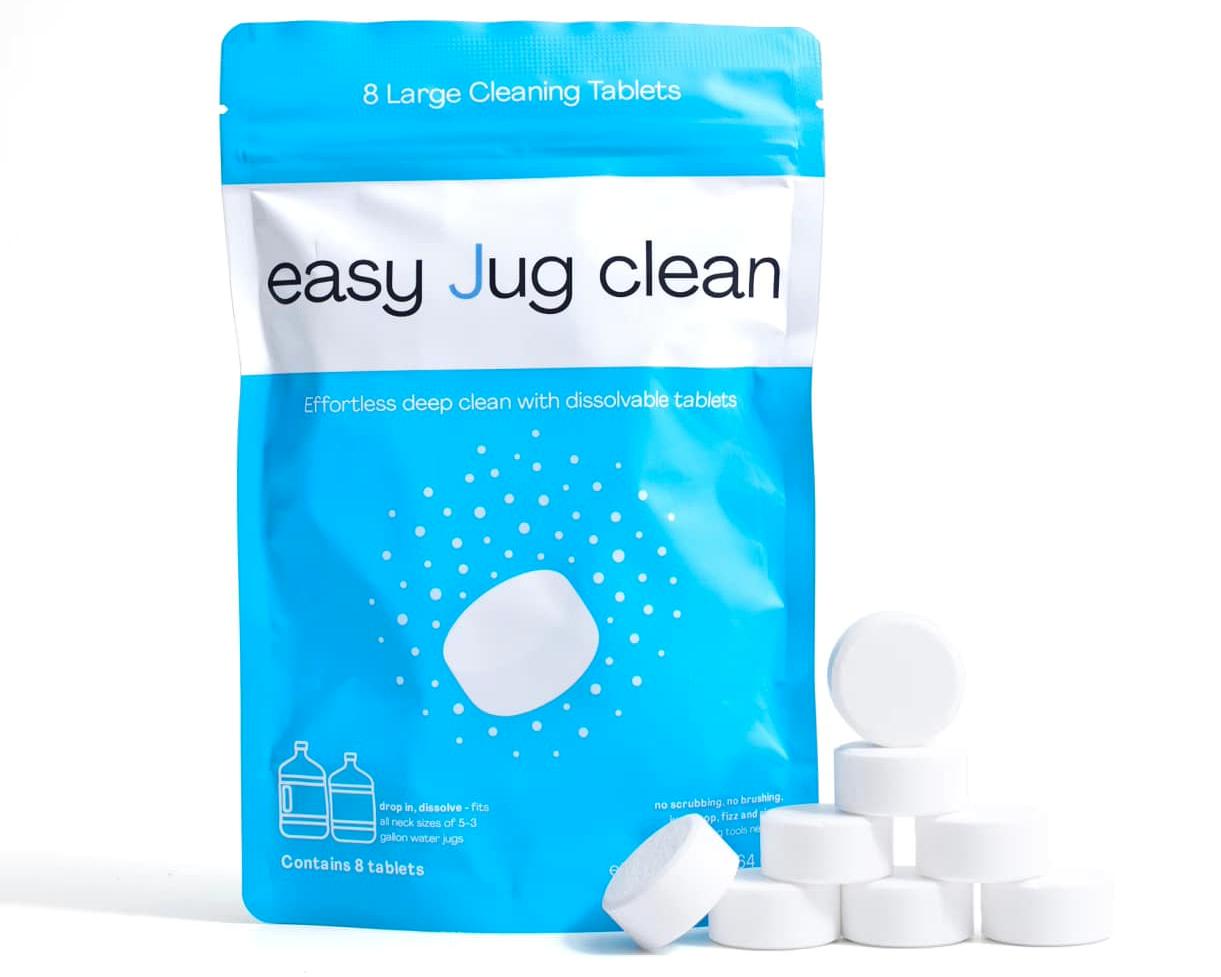
Everything the villain methods fail at, Easy Jug Clean was purpose-built to achieve. Not as a generic cleaning product that happens to work on jugs, but as a formulation engineered specifically around the chemistry required and the geometry constraints of a 5 gallon narrow-neck container.
Active Oxygen + Dual Chelation + Plant Surfactant + Surface Conditioning in One Tablet
Easy Jug Clean dissolves in warm water and treats the complete interior of your jug in 20 minutes. No brushing, no measuring, no fumes, no plastic-degrading chemistry. Its nine food-grade ingredients each serve a specific function. Sodium percarbonate releases active oxygen that destroys biofilm EPS matrices and kills bacteria — the only chemistry that genuinely penetrates the protective matrix that bleach fails against at household concentrations. Sodium citrate and sodium gluconate chelate (molecularly dissolve) hard water mineral scale — the bacterial shelter no sanitizer alone can address. Cocoyl glucoside (coconut-derived) lifts disrupted organic debris. Glycerin conditions and protects the plastic surface, counteracting the degradation that bleach and brushes cause. And fumaric acid with sodium bicarbonate powers the sustained effervescent delivery that distributes all chemistry to the bottom corners, lower walls, and shoulder zone that no brush physically reaches.
The protocol: fill halfway with warm water, drop 2 tablets, soak 20–30 minutes unattended, rotate at 10 minutes to cover the shoulder zone, rinse 2–3 times, invert to air dry. Under 5 minutes of active effort. per pack — a full month's supply. Full ingredient transparency at easyjugclean.com/pages/ingredients.
Jug vs. Dispenser Machine: The Priority Comparison
| Factor | 5 Gallon Water Jug | Dispenser Machine Body |
|---|---|---|
| Water contact surface | 600–800 cm² enclosed, all in direct contact with drinking water | Internal reservoir only (~150–300 cm²); exterior never touches water |
| Biofilm formation speed | Mature colony in 48–72 hrs; dispersal begins Day 3 | Slower due to larger volume-to-surface ratio |
| Cleaning difficulty | Extremely difficult — 48mm neck blocks access to 35–45% of interior | Reservoir drains via valve; spigots removable in most models |
| Required cleaning frequency | Every 7 days (4–5 days in warm conditions) | Reservoir: quarterly; Spigots: weekly wipe; Drip tray: daily |
| Contamination priority | PRIMARY — all water passes through the jug first, longest | SECONDARY — adds contamination after jug treatment |
| If neglected | Biofilm dispersal in drinking water; mineral shelter for bacteria; microplastic release from degraded plastic | Reservoir biofilm re-seeds clean jugs; nozzle bacteria enter final pour |
| Best cleaning product | Easy Jug Clean — liquid-phase active oxygen + chelation covers all surfaces without mechanical access | Easy Jug Clean also used for reservoir deep clean quarterly |
The Complete Water Dispenser Cleaning System — Every Component and Interval
🫙 5 Gallon Water Jug — Primary Treatment
Every 7 days ⏱ <5 min active🪣 Drip Tray — Daily Empty
Every day ⏱ 15 seconds🚰 Spigot Exterior — Weekly Wipe + Every Jug Change
Weekly + at each jug change ⏱ 60 seconds💧 Internal Reservoir — Quarterly Deep Clean
Every 3 months ⏱ 15 min active / 50 min totalThree Reasons the Jug Will Always Be the Highest Priority
1. Volume and Contact Duration
The dispenser reservoir holds 0.5–2 litres at any time. The 5 gallon jug holds 18.9 litres — approximately ten times as much. Every drop in the reservoir first spent significantly longer in the jug. If contamination exists in both, the jug's larger volume and longer water-residence time make it the dominant source of bacterial load in every glass. This isn't a marginal difference. It's an order-of-magnitude difference in contamination contribution.
2. Geometry Is the Enemy of Manual Cleaning
The dispenser reservoir drains via a valve and is accessible. The spigots can be removed and soaked. These components are not geometrically hostile to cleaning. The 5 gallon jug is the most geometrically constrained cleaning challenge in any household — 18 inches deep, 10 inches in diameter, accessible only through a 48mm opening. Understanding the engineering reason 5 gallon water jugs cannot be adequately cleaned by hand makes clear why the chemistry-based approach isn't a preference — it's the only approach that addresses the geometry constraint.
3. The Contamination Direction Always Flows Jug-to-Machine
When both components are contaminated, the jug contaminates the machine — not the reverse. Even a freshly deep-cleaned dispenser is re-seeded from a contaminated jug within days through the water flow. Fix the jug, and you interrupt the contamination chain at its source. Ignore the jug while cleaning the dispenser, and you're treating symptoms while the cause continues unchecked. For a complete picture of this contamination direction: The Contamination Direction: Why Cleaning Your Dispenser Is Pointless Without Cleaning the Jug First.
Adjusting the Schedule for Your Household
The weekly jug cleaning interval is calibrated to room temperature conditions and a standard healthy adult household. Several factors require adjustment:
- Consistently warm conditions (75°F+): Move to every 4–5 days. Bacterial growth rates approximately double with every 18°F increase, dramatically compressing the safe cleaning window. A warm kitchen in summer requires the same care as a warm-climate household year-round. Learn how summer heat changes your water jug cleaning schedule.
- Households with infants, elderly, or immunocompromised individuals: Every 3–5 days. These groups face higher consequences from the same bacterial load at the same exposure level.
- Hard water area: Standard weekly interval is appropriate after the initial scale is cleared. New Easy Jug Clean users in hard water areas should run 2–3 consecutive treatments on an existing jug to dissolve accumulated scale before settling into the weekly rhythm. Hard water significantly accelerates both scale buildup and bacterial shelter formation — the connection is explored in Why Hard Water Households Need to Clean Their Water Jug More Often.
- High-use households: If the jug cycles through its full 5 gallons in 3–4 days, the refill cycle is creating more water-contact surface exposure per week than a slower-use household. Consider a 5-day interval as a baseline.
Start With the Jug. Start This Week.
Everything in this guide points to the same first action: treat your 5 gallon water jug with Easy Jug Clean before you next fill it. Two tablets. Twenty unattended minutes. Food-grade chemistry that sanitizes, descales, and protects your jug's plastic — all in the same treatment, every week.
Watch Easy Jug Clean dissolve scale and odor buildup in a single 20-minute treatment:
→ Get Easy Jug Clean Now per pack · 8 tablets · One month's supply ·
Frequently Asked Questions
How often should I clean my 5 gallon water jug vs. the dispenser machine?
The jug requires cleaning every 7 days under standard household conditions — every 4–5 days in warm climates or homes with infants, elderly, or immunocompromised household members. The dispenser machine's internal reservoir needs a deep clean quarterly. Spigot exteriors benefit from a daily wipe and thorough weekly sanitising. The drip tray should be emptied daily. The jug cleaning frequency is the most critical interval in the entire system — nothing else comes close.
Can I use Easy Jug Clean on the dispenser machine components too?
Yes. Easy Jug Clean's food-grade active oxygen chemistry is appropriate for all water-contact surfaces in your dispenser. Use 2 tablets dissolved in 1 litre of warm water for the quarterly reservoir deep clean. Use 1 tablet in a small cup of warm water for monthly nozzle interior treatment. One product handles every component of the complete system.
What are the warning signs that my jug needs urgent cleaning?
Act immediately if you notice any of the following: a musty, earthy, sour, or chemical smell from the jug interior; a slippery or gel-like feel on the inner walls when touched through the neck opening; visible cloudiness on walls that was not present after the last treatment; or water that tastes flat, soapy, or unusual. Any of these signals indicate contamination has progressed past early stage. Use 3 tablets rather than the standard 2, and perform back-to-back treatments if the signs don't fully resolve after the first session.
Will cleaning the dispenser machine improve water quality if I don't clean the jug?
Minimally. Clean machine components reduce the contamination added at those downstream stages. But if the jug — the primary and largest contamination source — remains uncleaned, it continuously re-seeds the entire system with bacteria via the water that flows through every component. The only meaningful improvement at the glass comes from maintaining the jug weekly. Dispenser cleaning is the supporting act. The jug is the main event.
Is there a cleaning product designed specifically for 5 gallon water jugs?
Easy Jug Clean is the only consumer cleaning tablet formulated specifically for 5 gallon water jug applications. Generic effervescent tablets (including sports bottle tablets and general container tablets) use basic citric acid and baking soda — providing mild effervescence and partial scale removal, but no genuine active oxygen sanitization and no dual chelating chemistry. Easy Jug Clean's nine-ingredient formula includes active oxygen, dual chelators, a plant-based surfactant, and a glycerin surface conditioner — all calibrated for the 3–5 gallon container format that no generic product addresses.


 Order now — get it by