Is It Safe to Clean a Water Jug with Bleach? The Honest Answer
Reading time: ~7 minutes | Bleach Safety Chlorine 5 Gallon Jug
What Bleach Does Well
Household bleach — sodium hypochlorite (NaOCl) at 3–8% concentration — is a legitimate, proven disinfectant. In properly controlled conditions, it achieves the 99.9%+ pathogen reduction required for sanitization. This is not in dispute. The problem isn't bleach's efficacy in ideal conditions — it's the gap between ideal conditions and a home kitchen with a 5 gallon water jug.
The Five Real Risks of Bleach in a 5 Gallon Water Jug
Risk 1: Chlorine Residue That Is Nearly Impossible to Fully Rinse
A 5 gallon jug with a 48mm neck is extremely difficult to rinse completely. Chlorine molecules have a mild affinity for plastic surfaces and the cleaning solution doesn't flush out uniformly from a deep narrow container the way it does from a flat surface or open bowl. Chlorine residue remaining in the jug after rinsing dissolves into your drinking water — producing the characteristic bleach taste and creating a class of compounds (chlorinated disinfection byproducts) that have been associated with health concerns at repeated low-level exposure. If your water has ever tasted faintly chemical after a bleach cleaning, that's exactly what you were drinking.
Risk 2: Dilution Error — Too Much or Too Little
Effective sanitization with bleach requires a specific concentration window: too low and it doesn't achieve pathogen reduction; too high and the residue risk becomes significant and difficult to rinse. The CDC recommends approximately 1 teaspoon of household bleach per quart of water for emergency water container sanitization — a concentration most households don't measure accurately when doing a routine jug clean. Most people use far more bleach than necessary, creating the exact residue problem without gaining any additional sanitizing benefit.
Risk 3: Progressive Plastic Degradation
Sodium hypochlorite is an oxidizing agent — which is precisely why it kills bacteria. But that same oxidizing action also attacks the polymer chains of the plastic your jug is made from. Repeated bleach exposure degrades both polycarbonate and HDPE, causing the material to become progressively more brittle, developing fine surface cracks (crazing), and eventually breaking down in ways that accelerate microplastic release into your drinking water. The very material you're trying to keep safe for drinking water is being damaged by the product you're using to keep it clean.
Risk 4: No Descaling Action
Bleach is an oxidizer and disinfectant — it has no chemical mechanism for dissolving calcium carbonate mineral scale. In hard water households, bleach-cleaned jugs will continue accumulating scale regardless of cleaning frequency. This means even a perfect bleach sanitization still leaves the scale problem completely unaddressed — which in turn continues creating the rough surface conditions that favor bacterial re-colonization.
Risk 5: Fumes and Handling Hazards
Chlorine bleach releases hypochlorous acid vapor — an irritant to the respiratory system, eyes, and mucous membranes — during use. For households with asthma, allergies, or respiratory sensitivities, regular bleach use in enclosed kitchen spaces is a meaningful health concern. It also creates a risk of accidental contact with skin, clothing, countertops, and any surface that can be permanently damaged by oxidation bleaching. A product requiring these handling precautions is not appropriate as a casual weekly routine in a family kitchen.
When Bleach Is Actually Appropriate for Water Containers
Watch Easy Jug Clean's active oxygen sanitize a 5 gallon water jug without scrubbing:
✅ The Safer Sanitizing Alternative — No Chlorine, No Risk
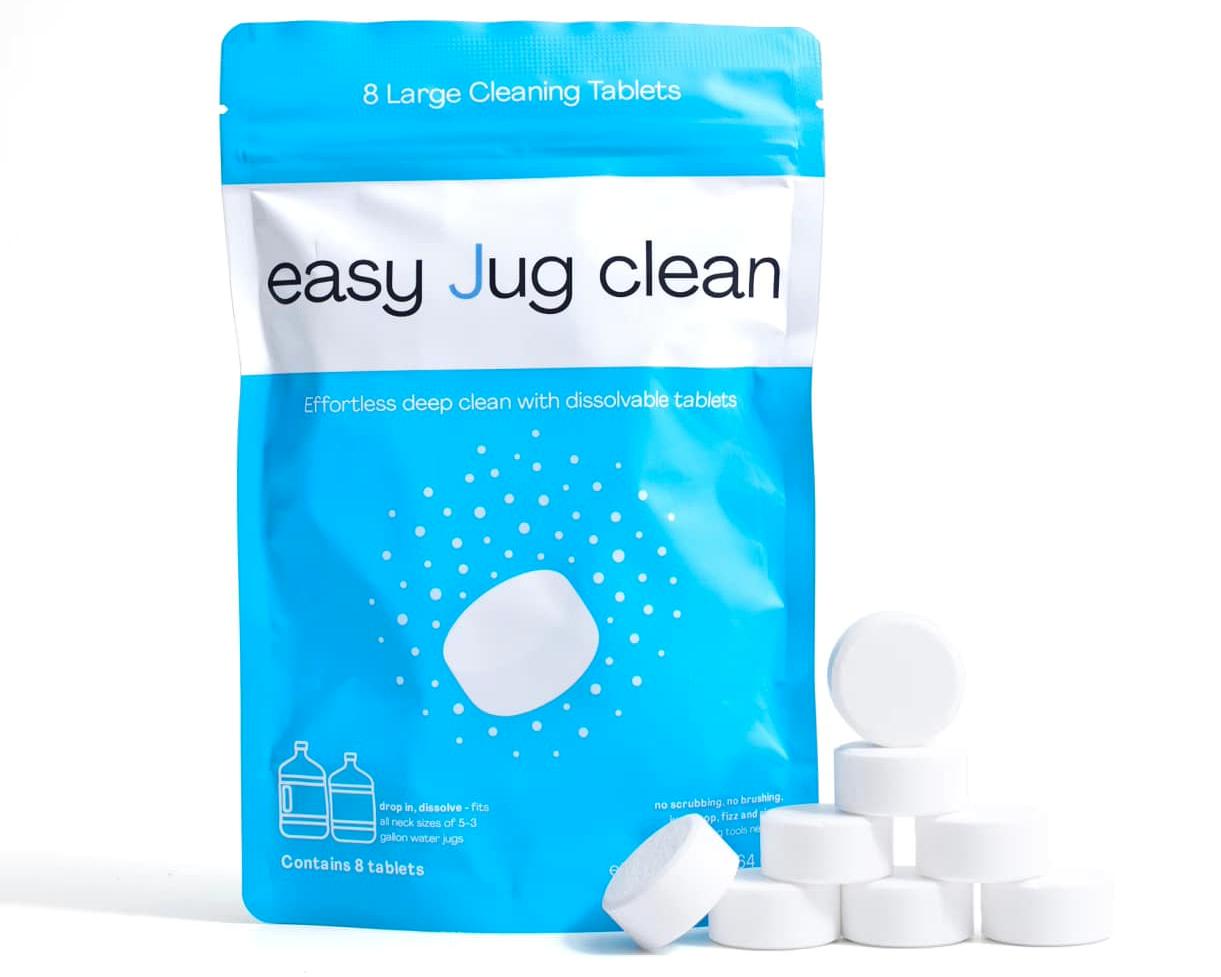
Easy Jug Clean's active oxygen formula sanitizes without bleach, without residue, and without damaging your jug's plastic. Food-grade. Safe to handle without gloves. Effective in 20 minutes.
Frequently Asked Questions
Q: I used too much bleach in my jug — what should I do?
Perform three complete rinse cycles with fresh water immediately. Then perform an Easy Jug Clean tablet treatment, which will help neutralize residual chlorine compounds through the active oxygen chemistry. Follow with two more rinse cycles. If you can still detect any chlorine smell after this protocol, repeat the Easy Jug Clean treatment and rinse sequence.
Q: Is there a "safe" concentration of bleach I could use regularly?
The CDC's emergency water container protocol — approximately 1/4 teaspoon unscented bleach per quart of water, 30-minute contact time, followed by thorough rinsing — is the most defensible approach if bleach is your only available option. But even at this concentration and protocol, it addresses only disinfection — not scale, not odor, not plastic preservation. For regular maintenance, Easy Jug Clean is the appropriate product for this application.
Q: Does bleach kill all bacteria including those in biofilm?
Bleach is effective against free-floating bacteria but significantly less effective against bacteria protected within biofilm at the concentrations used in household cleaning. The EPS matrix neutralizes much of the chlorine before it reaches the colony interior. This is a documented failure mode of chlorine-based disinfection in biofilm-colonized containers — one that active oxygen chemistry is better positioned to address.


 Order now — get it by