Why Hard Water Households Need to Clean Their Water Jug More Often
Reading time: ~8 minutes | Hard Water Cleaning Frequency Mineral Deposits
Why Hard Water Households Need to Clean Their Water Jug More Often
What Hard Water Actually Is
Hard water sounds like a vague term, but it's a precise measurement: the concentration of dissolved calcium and magnesium minerals. Water hardness is typically measured in either grains per gallon (GPG) or milligrams per liter (mg/L).
The USGS (U.S. Geological Survey) classifies water hardness as:
- Soft: 0-60 mg/L (0-3.5 GPG)
- Slightly hard: 61-120 mg/L (3.5-7 GPG)
- Moderately hard: 121-180 mg/L (7-10.5 GPG)
- Hard: 181-250 mg/L (10.5-14.5 GPG)
- Very hard: 250+ mg/L (14.5+ GPG)
The average American household has water hardness of 120-150 mg/L (moderately to hard), with some regions like Texas, New Mexico, and the intermountain West exceeding 300 mg/L (very hard). If you haven't checked, you can request a water report from your local utility or use an inexpensive test kit.
What Hard Water Does to Your Water Jug Interior
When hard water sits in a plastic jug for days or weeks, the minerals don't just stay dissolved. They gradually precipitate (crystallize) out of solution, creating white, chalky, or cloudy deposits on the interior walls. This is called mineral scale.
The deposits build up in layers:
- Initial deposits are barely visible—a microscopic coating of calcium carbonate on the plastic surface.
- Over weeks, the coating thickens, becoming visible as a white haze or cloudiness.
- In very hard water areas or with infrequent cleaning, deposits can reach 1-2mm thickness.
- The deposits are not just aesthetic—they fundamentally change the interior surface of the jug.
Many hard-water households report that their "clean" water looks cloudy or has a chalky taste. The cloudiness isn't bacteria (which don't scatter light visibly); it's suspended mineral particles and the mineral scale coating interfering with water clarity.
Mineral Scale Creates Enhanced Biofilm Attachment Sites
Here's why hard water turns a cleaning-frequency problem into a bacterial problem: mineral scale is not smooth. It's porous, rough, and has thousands of microscopic crevices.
Bacteria prefer rough surfaces. A smooth plastic interior offers little for bacteria to grip onto. A rough, mineral-scale-coated interior is a perfect substrate for biofilm formation. The bacteria can nestle into the microscopic pits, anchor themselves more securely, and form biofilm communities that are resistant to cleaning.
The result: hard water creates a vicious cycle:
Mineral scale accumulates → Rougher surface → Faster biofilm attachment → Harder to clean → More frequent cleaning needed to prevent contamination
Soft-water households might achieve adequate biofilm control with weekly cleaning. Hard-water households need to clean more frequently because biofilm establishes itself faster on mineral-scale-coated surfaces.
How Often Should Hard Water Households Clean?
The answer depends on your water hardness level:
| Water Hardness Level | mg/L or GPG | Recommended Cleaning Frequency |
|---|---|---|
| Soft | 0-60 mg/L / 0-3.5 GPG | Every 8-10 days |
| Slightly Hard | 61-120 mg/L / 3.5-7 GPG | Every 7 days (weekly) |
| Moderately Hard | 121-180 mg/L / 7-10.5 GPG | Every 5-6 days |
| Hard | 181-250 mg/L / 10.5-14.5 GPG | Every 4-5 days |
| Very Hard | 250+ mg/L / 14.5+ GPG | Every 3-4 days or twice weekly |
If you're in a moderately hard water area (the national average), you need to clean 15-20% more frequently than soft-water households. If you're in a very hard water area, you may need to clean 50-100% more frequently.
Why Brushing Alone Doesn't Work for Mineral Scale
Many hard-water users think the solution is simply to brush more vigorously. This is a misunderstanding that can actually make the problem worse.
Mineral scale has a specific chemical composition: calcium carbonate, magnesium hydroxide, and sometimes silica. Brushing doesn't dissolve these minerals; it only dislodges loose particles. The underlying scale remains, and the rubbing action can actually polish it smoother in some areas while roughing it up more in others.
Worse, vigorous brushing can create microscopic scratches in the plastic itself, giving bacteria even more places to colonize. Brushing is counterproductive for mineral scale removal—you need chemical dissolution, not mechanical abrasion.
This is where chelating agents become essential. Chelation is a chemical process where a chelator molecule surrounds a mineral ion and holds it in solution, preventing precipitation. By using a tablet cleaner with built-in chelators, hard-water households can actually dissolve mineral scale rather than just scrubbing at it.
Easy Jug Clean and Hard Water: Why It Matters
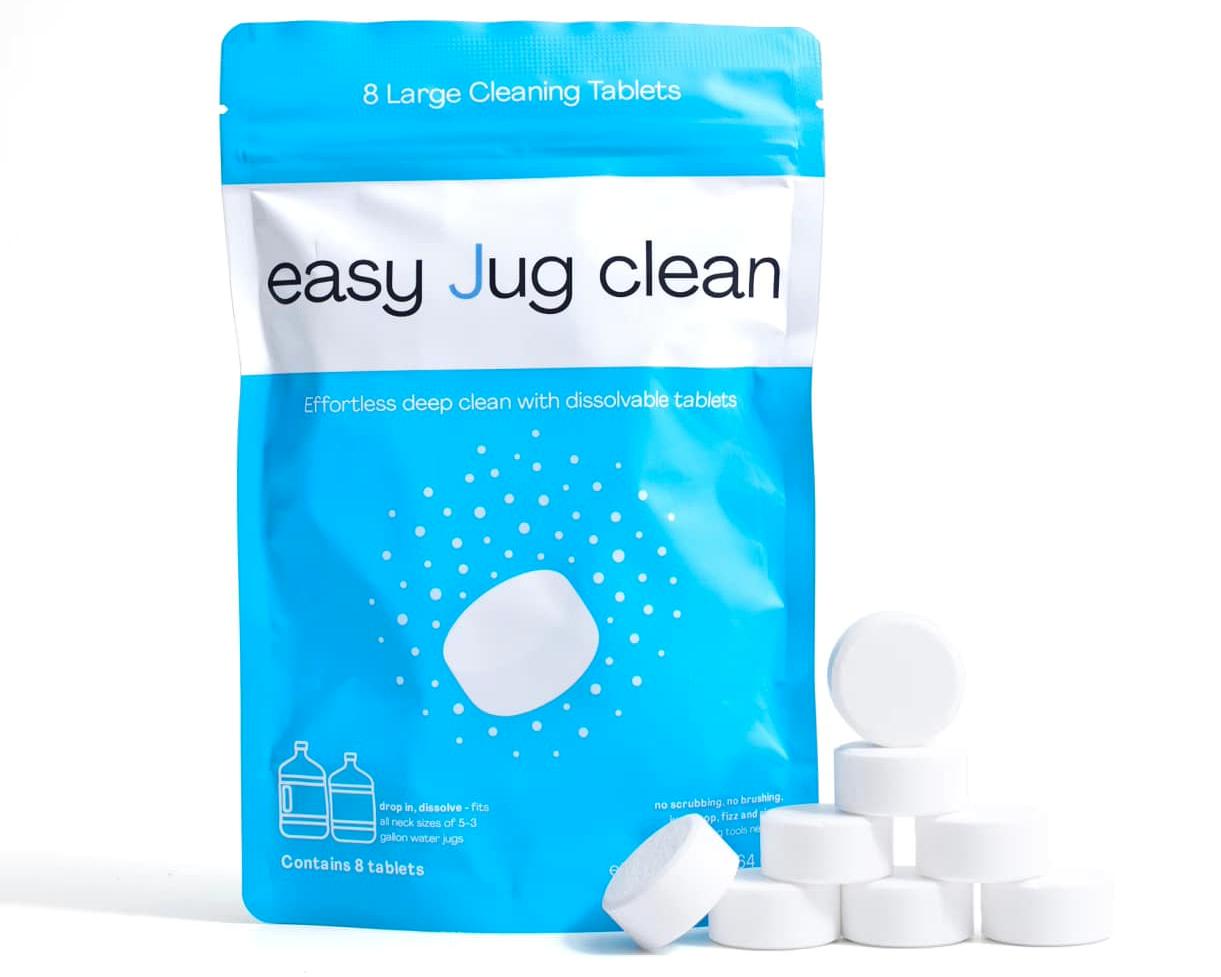
Easy Jug Clean tablets include chelating agents specifically designed to address mineral buildup. When you drop tablets into a hard-water jug, the fizzing action distributes the solution throughout the interior while the chemistry works to both sanitize and dissolve mineral deposits.
This means hard-water households can:
- Actually dissolve mineral scale rather than just brush at it.
- Establish a frequent cleaning routine without the time burden of manual brushing (which would be impractical if done 4-5 times weekly).
- Address both bacterial contamination AND mineral buildup in a single 20-minute treatment.
- Maintain smooth jug interiors over time, reducing the roughness that promotes biofilm attachment.
For hard-water users, the chemistry of the cleaner matters more than for soft-water users. A generic brush or even a generic tablet might clean surface bacteria but won't address the mineral scale that's accelerating biofilm formation in the first place.
The Regional Impact of Hard Water
Water hardness varies dramatically by region. If you live in any of these areas, you almost certainly have hard water:
- Texas: Particularly the Hill Country and South Texas regions (often 200-300+ mg/L)
- Arizona & New Mexico: Western regions with limestone-rich aquifers (frequently 250+ mg/L)
- Colorado & Utah: Intermountain West (often 150-200 mg/L)
- Florida & South Carolina: Areas with limestone geology (often 120-180 mg/L)
- Kansas, Oklahoma, & Nebraska: Great Plains groundwater (often 150-200 mg/L)
- Midwest (Illinois, Indiana, Wisconsin): Moderately to hard (often 120-180 mg/L)
If you live in the Pacific Northwest, parts of New England, or areas with granite geology, you likely have softer water. But most of America deals with at least slightly hard water.
Mineral Deposits and Taste/Safety
Beyond biofilm, mineral deposits affect your water quality in two ways:
Taste: Calcium and magnesium have distinct flavors. Some people perceive them as chalky, bitter, or metallic. Hard water deposits intensify this perception, especially as they build up inside the jug.
Safety: Mineral scale itself isn't directly dangerous, but the rough surface underneath it becomes a harbor for bacteria. The minerals essentially enable biofilm formation that wouldn't occur as readily on smooth surfaces. Mineral deposits affect both the taste and safety of your water, so removal is about more than just aesthetics.
FAQ
Q: Can I use a water softener on my whole house to reduce hard water in my jug?
A: Whole-house water softeners work, but many people bypass the softener for drinking water because the softening process adds sodium. For water jug cleaning purposes, knowing your hard water level matters more than installing a softener. Focus on chemistry-based cleaning designed for mineral dissolution.
Q: If I replace my jug frequently, do I still need to worry about mineral scale?
A: Mineral scale begins forming immediately when hard water enters a jug. Even brand-new jugs start building deposits within the first week. Frequent replacement is expensive and wasteful. Proper cleaning addresses the mineral buildup more economically.
Q: Is very hard water unsafe to drink?
A: Mineral-heavy water isn't inherently unsafe in terms of the minerals themselves (calcium and magnesium are actually beneficial in small amounts). The safety concern is the bacteria and biofilm that establish on mineral-scale-coated surfaces. The minerals enable contamination more than they cause it directly.
Q: What's the difference between a water softener and a chelating agent?
A: Water softeners remove calcium and magnesium ions from the water itself, preventing future scale formation. Chelating agents (like those in Easy Jug Clean) surround existing mineral ions and hold them in solution, dissolving current scale deposits. One prevents future accumulation; the other removes existing buildup. For jug cleaning, you need the latter.
Related Reading
Minerals fuel biofilm. Chemistry dissolves both.
✅ Dissolve Mineral Scale, Prevent Biofilm
If you have hard water, Easy Jug Clean's chelating agents dissolve mineral deposits while sanitizing bacteria. Increase your cleaning frequency without increasing effort—and actually maintain smooth, clean jug interiors over time.


 Order now — get it by