Why Your Bottle Brush Is Spreading Bacteria Instead of Removing It
Reading time: ~7 minutes | Bottle Brush Cross-Contamination Kitchen Bacteria
Why Your Bottle Brush Is Spreading Bacteria Instead of Removing It
The Spreading Mechanism: How Scrubbing Redistributes Contamination
This is the critical mechanism that makes bottle brushes dangerous: they don't kill bacteria. They move bacteria. And they move them to new locations.
Here's what happens physically when you scrub a contaminated water jug with a brush:
Step 1: The Brush Bristles Contact Biofilm
The bristles of a standard bottle brush are approximately 0.3-0.5 millimeters in diameter. A single bristle contacts a patch of biofilm that might be 10-100 micrometers thick. The bristle is far too large to penetrate the biofilm matrix effectively. Instead, it shears off fragments from the surface.
Step 2: Biofilm Fragments Become Projectiles
These fragments—which contain thousands or millions of bacterial cells held together by the protective polysaccharide matrix—don't get removed from the jug. They get pushed around inside the jug by the swishing water. They settle on different surfaces and reattach.
You've taken contamination from one location (the bottom where it was concentrated) and spread it to new locations (the sides, the upper interior). This is called "redistribution," and it's the primary thing your brush is accomplishing.
Step 3: Biofilm Fragments Are More Dangerous Than Intact Biofilm
When you mechanically disrupt biofilm, the bacteria respond. This is called a "stress response." The bacteria begin secreting increased amounts of polysaccharide, forming spores, activating antibiotic-resistance genes, and preparing for survival under harsh conditions.
You've just transformed your contamination from stable mature biofilm into a population of defensive, stress-activated bacteria. These bacteria are actually harder to kill with subsequent sanitizers because they've upregulated their protective mechanisms.
The Architecture Problem: Why Bristles Can't Reach Biofilm
Bottle brush bristles are simply too large to clean a water jug effectively. This isn't a design flaw you can overcome with better brushing technique—it's a fundamental geometry problem.
The Scale Mismatch
A typical bottle brush bristle: 0.3-0.5 mm diameter (300-500 micrometers)
A mature biofilm thickness: 10-200 micrometers (0.01-0.2 mm)
A biofilm channel or crevice: 1-10 micrometers
The bristle is 30-500 times larger than the biofilm structures you're trying to clean. It's like trying to clean the grooves in a fingerprint with a broom handle. The bristle can't fit into the spaces where bacteria are actually protected.
What the Brush Actually Touches
Your brush can only remove bacteria from the very surface of the biofilm—a layer maybe 10-20 micrometers thick. Beneath that, the biofilm matrix remains intact, sheltering billions of bacterial cells. After you brush, you might have removed 20-30% of the visible/loose biofilm. The remaining 70-80% is intact and ready to regrow.
You've created the psychological illusion that you've cleaned the jug. Visually, the jug looks better. Microbiologically, you've accomplished almost nothing except redistributing the contamination and activating bacterial defenses.
The Bristle Contamination Problem: Your Brush Is Dirtier Than Your Jug
There's another mechanism at work that makes bottle brushes actively dangerous: the brush itself becomes a contamination vector.
Bristles as Bacterial Traps
Bottle brush bristles have a cylindrical structure. Bacteria get trapped between bristles, inside bristle bases, and in the space between bristles where water and cleaning solution can't easily reach. After you clean your jug, your brush harbors millions of bacterial cells from your jug.
If you don't sanitize your brush after each use (and most people don't), it becomes a incubator. Bacteria multiply in the damp bristles. The brush becomes progressively more contaminated with each use.
Cross-Contamination: Multiple Jugs, One Brush
If you use the same brush for multiple water jugs—a common practice—you're creating a delivery system for contamination from one jug to the next. Bacteria from an old jug get trapped in the brush, then you use the same brush on a fresh jug, depositing contamination directly into the clean container.
This explains why bottle brushes are often the dirtiest things in a kitchen. They're designed to get dirty. They're impossible to actually clean (how do you sanitize the bristle bases?). And then you use them repeatedly on your drinking water supplies.
The Biofilm Stress Response: Why Your Scrubbing Activates Bacterial Defense
When you mechanically disrupt biofilm, you trigger a biological defense response in the bacteria. This is documented in microbiology literature and it's crucial to understanding why scrubbing fails.
Phenotypic Switching
Bacteria in biofilm have a different gene expression profile than planktonic (free-floating) bacteria. When you mechanically disturb the biofilm, bacteria switch expression patterns. They upregulate production of:
- Antibiotic resistance proteins (pumps that expel antimicrobial compounds)
- Protective enzymes (catalase, superoxide dismutase)
- Adhesins (stickier molecules that help them reattach faster)
- Spore-forming mechanisms (dormancy structures that survive harsh conditions)
This is the bacteria saying: "We're under attack. Activate survival mode." You've just made them harder to kill.
Accelerated Biofilm Re-establishment
After you brush, the remaining biofilm fragments and newly-stressed bacteria recolonize surfaces faster than they did initially. The bacteria have already expressed adhesin genes. They've activated quorum sensing. They're in "biofilm formation mode."
A jug that took 3-4 days to develop biofilm initially might develop it in 24-48 hours after you've mechanically disturbed it with a brush. You've made the problem worse, not better.
Micro-Scratches: Creating New Homes for Bacteria
Beyond the direct spreading problem, bottle brushes cause physical damage to the jug's plastic interior. This damage actually makes the jug easier to contaminate in the future.
How Scratches Are Created
A standard bottle brush bristle is harder than the plastic in a 5-gallon water jug. When you scrub with pressure, bristles create microscopic scratches and gouges on the plastic surface. These scratches are small—often only 1-10 micrometers deep—but to a bacterium, they're crevasses.
Why Scratches Harbor Bacteria
Bacteria preferentially colonize scratched or grooved surfaces over smooth ones. The crevasses provide protection from fluid flow and chemical contact. Biofilm establishes faster in scratched areas. And once biofilm is in a scratch or gouge, it's mechanically protected from future brush scrubbing.
This is why micro-scratches from bottle brushes cause long-term damage beyond the immediate contamination problem. You're permanently altering your jug's surface to be more hospitable to bacterial colonization.
The Long-Term Effect
After months of brush use, your jug's interior is covered with microscopic scratches. Biofilm establishes faster, becomes thicker, and becomes harder to remove. What was a moderate contamination problem becomes chronic. Some people report having to replace jugs after a year or two because they're so scratched that they can't be adequately cleaned anymore.
Why Bristle Size Guarantees Ineffective Cleaning
Let's return to the core issue: the scale mismatch makes brushes fundamentally ineffective.
The Unreachable Interior
Biofilm has interior structure—channels and chambers where bacteria live. These chambers are typically 1-10 micrometers in diameter. A brush bristle cannot fit into these spaces. The bacteria inside these chambers remain untouched, continue to reproduce, and continue to release bacteria and biofilm fragments into the water.
When you look at your jug after brushing, the visible slime might be reduced. But the structural biofilm remains, and the bacteria inside it are undisturbed and actively multiplying.
The Curved Bottom Problem
A standard 5-gallon water jug has a curved bottom with a radius of curvature that's approximately 40-60mm. Biofilm concentrates in this curved section because water circulation is weakest there. A bottle brush can't effectively reach the curved geometry of the bottom without creating mechanical stress.
Most people end up scrubbing the bottom with hard, angled strokes. This maximum-pressure approach is exactly what fragments biofilm and triggers stress responses in the bacteria. You're making the contamination worse with each stroke.
The Comparison: Brush vs. Effective Sanitization
| Method | Bacterial Reduction | Biofilm Penetration | Re-establishment Time | Side Effects |
|---|---|---|---|---|
| Bottle Brush | 20-30% | 0% (surface only) | 24-48 hours | Spreads remaining bacteria, scratches plastic, triggers defenses |
| Weak Bleach (1:10) | 40-60% | 10-20% | 3-5 days | Damages plastic over time, uneven coverage |
| Vinegar (undiluted) | 30-50% | 5-15% | 3-4 days | Limited effectiveness, not a sanitizer |
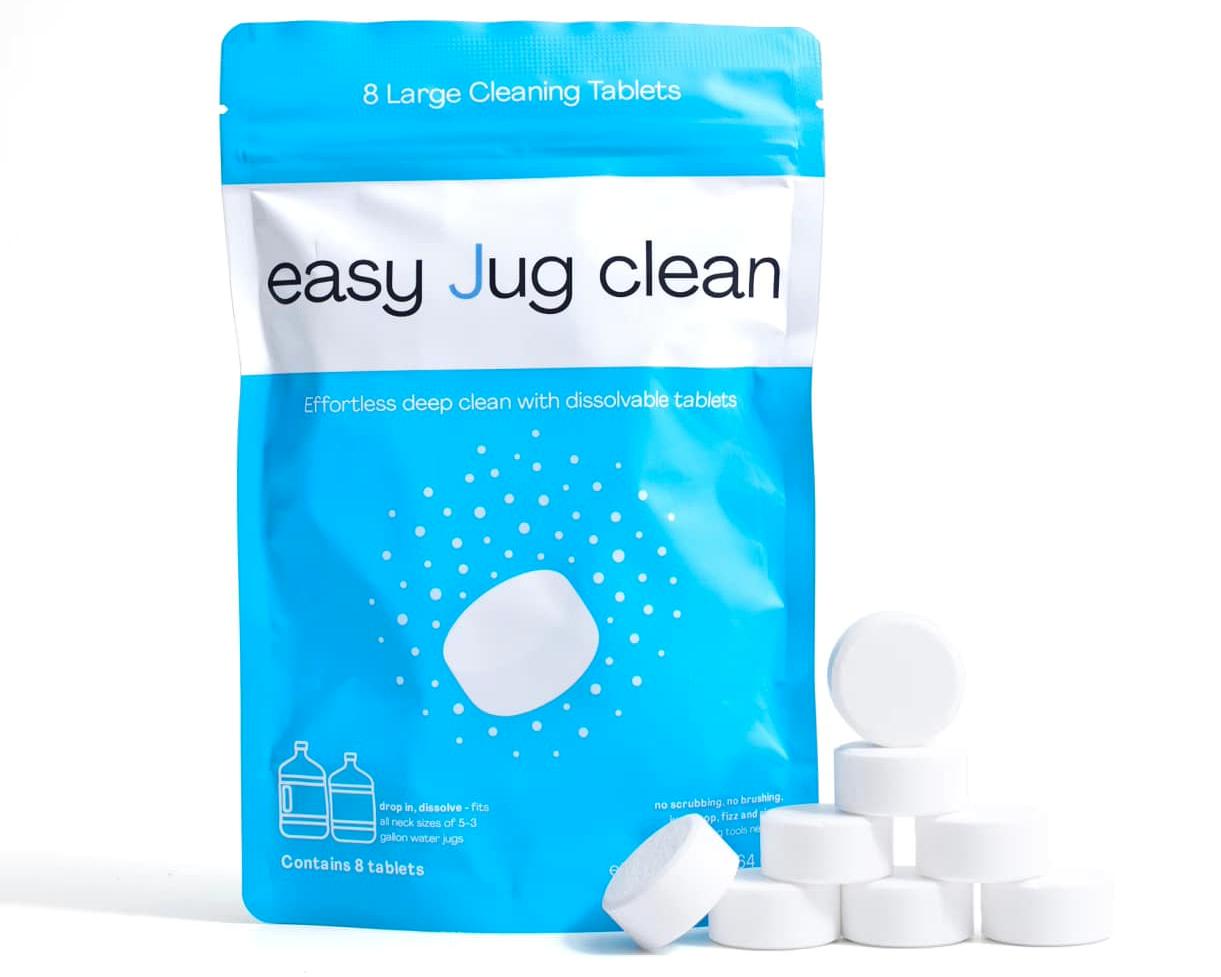
| Effervescent Tablets (Easy Jug Clean) | 95%+ | 80%+ | 7-10 days | None, food-grade ingredients |
The difference is stark. A brush removes maybe 20-30% of contamination and makes the remaining bacteria harder to kill. An effective chemical sanitizer removes 95%+ of the bacterial population and biofilm matrix.
What Actually Works Instead of a Bottle Brush
An effective sanitizing treatment must:
- Distribute throughout the entire jug volume – Not just contact surfaces, but penetrate the water itself
- Penetrate biofilm matrices – Not just remove loose material, but dissolve the protective structure
- Reach protected interior bacteria – Kill cells hiding in channels and crevices where brushes can't reach
- Not require mechanical force – The cleaning action comes from chemistry, not from scrubbing
- Not create micro-damage – Won't scratch the plastic or create new harbors for bacteria
- Actually kill bacteria – Not just redistribute them
Fizzing tablets accomplish all of these requirements. The effervescent action reaches spots no brush can touch, the sodium percarbonate penetrates biofilm, and the whole jug is treated in a 20-minute cycle. No spreading, no scrubbing, no stress response activation. Just effective sanitization.
Why People Keep Using Brushes Despite Knowing Better
Even after understanding how brushes fail, many people continue using them because:
- They feel like they're doing something – The physical action of scrubbing creates a psychological sense of accomplishment
- The jug looks visually better after brushing – Even though microbiological contamination remains, the visible cleanliness creates false confidence
- It requires no additional purchase – A brush is cheap and reusable (though contaminated)
- The bacteria-spreading mechanism is invisible – Most people don't know this is happening
But once you understand that brushing is actually making contamination worse, not better, the logic becomes clear: stop brushing. Use a proven chemical sanitizer instead.
Stop spreading bacteria with a brush. Start actually sanitizing.
✅ Clean Without Spreading Contamination
Easy Jug Clean tablets eliminate the brush problem entirely. Drop two tablets in, wait 20 minutes, and the bacteria are actually killed instead of redistributed. Your jug is genuinely clean, not just visually cleaner.
Frequently Asked Questions
Q: If I scrub harder and longer, does that improve the brush's effectiveness?
No. Harder and longer scrubbing causes more stress activation in bacteria, fragments more biofilm, and spreads contamination more widely. It might make the jug look cleaner, but it makes the actual contamination worse. More pressure equals more damage and more stress response.
Q: Can I sanitize my bottle brush to prevent cross-contamination?
It's difficult. You'd need to either autoclave it (high-pressure steam, not available for most households) or soak it in a strong bleach solution, but you can't reach the bristle bases effectively. Even with attempt sanitization, the bristles will be re-contaminated the moment you use it on a water jug. Better to simply eliminate the brush entirely.
Q: Is there a type of brush that works better than a standard bottle brush?
Not fundamentally. All bristle-based brushes have the same geometry problem. Some soft-bristle brushes might spread slightly less contamination, but they clean even less effectively because they have even less mechanical force. There's no "good" brush for water jug sanitization—the brush concept itself is flawed.
Q: What about using a cloth or sponge instead of a brush?
Same problem, slightly different form. Cloths and sponges spread biofilm, contaminate themselves, and provide even more surface area for bacteria to colonize. A sponge is actually worse than a brush because it can hold more water and bacteria, creating an ideal incubator.


 Order now — get it by