What Is Biofilm in Your 5 Gallon Water Jug and Dispenser System
Reading time: ~7 minutes | Water Jug Biofilm Dispenser System Sanitizing Science
What Is Biofilm in Your 5 Gallon Water Jug and Dispenser System?
The Definition That Matters: It's Not What You Think
Biofilm isn't slime. That's the first misconception to drop. Biofilm is a sophisticated, multi-cellular bacterial community—a literal city of microorganisms held together by a self-produced matrix of polysaccharides, proteins, and extracellular DNA. Think of it like a fortress. The bacteria inside aren't floating freely; they're protected by walls that make them resistant to cleaning chemicals, antibiotics, and even immune system responses.
When bacteria first colonize a surface—like the inside of your 5-gallon water jug or the internal components of your dispenser—they begin as free-floating cells. Within hours, they start secreting this protective matrix. Within 24-48 hours, they've already organized into structured biofilm communities. Once established, a biofilm can reduce bacterial susceptibility to sanitizers by up to 1,000 times compared to free-floating cells.
The dangerous part? Biofilm bacteria survive longer, multiply faster, and resist your cleaning attempts far better than any individual bacteria ever could. And in a water jug and dispenser system, you're not dealing with just one biofilm—you're dealing with two separate ones that feed each other.
Two-Part System, One Biofilm Problem: How Jugs and Dispensers Work Together
Here's what most people don't understand about the water jug + dispenser ecosystem: they're not separate problems. The biofilm forms in two distinct locations with different characteristics, but they communicate through the water itself.
Biofilm Location #1: Inside the Water Jug
Your 5-gallon jug is a nearly ideal biofilm environment. It's dark, relatively stable in temperature, and provides a constant nutrient source (minerals in the water, organic compounds). Biofilm forms preferentially on the curved bottom and lower sidewalls of the jug, where water circulation is weakest and sediment settles.
The biofilm in your jug has a different consistency than what forms in the dispenser. It clings to the plastic surface itself, often invisible to the naked eye even when substantial. Some sections appear as a barely-visible cloudy film; others are microscopic. This is why you can scrub with a brush and feel like you've cleaned it—but you haven't touched most of the biofilm at all.
Biofilm Location #2: Inside the Water Dispenser
Your water dispenser has a separate biofilm problem, and it's actually more dangerous because it's closer to where the water comes out. Biofilm forms inside the internal water reservoir (the chamber that holds water while the jug is mounted), on the cooling coils (if you have a cold-water dispenser), on the heating element (if you have a hot option), and especially around the dispensing spigot where water flows out.
This biofilm has different characteristics because the dispenser's interior is warmer, the water flow is intermittent, and sediment accumulates differently. The biofilm here can be slightly thicker and more visible—sometimes appearing as brownish or reddish discoloration—but it's equally resilient.
The Contamination Cycle: Why Cleaning Just One Half Fails
Here's the mechanism that most home-cleaning advice misses: the contamination cycle flows both directions.
Direction 1: Jug-to-Dispenser
When you install a new jug on your dispenser, the jug's biofilm immediately begins shedding into the dispenser's reservoir. As water flows down from the jug into the dispenser, it carries biofilm fragments and planktonic (free-floating) bacteria. These colonize the dispenser's internal surfaces. Within days, the dispenser develops new biofilm growth seeded by the jug's contamination.
If your jug is heavily colonized, your dispenser becomes heavily colonized. If your dispenser was previously clean, it won't stay that way.
Direction 2: Dispenser-to-Jug (The Surprise Direction)
Here's what breaks most people's cleaning attempts: the dispenser contaminates the jug right back. When you install a fresh jug on your dispenser, the dispenser's internal probe pushes up into the jug's bottom spout. If that probe is contaminated with biofilm (which it usually is), it deposits a concentrated inoculum of bacteria directly into your "clean" jug. The bacteria from the probe spread throughout the fresh water supply.
This is why cleaning only your jug without also cleaning your dispenser is like shampooing one side of your head. The moment you reconnect them, the cycle restarts.
How Biofilm Actually Grows: The Four Stages You Need to Know
Understanding biofilm growth stages explains why quick rinses fail but a proper treatment works.
Stage 1: Attachment (0-1 hours)
Free-floating bacteria land on a surface and start to stick. This is actually a reversible stage—physical removal (rinsing) can sometimes work here. But in a water jug, this window is essentially missed because the bacteria are invisible and you don't know they're there.
Stage 2: Microcolony Formation (1-8 hours)
Bacteria begin secreting the polysaccharide matrix and organizing into clusters. Once they're in this stage, simple rinsing won't remove them. They've started producing adhesins—molecules that grip the surface more strongly than gravity alone.
Stage 3: Biofilm Maturation (1-3 days)
The biofilm develops three-dimensional structure with channels, towers, and protected interior zones. Bacteria deep inside the biofilm are largely insulated from chemical treatment. A bottle brush might physically remove some surface biofilm, but the matrix holds tight and the interior bacteria survive untouched.
Stage 4: Dispersal (3+ days, ongoing)
Mature biofilm begins releasing planktonic cells that can spread to new surfaces. Some bacteria also form spores or enter a viable-but-non-culturable state where they're dormant and even harder to kill. This is when your water might taste off or develop a slight cloudiness despite looking clean.
Why Your Bottle Brush Can't Break the Biofilm Fortress
A bottle brush removes loose surface material. It doesn't penetrate the polysaccharide matrix. The brush bristles are too large to reach into biofilm microstructures, and the mechanical scrubbing actually causes a stress response in the bacteria—they release spores and activate survival mechanisms, sometimes making them harder to kill with subsequent chemical treatment.
The brush essentially redistributes biofilm fragments around the jug rather than eliminating them. You've moved the contamination around and made the biofilm population more defensive.
The Science Behind Biofilm's Chemical Resistance
Biofilm bacteria are fundamentally different from free-floating bacteria in a way that's critical to understand: they have a communication network.
Bacteria in biofilm use a process called quorum sensing to detect how many of their neighbors are present. Once the population reaches a certain density, they upregulate production of protective proteins and antibiotic-resistance mechanisms. This is why a sanitizer that kills 99.9% of free-floating bacteria might only kill 5% of biofilm bacteria at the same concentration.
The extracellular polysaccharide matrix also acts as a physical barrier, slowing the diffusion of chemicals and creating pH-neutral microenvironments inside the biofilm even when you're treating it with strong chemicals on the outside.
The Biofilm Transfer Between Jug and Dispenser: A Contamination Loop
Let's walk through what actually happens in your system over a 2-week cycle:
Day 1: You install a new jug. Even if it was "clean," any residual biofilm in the dispenser's probe transfers into the fresh jug. The jug now has approximately 10,000-100,000 bacterial cells from the dispenser.
Days 2-4: These bacteria multiply and begin biofilm formation in the jug. Simultaneously, the jug's water is trickling into the dispenser, depositing new bacteria and biofilm fragments.
Days 5-7: Both the jug and dispenser now have established biofilm. The jug's biofilm is thickening on the bottom and sides. The dispenser's biofilm is settling on internal surfaces and the spigot area.
Days 8-14: Mature biofilm in both locations is shedding planktonic cells. Your water might start tasting slightly off, or people might report minor stomach upset after drinking from this system.
Day 14+: Without intervention, biofilm maturity reaches a threshold where the contamination becomes visible or unmistakable.
This is why cleaning only the jug every 2 weeks doesn't work. The dispenser is continuously re-contaminating fresh water. And if you only clean the dispenser every month while changing jugs weekly, the jug is the vector bringing fresh bacteria back into your (supposedly) clean dispenser.
The entire ecosystem needs to be treated together, or the biofilm cycle never breaks.
What Makes a System-Wide Treatment Effective
An effective sanitizing approach must:
- Penetrate the biofilm matrix – Not just remove surface material, but disrupt the polysaccharide scaffold that holds the bacterial community together
- Reach protected interior bacteria – Kill cells deep inside the biofilm, not just the exposed ones
- Break quorum sensing – Reduce the bacterial population below the threshold where they activate defensive mechanisms
- Treat both locations simultaneously – Address jug biofilm and dispenser biofilm in the same cycle to break the recontamination loop
- Leave residual protection – Either the treatment should leave a protective coating, or it should be frequent enough that biofilm never re-establishes to dangerous levels
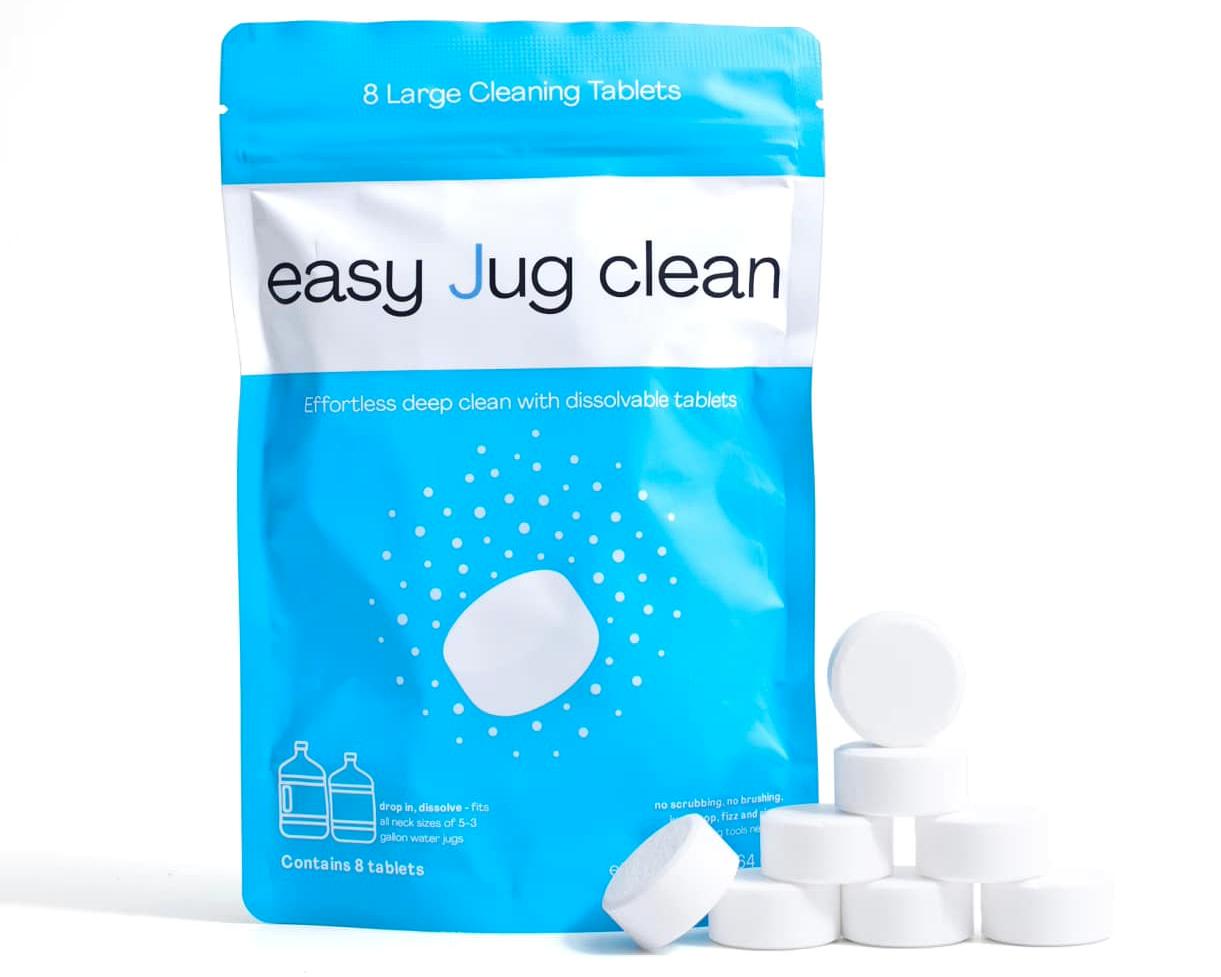
This is why fizzing tablets like Easy Jug Clean work where brushes fail. The effervescent action distributes the active ingredients—sodium percarbonate and citric acid chelators—throughout the entire jug volume, reaching biofilm in places a brush can't touch. The active oxygen penetrates the matrix. The fizzing action creates a dynamic cleaning environment rather than static contact.
Why Biofilm Keeps Coming Back After You "Clean" Your System
If you're using only a brush or weak cleaning solution, biofilm returns quickly because:
- You haven't actually killed the bacteria—you've only removed visible slime
- Biofilm bacteria release spores that survive cleaning attempts
- New bacteria are constantly entering from the dispenser or from the source water itself
- Any remaining biofilm seeds new growth within 24-48 hours
- The jug and dispenser keep recontaminating each other
You need a treatment that actually eliminates the bacterial population, not just removes what you can see. And you need to repeat it frequently enough that biofilm never re-establishes to dangerous levels.
The Hidden Biofilm You Never See
Most biofilm inside a 5-gallon jug is invisible. It doesn't smell bad. It doesn't make the water cloudy—not until it's extensive. You could have biofilm colonies in there right now that are shedding pathogenic bacteria into every glass you drink, and you'd never know it visually.
This is why a jug can be visually clean but still make you sick. The microbiological contamination exists entirely invisibly, below the threshold of human perception but well above the threshold of causing illness.
Breaking the Cycle: Why System-Wide Treatment Is Non-Negotiable
You cannot treat just your jug and expect lasting results. You cannot treat just your dispenser. The system operates as one contamination ecology.
Effective water jug maintenance requires treating both the jug and dispenser in the same cleaning cycle, frequently enough that biofilm never fully re-establishes. This needs to be part of your routine every 7-10 days for optimal protection, not just when something smells bad or tastes wrong.
Biofilm takes 1-3 days to mature to the point where it's actively dangerous. If you clean every 14 days, you're allowing 4-6 cycles of maturation before intervention. By that point, you're constantly drinking from contaminated water and hoping nothing bad happens.
The simplest way to break the biofilm cycle in both your jug and dispenser
✅ Stop Biofilm Contamination Before It Starts
Drop two tablets into your water jug, wait 20 minutes, and the entire system gets cleaned. The effervescent action penetrates biofilm in your jug and dispenser both, breaking the recontamination cycle and keeping your water actually safe.
Frequently Asked Questions
Q: How much biofilm do I need to have before it becomes dangerous?
Biofilm doesn't need to be extensive to cause illness. A biofilm that's only 1-2 millimeters thick and invisible to the naked eye can contain billions of bacterial cells. The bacteria don't need to outnumber the good cells—they just need to include a small percentage of pathogens like E. coli or Legionella to trigger GI illness or worse.
Q: If I clean my jug weekly, do I still need to clean my dispenser?
Yes. Even if you clean your jug weekly, your dispenser is accumulating biofilm on its internal surfaces and your probe. When you install that freshly cleaned jug, the contaminated probe recolonizes it. You need both cleaned in the same cycle, or the biofilm transfer never stops.
Q: Can I see biofilm if I look inside my jug while it's full of water?
Not usually. Visible biofilm (the cloudy coating or slight discoloration you might see) represents only a fraction of the actual biofilm present. Most biofilm is too thin and translucent to see, especially through blue or cloudy jug plastic. By the time it's visible, it's usually a serious contamination problem.
Q: Does the temperature of the water affect biofilm growth?
Significantly. Warmer water (60-80°F) promotes faster biofilm growth. If you keep jugs in a warm location or use a hot-water dispenser, biofilm develops faster and becomes thicker. Cold temperatures slow growth but don't stop it. This is why treatment frequency needs to increase in summer or in warm climates.


 Order now — get it by